DbcultAccessing Vault...
6.6/10
Senior Film Conservator
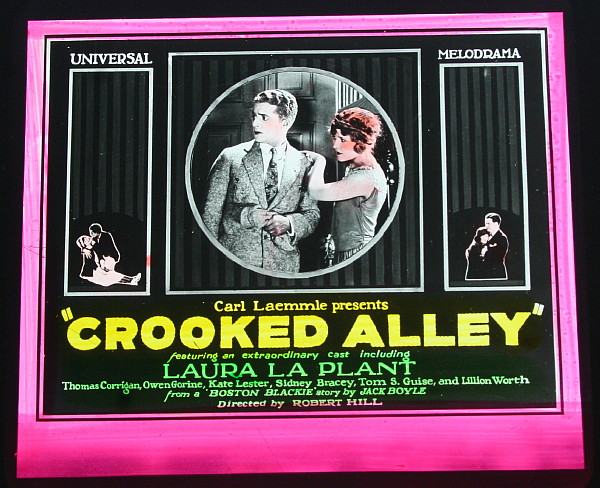
A definitive 6.6/10 rating for a film that redefined the boundaries of cult cinema. Crooked Alley remains a cornerstone of transgressive art.
The 1923 landscape of silent cinema was often bifurcated between the slapstick whimsy of the Keystone era and the burgeoning, atmospheric grit that would eventually crystallize into the noir tradition. Robert F. Hill’s Crooked Alley stands as a fascinating specimen from this transitional epoch, offering a narrative that is as much about the architecture of morality as it is about the mechanics of a heist or a sting. Within the flickering frames of this Universal production, we find a protagonist who had already become a folk hero of the American underworld: Boston Blackie.
Boston Blackie, as conceptualized by Jack Boyle, was never a common thug; he was a philosopher-criminal, a man whose code of ethics existed entirely outside the jurisprudential frameworks of the early 20th century. In Crooked Alley, Thomas Carrigan portrays a version of Blackie that is weary, reformed, yet still tethered to the loyalties of his past. This isn't the high-octane action of The Eagle's Talons; rather, it is a psychological chamber piece played out in the drawing rooms and backstreets of a society that refuses to forgive.
The thematic weight of the film is established early when Blackie’s plea for a dying friend is met with the icy indifference of a judge. This rejection serves as the catalyst for a narrative that mirrors the structural complexity found in works like Loaded Dice. The judge, played with a stolid, almost archaic rigidity by Tom Guise, represents the 'straight' world—a world that claims the moral high ground while lacking the basic empathy that Blackie, the former thief, possesses in spades.
While Carrigan provides the film’s stoic anchor, it is Laura La Plante who provides its heartbeat. Playing Norine, the daughter of the man the law let die, La Plante demonstrates the burgeoning star power that would soon make her a silent-era icon. Her task within the plot is one of deception—to seduce Rudy, the judge’s son—but her performance transcends the 'femme fatale' archetype. There is a vulnerability in her machinations that reminds one of the delicate balance seen in The Little Girl Next Door, though the stakes here are significantly more mature.
The chemistry between La Plante and Owen Gorin (Rudy) is essential to the film's success. If the audience does not believe in the genuine affection that begins to sprout from the seeds of Blackie’s revenge, the entire third act collapses. Hill directs these sequences with a surprising amount of restraint, allowing the shadows of the set design to do the heavy lifting. The 'alley' of the title isn't just a physical location; it’s a metaphor for the circuitous, often dark path these characters must navigate to find a semblance of peace.
Robert F. Hill, a director often associated with the serialized thrills of the era, shows a remarkable hand for pacing in Crooked Alley. Unlike the frantic energy of Jungle Jumble, this film breathes. It utilizes the chiaroscuro lighting of the early 20s to delineate the two worlds: the bright, sterile halls of the judge’s mansion and the textured, murky environments where Blackie operates. This visual dichotomy reinforces the film’s central question: who is truly 'crooked'?
The writing, a collaborative effort between Hill, Boyle, and Adrian Johnson, avoids the pitfalls of excessive title cards. The story is told through the eyes, the gestures, and the spatial relationships between the characters. When compared to contemporary works like Das Geheimnis von Bombay, one can see the American school of silent filmmaking moving toward a more naturalistic, character-driven style, even within the confines of a genre piece.
To fully appreciate the nuances of Crooked Alley, one must look at how it treats the concept of the 'fallen woman' or the 'wronged man.' In A Woman of No Importance, social standing is the ultimate arbiter of fate. In Hill’s film, however, social standing is merely a costume. Blackie wears his reform like a suit that doesn't quite fit, while the judge wears his authority like armor that has begun to rust. This inversion of social expectations is a recurring theme in the era's more sophisticated offerings, such as Angel of Crooked Street, which shares more than just a titular similarity in its exploration of urban decay and redemption.
Furthermore, the film’s subversion of the revenge plot anticipates the psychological depth of later noir. Where a film like The Tiger Lily might rely on more overt melodrama, Crooked Alley finds its tension in the unspoken. The moment Blackie realizes his plan has worked too well—that Norine has actually fallen for the son of his enemy—is played with a devastating subtlety by Carrigan. It is a moment of profound realization: you cannot manipulate human emotions without becoming a victim of them yourself.
Produced in the wake of the Great War, there is an underlying cynicism in the film regarding institutional power. The judge is not a villain in the traditional sense; he is a man who believes he is doing right by following the letter of the law. This clash between the 'letter' and the 'spirit' of justice was a common anxiety in 1923. We see echoes of this in Friday, the Thirteenth, where fate and luck often override human intent. In Blackie’s world, however, fate is something you try to manufacture, only to have it blow up in your face.
The inclusion of Rudy as the romantic interest is also significant. He represents the youth of America—caught between the rigid traditions of the Victorian fathers and the burgeoning, slightly dangerous freedom of the Jazz Age. His attraction to Norine is an attraction to the 'other side' of the tracks, a theme explored with less grit but similar intent in Tropical Love.
From a technical standpoint, the cinematography is remarkably clean for a 1923 production. The use of close-ups to convey Norine’s internal conflict is particularly effective. It’s a far cry from the wider, more theatrical staging of Seeing America or the documentary-adjacent feel of Boy Scouts of America. Hill understands that the 'alley' is as much a state of mind as a physical location, and his camera lingers on the textures of the sets—the peeling wallpaper, the polished mahogany—to tell that story.
However, like many films of this vintage, Crooked Alley suffers from the passage of time. The surviving prints often lack the vibrancy of the original nitrate, making the sophisticated lighting schemes harder to appreciate. Yet, even through the grain of time, the emotional resonance of the story remains intact. It is a film that deserves a place in the conversation alongside From Dusk to Dawn or the investigative intrigue of A Social Sleuth.
Ultimately, Crooked Alley is a vital chapter in the evolution of the Boston Blackie mythos. It transitioned the character from a pulp magazine fixture to a cinematic icon capable of carrying a complex moral narrative. The film’s refusal to provide a simple, happy ending—preferring instead a bittersweet resolution that acknowledges the scars left by the journey—is what makes it feel surprisingly modern. It doesn't offer the easy escapism of many of its contemporaries; instead, it offers a mirror.
As we look back at the cinematic output of 1923, Hill’s work stands out for its maturity. It is a reminder that even in the 'silent' era, the questions being asked were loud, clear, and deeply human. Whether you are a fan of the later radio serials or the television adaptations, returning to this early iteration of Blackie provides a necessary context for the character’s enduring appeal. He is the man who walks the crooked alley so that others might find the straight road, a sentinel of the shadows whose story is far from over.
In the final analysis, this is a film about the cost of pride and the transformative power of empathy. It reminds us that justice, when stripped of mercy, is merely another form of cruelty, and that the most dangerous alleys are those we build within our own hearts.
IMDb —
1936
Community
Log in to comment.