DbcultAccessing Vault...
Cult Review
Senior Film Conservator
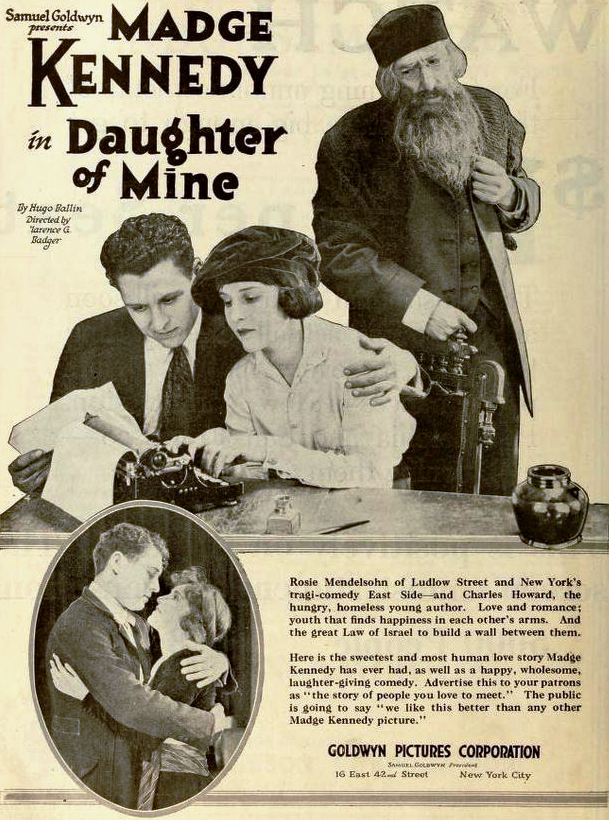
In the cinematic landscape of 1919, Hugo Ballin emerged not merely as a director but as a visual architect of the immigrant soul. Daughter of Mine stands as a poignant artifact of a transitional era, capturing the friction between the Old World’s dogmatic certainty and the New World’s chaotic promise. The film, starring the luminous Madge Kennedy, transcends the typical melodrama of the silent epoch by embedding its narrative within the authentic grit of the Lower East Side. Unlike the stylized artifice often found in contemporary productions like The Ghosts of Yesterday, Ballin’s work here possesses a tactile quality, a sense that the dust on the tailor’s workbench is as real as the heartbreak in Rosie Mendelsohn’s eyes.
The film opens with a sequence that establishes the domestic economy of the Mendelsohn household. Here, Abraham Schwartz portrays the tailor with a gravitas that avoids the caricatures common in the early twentieth century. His performance is a study in protective isolationism. The ghetto is not just a neighborhood; it is a fortress of identity. When Rosie is forced to sever her ties with George Howard, the tragedy is not merely personal—it is cultural. The refusal to permit a union with a gentile reflects the internecine struggle of a community desperate to preserve its essence against the encroaching tides of assimilation. This thematic depth elevates the film beyond the simplistic romantic tropes found in The Marriage Speculation.
As the narrative shifts from the tenements to the mahogany-lined offices of Joseph Rayberg, the film evolves into a sharp critique of the commodification of creativity. Arthur Edmund Carewe’s portrayal of Rayberg is chillingly modern. He represents the systemic exploitation of the artist, a theme that resonates even a century later. When Rosie presents George’s manuscript under the guise of a discovery, she enters a den of wolves. The 'contest' she proposes is a brilliant narrative device, a meta-commentary on how the industry manufactures prestige. Rayberg’s interest in the manuscript is secondary to his predatory gaze on Rosie, creating a tension that mirrors the social vulnerabilities explored in Snares of Paris.
The bargain Rosie strikes—a promise of her own agency in exchange for George’s literary recognition—is a harrowing pivot. It highlights the limited currency available to women of her station. While films like The Love Swindle might treat such deceptions with a light touch, Ballin imbues the situation with a sense of impending doom. The office becomes a claustrophobic cage, a stark contrast to the sprawling, albeit impoverished, freedom of the streets. The cinematography utilizes shadows and tight framing to emphasize Rosie’s entrapment, a technique that predates the noir sensibilities seen in later mysteries like The Mystery of Room 13.
George Howard, played with a sensitive vulnerability by John Bowers, is the quintessential struggling intellectual. His manuscript is described as a humorous reflection of Rosie’s life, suggesting that the only way to survive the ghetto is to find the comedy within its tragedies. This reflexive nature of the story—a movie about a book about the life we are watching—adds a layer of sophistication rarely seen in 1919. It challenges the audience to consider the source of their entertainment. Are we, like Rayberg, merely consuming the struggles of the working class for our own amusement? This moral ambiguity is far more complex than the straightforward heroism of The Long Trail.
The film’s pacing is deliberate, allowing the psychological weight of the characters' decisions to breathe. Ballin, an artist by training, treats every frame like a canvas. The composition of the Mendelsohn tailor shop, with its stacks of fabric and flickering lamps, creates a chiaroscuro effect that highlights the dignity of labor. This visual richness serves as a counterpoint to the moral bankruptcy of the publishing world. While A Study in Scarlet relies on the thrill of the chase, Daughter of Mine finds its momentum in the quiet desperation of its protagonist’s choices. The dialogue intertitles are sparse but impactful, avoiding the florid sentimentality that often plagues the era.
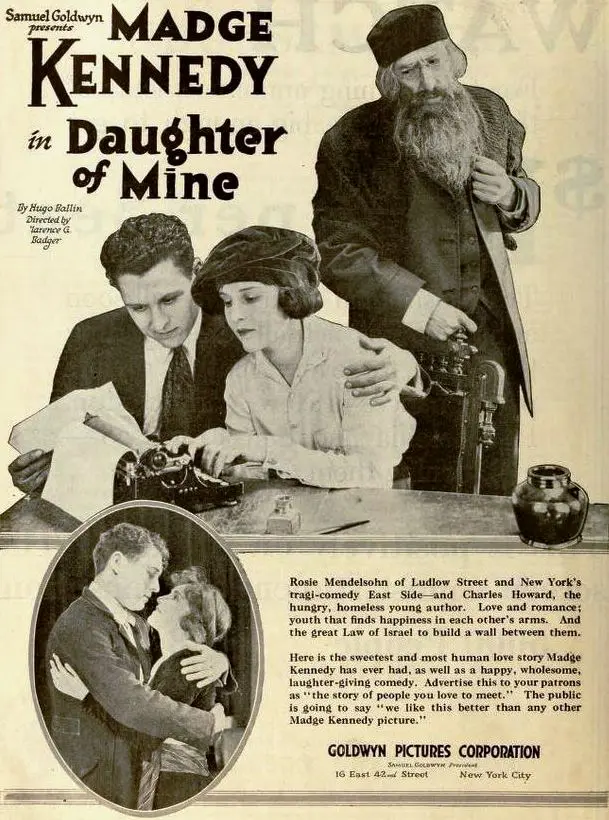
The final act of the film is a masterclass in suspense. The locking of the office door is not just a plot point; it is the culmination of the systemic oppression Rosie has navigated throughout the story. Her escape is not merely a flight from a predator but a rejection of the transactional nature of her existence. When she falls into George’s arms, it isn't just a romantic resolution; it is the reclamation of her narrative. The manuscript has been published, the truth has been told, and the power dynamic has been irrevocably shifted. This sense of justice is as satisfying as the resolution in The Railroader, but with a significantly more intimate emotional stakes.
The most surprising element of the film is the transformation of the father. His eventual blessing of the union is not presented as a sudden, illogical whim, but as a recognition of his daughter’s strength and the universality of the human experience. He realizes that the walls he built to protect her were also the walls that imprisoned her. This reconciliation provides a bridge between the traditional and the modern, suggesting that heritage and progress need not be mutually exclusive. This nuanced take on societal expectations offers a profound contrast to the rigid social structures depicted in What Will People Say?.
In the broader context of silent cinema, Daughter of Mine occupies a unique space. It lacks the sweeping epic scale of The Capitol or the rugged frontierism of Riders of the Purple Sage, yet it achieves a level of psychological verisimilitude that is arguably more enduring. It explores the 'ghetto' not as a place of pity, but as a site of vibrant, complex life. The film’s focus on a Jewish family in New York provides a rare glimpse into the immigrant experience of the time, predating the more famous 'Jazz Singer' era by nearly a decade. It shares a certain grim realism with The Barricade, yet maintains a hopeful undercurrent that speaks to the resilience of the human spirit.
Comparing this film to European imports of the time, such as the Swedish Brottmålsdomaren or the German Die Hochzeit im Excentricclub, one notices a distinct American pragmatism in Ballin’s direction. While the Europeans were experimenting with expressionism and surrealism, Ballin was perfecting a form of social realism that felt immediate and urgent. The film’s legacy is found in its refusal to simplify the immigrant struggle. It acknowledges the pain of leaving one’s roots while celebrating the courage required to plant new ones. Even the minor characters, like those who might appear in a colonial drama such as The Bushman's Bride, are given moments of humanity that flesh out the world of the East Side.
The technical proficiency of the film is noteworthy. The lighting in the Mendelsohn shop, often relying on single light sources to create deep shadows, adds a layer of theatricality that enhances the emotional beats. Madge Kennedy’s performance is a revelation; her ability to convey complex internal monologues through subtle shifts in expression is a testament to her mastery of the silent medium. She carries the film’s moral weight with an effortless grace, making Rosie Mendelsohn one of the most compelling heroines of 1910s cinema. The chemistry between Kennedy and Bowers is palpable, providing the necessary emotional anchor for the film’s more daring plot twists.
Ultimately, Daughter of Mine is a film about the power of the word—both written and spoken. It is about the stories we tell ourselves to survive and the stories we share to connect. By the time the final frame fades to black, the viewer is left with a profound sense of the interconnectedness of all people, regardless of their origin or creed. It is a reminder that even in the darkest corners of a crowded ghetto, there is room for art, for humor, and for love. Hugo Ballin’s vision remains a vital piece of cinematic history, offering a window into a world that, while physically gone, remains spiritually relevant to our ongoing discussions about identity, belonging, and the price of the American dream.
IMDb —
1923
Community
Log in to comment.