DbcultAccessing Vault...
Cult Review
Senior Film Conservator
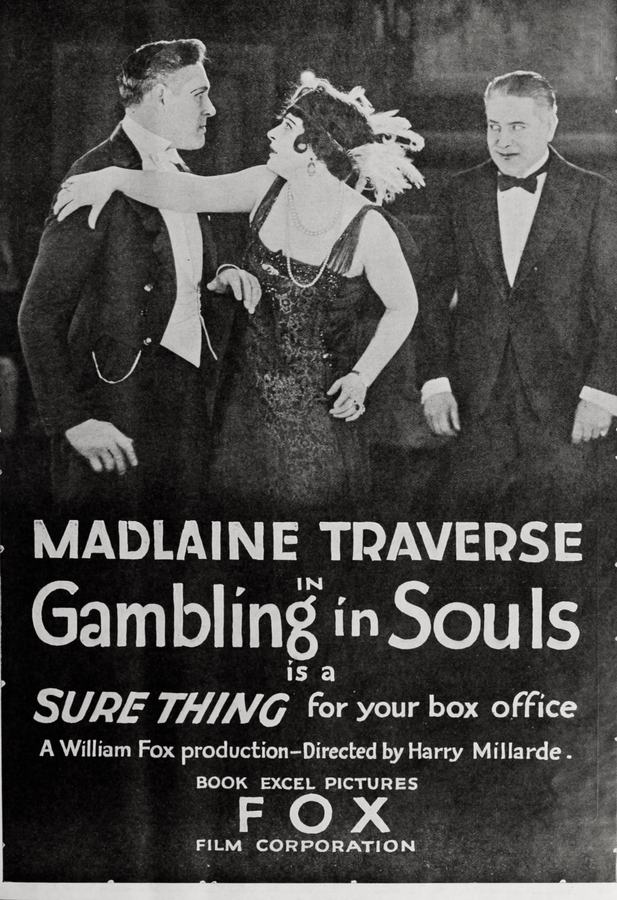
When the dust of the Roaring Twenties settled over the glitter of Wall Street, cinema captured the era’s undercurrents with a ferocity that still reverberates. Gambling in Souls, directed by the deft hand of Samuel J. Warshawsky and Denison Clift, is a stark tableau of loss, retribution, and the inexorable pull of destiny. The film’s narrative architecture is as precise as the spin of a roulette wheel, each turn delivering a fresh revelation about its protagonists.
Robert Dunning’s demise is not merely a plot device; it is a crucible that forges Marcia Dunning’s metamorphosis from grieving spouse to avenging architect. Lew Zehring’s portrayal of the tormented husband is suffused with a quiet desperation that mirrors the silent era’s penchant for expressive pantomime. When the broker’s machinations strip Robert of his wealth, the audience feels the palpable weight of a world turned on its axis.
Marcia, embodied by Madlaine Traverse, is a study in controlled fury. Her decision to become a roulette operator is a calculated infiltration, a move reminiscent of the cunning seen in Beyond the Law’s heroine, who also navigates male‑dominated spheres with razor‑sharp intellect. Traverse’s eyes, constantly flickering between sorrow and resolve, convey an inner storm that the intertitles merely hint at.
The magnetized finger ring, a seemingly gimmicky prop, functions as a potent metaphor for control. It allows Marcia to manipulate the roulette wheel, turning chance into a weapon. This device echoes the subtle manipulations in The Still Alarm, where a simple signal becomes the fulcrum of an entire rescue operation. In both cases, the object’s ordinary appearance belies its capacity to reshape destinies.
When the broker’s son—portrayed with reckless charm by Henry A. Barrows—falls prey to the rigged spin, his betrayal of his father sets off a cascade of financial ruin. The film deftly illustrates how a single act of deceit can reverberate through generations, a theme that resonates with contemporary audiences attuned to the ripple effects of economic crises.
The revelation that Marcia’s daughter, played by Mary McIvor, has secretly wed the very son she seeks to ruin adds a Shakespearean twist to the narrative. This clandestine union forces Marcia into a moral quandary: should she prioritize vengeance or safeguard her child’s happiness? The tension mirrors the emotional stakes in The Crimson Dove, where love and duty clash in a vortex of tragedy.
Marcia’s appeal to the gambling house partners—each a distinct embodiment of greed, loyalty, or indifference—creates a microcosm of societal stratification. One partner’s obstinacy, juxtaposed with another’s love‑infused gamble, underscores the film’s exploration of altruism versus self‑interest.
When the enamored partner stakes his share against the dissenting faction and loses, the narrative reaches a fever pitch. Marcia’s decision to wager herself—her very reputation and future—against the victorious partners is a bold narrative choice that elevates the drama from a mere financial duel to an existential contest. Stripped of her magnetized ring, she relies on intuition, poise, and an indomitable will.
The victory, earned without the crutch of cheating, feels like a cathartic release. It affirms the film’s underlying thesis: true power lies not in manipulation, but in the integrity of one’s convictions. This resolution is reminiscent of the moral triumph in Big Little Person, where the protagonist’s inner strength ultimately outweighs external adversity.
Visually, the film employs chiaroscuro lighting that accentuates the stark contrast between the opulent gambling hall and the shadows of Marcia’s inner turmoil. The use of deep reds and muted blues creates a palette that feels both luxurious and foreboding, a visual echo of the film’s thematic dualities.
Herbert Heyes, as the cunning broker, delivers a performance that is at once charismatic and chilling. His eyes, often glinting with a predatory gleam, betray a man whose moral compass has long since been eclipsed by avarice. In contrast, Murdock MacQuarrie’s supporting role as the house’s senior manager provides a steady, if understated, counterbalance, embodying the institutional inertia that both enables and resists change.
Warshawsky and Clift orchestrate the film’s pacing with the precision of a seasoned dealer. The opening act, steeped in tragedy, quickly transitions into a calculated plan of retribution, keeping the audience engaged without lingering on melodrama. The middle section, rich with subplots involving the daughter’s secret marriage and the partners’ conflicting motives, adds layers of complexity without sacrificing narrative cohesion.
The final act, though climactic, avoids melodramatic excess. Instead, it offers a measured resolution where each character’s fate aligns with the moral architecture established early on. The decision to return the stolen funds for the daughter’s sake, rather than revel in triumph, underscores the film’s nuanced stance on justice.
When placed alongside contemporaneous works such as The Baseball Revue of 1917 or the Swedish melodrama Fyrvaktarens dotter, Gambling in Souls stands out for its intricate intertwining of personal vendetta and broader socioeconomic commentary. While the former revels in spectacle and the latter in pastoral tragedy, this film marries the two, delivering a narrative that feels both intimate and expansive.
The screenplay, penned by Warshawsky and Clift, showcases a deft command of silent storytelling. Intertitles are sparingly used, allowing visual nuance to carry the emotional weight. This restraint aligns the film with the narrative economy found in The Mortal Sin, where every frame is purposeful.
Decades after its premiere, Gambling in Souls retains a relevance that transcends its era. Its exploration of financial ruin, systemic exploitation, and the agency of women in hostile environments anticipates contemporary discourses surrounding economic inequality and gendered power dynamics. The film’s ending—marriage between Marcia and the devoted partner—offers a hopeful, albeit conventional, closure that suggests redemption is possible when compassion outweighs vengeance.
For cinephiles seeking a silent‑era narrative that blends suspense, moral philosophy, and visual flair, this film is a requisite viewing. Its layered storytelling invites repeated analysis, rewarding each subsequent watch with fresh insights into the human condition.
Rating: ★★★★½ (out of 5)
Gambling in Souls is a compelling study of retribution turned redemption, anchored by powerhouse performances and a meticulously crafted visual language. Its magnetized ring may be a relic of cinematic gimmickry, but the film’s true magnetism lies in its ability to spin a tale that is as emotionally resonant today as it was a century ago.
IMDb 6.5
1915
Community
Log in to comment.