DbcultAccessing Vault...
Cult Review
Senior Film Conservator
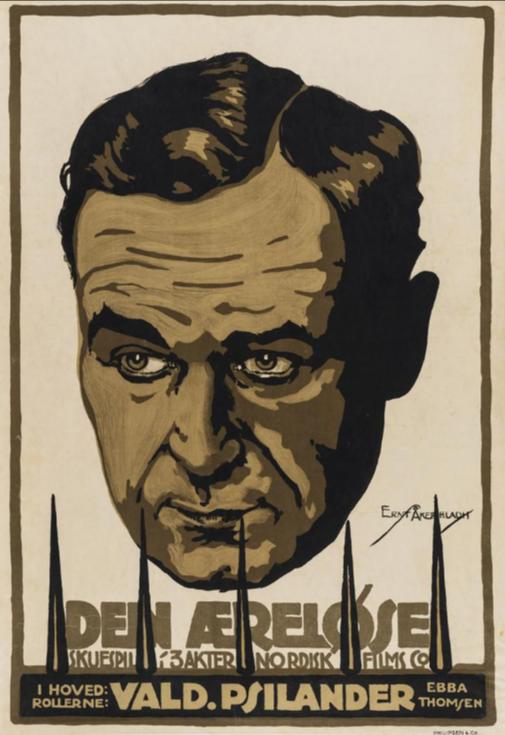
To witness Den Æreløse (The Dishonoured) is to step into a sepia-toned abyss where the currency of reputation is more valuable than life itself. Produced during the zenith of the Nordisk Film Company’s global dominance, this work serves as a testamentary monument to the legendary Valdemar Psilander. It is a film that breathes through its silences, utilizing the grammar of the frame to articulate a tragedy that words would only dilute. While many contemporary American productions like The Blue Envelope Mystery were leaning into the mechanics of the procedural, the Danish masters were perfecting the landscape of the human soul.
Valdemar Psilander, whose untimely death cast a long shadow over this release, occupies the screen with a gravity that few actors have ever replicated. In Den Æreløse, his portrayal of a man stripped of his social armor is nothing short of transcendent. He does not merely act the part of the disgraced; he embodies the physical weight of shame. His eyes, often caught in the low-key lighting typical of Holger-Madsen’s aesthetic, reflect a profound existential weariness. Unlike the rugged heroism found in Lightning Bryce, Psilander’s strength lies in his vulnerability, a trait that defined the 'Danish style' and influenced the subsequent German Expressionist movement.
The supporting cast, including the formidable Ebba Thomsen and Robert Schmidt, operate within a tightly choreographed ensemble. Thomsen, in particular, navigates the treacherous waters of loyalty and social expectation with a grace that prevents her character from becoming a mere archetype of the suffering wife. The chemistry between her and Psilander is underscored by a palpable tension—a realization that their shared domesticity is a house of cards waiting for the wind of scandal to blow it down. This thematic focus on the fragility of the home is a stark contrast to the more sprawling, adventurous narratives like South, focusing instead on the internal frontiers of morality.
The cinematography in Den Æreløse is a masterclass in atmospheric storytelling. The use of light is not merely functional; it is a narrative voice. Deep shadows swallow the corners of the opulent drawing rooms, suggesting that even in the height of luxury, darkness is encroaching. The film employs a visual language that communicates the protagonist's isolation far more effectively than the intertitles ever could. We see him framed against large, empty windows or dwarfed by the massive architecture of the courtrooms and clubs—spaces that once welcomed him but now stand as monuments to his exclusion.
When compared to the more straightforward visual approach of Nobody Home, Den Æreløse feels significantly more modern. Holger-Madsen understands the power of the close-up, using it sparingly but with devastating impact. The camera lingers on a trembling hand, a discarded letter, or a fleeting expression of despair, forcing the audience into an intimate proximity with the character's suffering. This is not the broad, theatrical gesturing of early silent cinema; it is a nuanced, cinematic performance that anticipates the psychological depths of the 1920s.
At its heart, the film is a scathing critique of a society that values the appearance of virtue over virtue itself. The 'dishonor' of the title is not just a personal failing but a societal verdict. The protagonist’s fall is catalyzed by financial desperation, a theme that resonates through the ages. While a film like Rags explores the struggle of the lower classes with a certain sentimentalism, Den Æreløse examines the rot within the upper echelons. It suggests that the higher one climbs, the more lethal the fall becomes. The rigid class structures of early 20th-century Denmark are depicted as a prison, where one’s lineage and financial standing are the only bars that matter.
The inclusion of Peter Nielsen and Hugo Bruun in the cast adds layers of antagonistic pressure. They represent the cold, unyielding face of the establishment—the creditors and the 'friends' who evaporate at the first sign of trouble. This dynamic creates a sense of inevitable doom that mirrors the tragic arcs of The Tide of Death. However, where other films might lean into the sensationalism of the crime, Den Æreløse remains focused on the internal erosion of the man himself. It is a slow-burn character study that demands patience and rewards it with a profound sense of pathos.
Holger-Madsen’s direction is characterized by an almost surgical precision. He manages the pacing with an expert hand, allowing the tension to build through silence and stillness rather than frenetic action. There are sequences in this film that possess a dreamlike quality, particularly the moments of solitary reflection where the protagonist contemplates his fate. This stylistic choice elevates the film from a mere social drama to a piece of poetic realism. It shares a certain kinship with the atmospheric dread found in The Crimson Dove, yet it remains firmly rooted in the tangible world of social consequence.
The screenplay (often uncredited or collaborative in this era) avoids the clichéd 'happy ending' that marred so many of its contemporaries. There is no sudden inheritance to save the day, as one might find in Billy's Fortune. Instead, the film stays true to its somber premise. The resolution is a quiet, devastating acknowledgement of loss. It is this commitment to emotional honesty that makes Den Æreløse a superior work of art. It doesn't seek to comfort the audience; it seeks to provoke them, to make them question the very foundations of the 'honor' they so prize.
Reviewing Den Æreløse today requires an appreciation for the historical context of its production. Released during a time of global upheaval, the film’s focus on personal and social ruin must have resonated deeply with an audience living through the end of the First World War. It captures the zeitgeist of an era that was seeing the old world order crumble. In its depiction of a man lost between two worlds—the one he was born into and the one he has been cast into—it mirrors the displacement of millions. This thematic weight is comparable to the harrowing narratives of Doch isterzannoy Pol'shi, though handled with a more restrained, Nordic sensibility.
The film also stands as a crucial entry in the filmography of Frederik Jacobsen and Axel Boesen, who provide the necessary texture to the film’s social milieu. Their presence ensures that the world surrounding Psilander feels lived-in and authentic. Every character, no matter how small their screen time, contributes to the sense of a cohesive, albeit judgmental, community. This level of detail in world-building is what separates a masterpiece like this from more ephemeral fare like Loot or the serialized thrills of The Iron Claw.
Ultimately, Den Æreløse is a film about the architecture of the soul. It uses the medium of silent film not as a limitation, but as a canvas for a profound exploration of human frailty. The combination of Psilander’s haunting performance, Holger-Madsen’s visionary direction, and a narrative that refuses to pull its punches makes it an essential viewing for any serious student of cinema. It is a reminder that before the advent of sound, movies had already found a way to speak with a power that was both visceral and intellectual.
Whether compared to the rugged survivalism of A Child of the Wild or the supernatural undertones of The Phantom Honeymoon, Den Æreløse remains unique in its somber, psychological focus. It does not rely on gimmicks or genre tropes; it relies on the fundamental truth of the human condition. It is a story of a man who loses everything—his status, his family, and his name—only to find, in the wreckage of his life, a terrifyingly clear reflection of himself. It is a film that lingers in the mind long after the final frame has faded, a testament to the enduring power of the 'Dishonoured'.
A haunting, essential artifact of the Danish silent era that remains as relevant today as it was a century ago. A true 10/10 for fans of psychological drama and cinematic history.

IMDb 6.5
1929
Community
Log in to comment.