DbcultAccessing Vault...
Cult Review
Senior Film Conservator
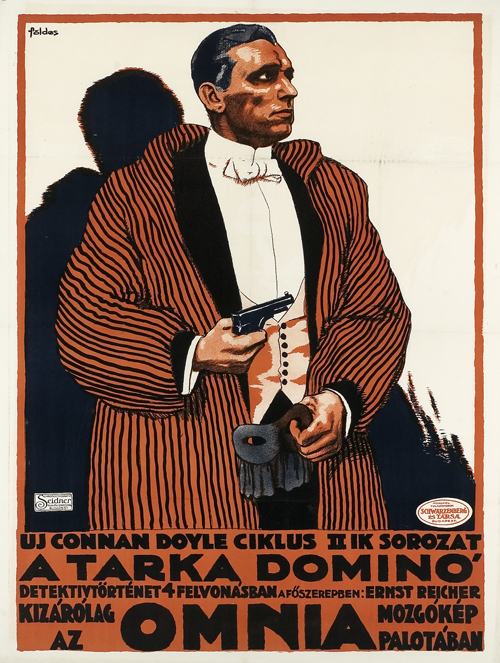
If you whistle while walking Vienna’s Ringstrasse at 3 a.m. today, the arc-lights will bleach your shadow into anonymity; but in 1916 the streetlamps were syphilitic, their glow the colour of absinthe turning sour, and every silhouette carried a daggered biography. Der gestreifte Domino is the celluloid ghost of that moment—an artefact so feverishly stylized it feels less like a crime caper than like cocaine injected straight into the iris.
Ludwig Trautmann’s physique belongs to the same gene pool as Fairbanks, yet his movements are slowed by Viennese cynicism; when he vaults from a balustrade he lands inside a moral paradox, not merely on a balcony. The Domino’s domino—those striped silks—operates like a living Rorschach: bourgeois audiences read order (the regularity of pattern), while revolutionaries read rebellion (the black disrupting the white). No other prop in silent cinema, not even Fantômas’s daggered glove, weaponises ambiguity so economically.
Beatrice Altenhofer, frequently framed beneath chandeliers that drip like melting diamonds, plays Anna as a woman who has memorised every rule only to misquote them at the crucial hour. Watch the moment she trades her tiara for a single theatre ticket—an edit smash-cuts to a close-up of her pupils, the iris-swallowing blackout of someone who has wagered her last illusion. It’s 1916; the Habsburgs are wheezing; the nobility survives on IOUs written in ennui. Anna’s alliance with the Domino is less a seduction than a leveraged buy-out of her own obsolescence.
Emmerich Hanus gifts Wexler a tic—he clicks his tongue whenever evidence evaporates. The tic metastasises into full-blown obsession once he realises the Domino holds the ledger that could ransom half the Hofburg. In the opera-house sequence, the camera dollies backward as Wexler advances through a swarm of powdered masks; the shot’s depth crates a vortex: cop and criminal swirling toward the same black hole. Expressionist cinema usually externalises torment through set design; here the camera choreography is the torment.
Ernst Reicher, who headlined Germany’s Stuart Webbs detective cycle, relishes Jaromir’s dandyism: he pets a white rat while discussing murder as though picking a necktie. His palace boudoir is a catacomb of art-nouveau clutter—opium pipes, Persian rugs, a cinematograph endlessly looping Paradise Lost. Jaromir wants the Domino autographed, not captured; to him crime is a private language only two aesthetes can speak. When he finally corners the striped night-bird, the film cross-cuts between their faces and a cinematograph reel catching fire—celluloid itself shrieks that the affair will combust.
Director Xaver Gruber (never heard of him? blame the war) shoots the city like an MC Escher fever dream: staircases fold onto rooftops, sewer grates exhale cigar smoke, tramlines knot into hangman’s nooses. Compare to The Rogues of London—there the fog is external; here the fog is psychological, leaking out of characters’ ears. One tracking shot glides from the Danube canal up a drainpipe, through a courtesan’s window, into a champagne flute, and finally into a police file—an early example of environmental storytelling that would make even modern open-world game designers blush.
Forget the heteronormative rescue arcs of American serials. Anna engineers her own downfall, then buys a resurrection coupon from the Domino. Their rooftop waltz—yes, a literal waltz on a slate mansard—plays out in silhouette against a moon like cracked porcelain. The moment she slips her hand into his glove, the stripes on his sleeve align with hers, forming a continuous barcode: two aristocracies—old money and new crime—merging into one commodity. It’s the most erotic transaction in silent Austrian cinema, and not a single bodice is ripped.
Though released without official score, contemporary Kino programmes list the recommendations: Schubert’s Unfinished for police scenes, Johann Strauss on helium for chase sequences, and for the finale—a waltz played adagio on a detuned barrel organ, evoking a city dancing on its own grave. Modern restorations often commission new compositions, but the true frisson comes from realising that 1916 Viennese audiences themselves hummed those tunes, becoming an unpaid Greek chorus.
Where Fantômas wallows in nihilism—each crime an existential prank—the Domino restores moral ambiguity as a currency. Fantômas wears a black hood; the Domino dons stripes—order and anarchy in symbiosis. Further, Feuillade’s Paris is flat, a comic-strip grid; Gruber’s Vienna is a Möbius strip, crimes on one side, justice on the other, indistinguishable.
Peek behind the Ferris-wheel finale and you’ll spot a crate stamped “Kamerun,” a reminder that Vienna’s opulence is bankrolled by colonies whose names history barely records. The Domino’s final heist isn’t jewelry—it’s that crate, swapped for a coffin labeled “Unknown Soldier.” Gruber slips in a socio-political jab without sermon: imperial plunder smuggled under the mask of folklore.
Only one German-language print survived the Allied bombing of Berlin; it toured Swiss cinematheques as a curiosity, mislabeled Der Doppeldomino. A 2018 4K restoration by the Austrian Film Museum unearthed missing intertitles in a Tyrolean monastery—monks had repurposed the film strips as bookmarks! The restored tints oscillate between arsenic green and blood-orange, colours that scream fin-de-siècle anxiety louder than any intertitle could.
Trautmann’s trademark is the three-frame blink—so rapid that on 18 fps projection it registers subliminally, a shutter-click of conscience. Altenhofer counters with the jaw-clench-release calibrated to the heartbeat of a dying waltz. Together they create a semaphore of guilt visible only when you slow the footage to 12 fps, revealing emotions flickering like faulty neon.
Gruber refuses catharsis. In the coda, Wexler pockets the Domino’s mask, strips it to a single stripe, and ties it around the city’s coat of arms—Vienna rebranded by its own schizophrenia. The camera lingers on a street sign: “Domino-platz (Provisional).” That parenthetical sneer is the film’s moral signature: history itself is provisional, stitched together by rogues who vanish before the invoice arrives.
Watch Der gestreifte Domino if you crave a film that pickpockets your certainties and leaves you humming waltzes in a minor key. Do not watch it if you need heroes, moral closure, or a coherent city map. The movie is a kaleidoscope assembled by saboteurs; each twist leaves shards under the skin—tiny mirrors reflecting who you might become once the mask is offered and the city runs out of streetlights.
STREAMING TIP: The 4K restoration is currently rotating on MUBI under the title Stripes on the Blade. VPN to Austria for the uncut version; U.S. prints omit the crate epilogue, arguably the film’s moral fulcrum.

IMDb 6.8
1928
Community
Log in to comment.