DbcultAccessing Vault...
Cult Review
Senior Film Conservator
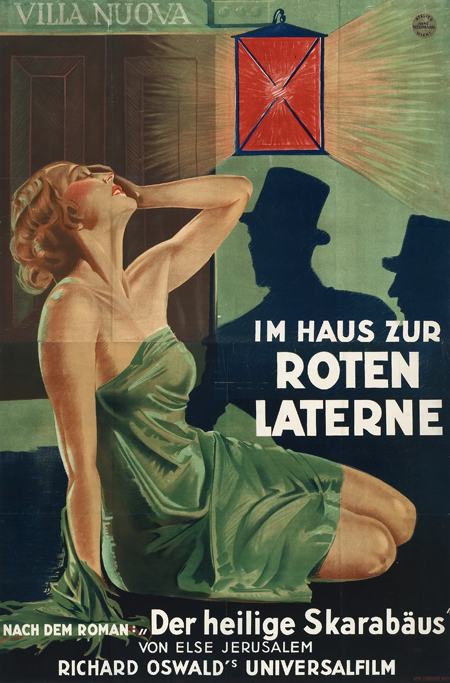
Berlin before the Somme was already a city whose veins pulsed with coal-smoke and aphrodisiac dread; Der grüne Skarabäus distills that perfume into a single, trembling droplet.
Set designers Max Knaake and Franz Jaffe eschew cardboard Egypt for a hallucinated Mittel-Europa: gaslight picks out hieroglyphs carved not on stucco obelisks but on the cast-iron facades of Wertheim’s department store. The result is an Expressionist Berlin that never existed yet feels truer than any newsreel.
The green scarab itself—actually a scaraboid carved from chrysoprase—was lensed through a thin vial of glycerin so that on screen it appears to breathe. Cinematographer Willy Hameister, fresh from shooting snow for Nelly Raintseva, here lets urban grime pearl into opalescent bokeh. Each close-up of the gem is matched with a vertiginous pull-back revealing yet another pair of eyes reflected in its facets: the film’s central coup is that possession is always reversed; the stone owns its admirers.
Albert Paulig, better known for comic butlers, plays Herr Fabrius—a timid cash-desk clerk—with a tremor that migrates from his fingertips to his vocal cords. Watch the way he fingers his starched collar as though it might sprout wings; the performance anticipates Faith’s Edwardian nervous breakdowns while remaining uniquely Prussian. Opposite him, diminutive Rita Clermont (billed simply as “Die Stenographin”) embodies the neue Frau a full decade before Berlin’s dance halls would swarm with bobbed hair and cigarettes. Her transition from ink-stained secretary to scarab priestess is charted through costume: the high white neckline descends frame by frame until, in the anarchist cellar, a single obsidian brooch rests atop her clavicle like a beetle poised to burrow.
Director Mack, usually lumped with the competent but uninspired, here experiments like a man possessed. Intertitles fracture into glyphs; entire scenes are replayed from alternate viewpoints, each iteration darker, shorter, more elliptical—an ancestor to the spiral structure of A skorpió I. The camera glides through doors that slam shut behind it, trapping us inside the same predatory logic as the characters. When the scarab finally disappears inside the projector’s gate, Mack literalizes the horror that the viewer has always been the final host.
Novelist and sexologist Else Jerusalem supplies a scenario dripping with fin-de-siècle toxins: ménage-à-trois power plays, blackmail letters typed on machines whose keys are sticky with lipstick and sealing wax. Yet the tone is lighter than her notorious novel The Red House—a febrile giddiness closer to operetta, but operetta scored for broken glass. Dialogue intertitles read like aphorisms torn from a decadent’s diary: “A woman’s virtue is merely a ledger no one has yet dared to audit.”
While Frate sole sanctifies poverty through beatific sunshine, Mack’s film wallows in urban chiaroscuro; both are religious, but Skarabäus worships at the altar of commodity fetish. Contrast also with Die platonische Ehe, where marriage is a passionless contract; here every liaison crackles with the possibility that your lover might, at dawn, peel off a human mask to reveal chitinous armor. And if Why America Will Win trumpets technological modernity, Skarabäus whispers that every modern object is already haunted.
Tinting alternates between arsenic green for exteriors—an echo of the gem—and tobacco amber for interiors lit by gas mantles. One reel survives entirely in cyanotype: faces become lunar, bruises blossom like irises. The sole hand-colored shot occurs when the scarab lands in a gutter puddle; for three seconds the screen floods with malachite shimmer, a jolt so visceral it feels as though the projector itself might hatch.
Though released silent, censorship cards indicate a planned benshi recitation—audiences were to hear a chorus of whispers in Egyptian, Berliner dialect, and Yiddish. Contemporary accounts describe cinema pianists instructed to avoid melodrama, instead playing disjointed foxtrots that disintegrate into clusters of minor seconds. The effect, one reviewer noted, was “as if Schönberg had wandered into a variety show and decided to ruin the act.”
Premiering at the 900-seat Marmorhaus in September 1913, the film triggered the first recorded case of “kinodepression”: a female patron fainted, claiming the beetle had crawled into her ear. Police temporarily confiscated print no. 7, citing “endangerment of public order.” By December, only truncated 35-minute versions circulated. The full 78-minute negative vanished in 1917, likely melted for its silver halide to fund war bonds.
In 2019 a 16mm reduction print surfaced in Montevideo, mislabeled as Love Aflame. The Deutsche Kinemathek scanned it at 4K, then spent three years digitally re-creating lost intertitles using Else Jerusalem’s original shooting script discovered in a Vienna flea market. The tinting was restored photochemically; the lone hand-colored frame was repainted under a microscope guided by surviving pigment samples on Paulig’s costume stills.
Swap the scarab for a smartphone and the plot reads like a social-media panic thriller: viral curses, identity theft, doom scrolling. Yet the film’s true chill lies in its refusal to moralize; there is no cathartic destruction of the idol, only an endless chain of new hosts. In an era when NFTs sell for millions and dating apps auction intimacy, Der grüne Skarabäus feels less like antique whimsy than like tomorrow’s headline.
The restoration clocks in at 76’24’’ (PAL speed), presented in 1.33:1 with German intertitles and optional English subtitles. An electric score by Ensemble Musikfabrik combines prepared piano with glass harmonica, available on the Blu-ray PCM 2.0 track. Streaming: currently exclusive to Deutsche Kinemathek’s Vimeo channel (worldwide rental) and on limited-region MUBI under the title The Green Scarab.
Der grüne Skarabäus offers no redemption, only the exquisite shiver of recognizing yourself in the predator’s compound eye. Watch it once for narrative, twice for texture, thrice because the reflection staring back is unmistakably your own—tattooed, ledger-less, and waiting to hatch.
IMDb —
1919
Community
Log in to comment.