DbcultAccessing Vault...
Cult Review
Senior Film Conservator
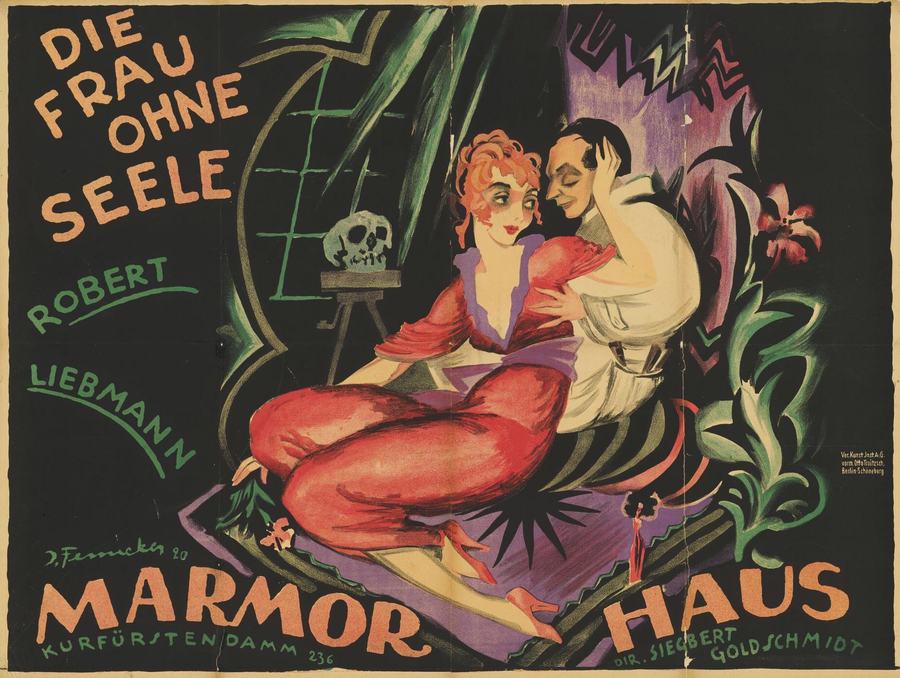
Weimar cinema loved its monsters, but few were ever framed in such opulent permafrost as Die Frau ohne Seele. Georg Jacoby’s 1926 chiller—long misfiled as a drawing-room melodrama—returns like a blood-stained calling card, proving that post-war Berlin already knew how to weaponize glamour against itself. Every tracking shot glides across parquet floors polished to ice-rink reflectivity; every close-up lingers on cheekbones sharp enough to cut ether. The film’s title translates to “The Woman Without a Soul,” yet the true horror is not Irena’s rumored hollowness but the vacuum she creates in others: once you stare too long into her absence, your own conscience slides out like a drawer.
Forget the linearity you expect from silents; this narrative spirals inward like frost on glass. Within the first reel, Jacoby establishes a triangulation of gazes: the husband who collects wives like vintage wines, the musician who believes art can resurrect a heart, and the step-child who coughs her tubercular verdict on them all. The screenplay, co-written by Robert Liebmann, drips with fin-de-siècle nihilism yet is paced like a thriller: intertitles appear sparingly, often mid-action, so that dialogue feels like an intrusion rather than exposition. When Alfred Abel’s Seebold barks “Mein Haus, meine Regeln,” the subtitle flashes only after he has already slammed the door—an audio-visual stutter that makes tyranny feel habitual, not theatrical.
The centerpiece is the twelve-night structure, each evening announced by a snow-stained intertitle whose font grows more jagged as morality unravels. Night One: Irena’s entrance in a gown of liquid jet beads that clack like teeth. Night Four: Alfons composing at a piano whose strings are later revealed to be strung with human hair—Kathe’s, snipped while she slept. Night Seven: a pagan Weihnachten where servants burn effigies of their employers, the flames reflected in Irena’s unblinking irises. By Night Twelve, the requiem is ready, but so is the river, and Jacoby cross-cuts between orchestral crescendo and ice cracking like a metronome counting down to damnation.
Edith Meller’s Irena is a triumph of negative space. She never acts she withholds. Watch her linger at the threshold of a room, half-lit, face angled away as though even the camera might bruise her. The strategy weaponizes the spectator’s voyeurism: the longer we seek humanity, the more we project our own rot. In one chilling insert, she practices smiling in a boudoir mirror, then wipes the expression off with a cloth as if it were rouge. The gesture lasts three seconds but hollows the entire film.
Opposite her, Ferry Sikla’s Alfons is all nerve endings. His hands tremble even when they hover above silent keys; Jacoby amplifies the trait by cutting to extreme close-ups of twitching knuckles, making the musician’s body a percussive echo of his unplayed score. The performance peaks in a single-take confession shot from the POV of a gramophone horn: Alfons’s face distorts in the brass reflection, warping into something both saintly and carnivorous. Silent cinema rarely got this close to psychological cubism.
Werner Krauss, fresh from The Cabinet of Dr. Caligari, cameos as Krastin the butler. He moves with the rubber-jointed eeriness of a marionette, yet every gesture is logged with bureaucratic precision—he oils hinges with the same solemnity he might sign a death warrant. The role is small, but Krauss turns exposition into ritual; when he closes his “soul ledger,” the click of the clasp reverberates like a judge’s gavel.
Cinematographer Theodor Sparkuhl, later lauded for Pandora’s Box, shoots winter not as wonderland but as whiteout purgatory. Exterior scenes are over-exposed until the horizon line evaporates; characters seem to walk on light itself. Interiors, by contrast, drown in Stygian cobalt shadows that pool like spilled ink. The result is a chiaroscuro so extreme it borders on X-ray: faces emerge as skull-masks, corsets as armor, candle flames as interrogation lamps.
Jacoby repeatedly frames Irena within doorways that taper toward vanishing points, literalizing the femme fatale as architectural void. In one bravura setup, the camera tracks backward through seven consecutive rooms, each threshold further miniaturizing her figure until she becomes a paper-cut silhouette. The move predates Welles’s Kane by fifteen years and rivals any noir labyrinth for spatial dread.
Though mute, the film is obsessed with music as moral barometer. Alfons’s unfinished requiem is heard only through orchestral hallucinations: title cards describe “a chord that curdles starlight,” while the visuals show servants freezing mid-step as though the air itself vibrated. When the final concert implodes, Jacoby cuts to Kathe’s heartbeat intercut with broken metronomes—a synesthetic assault that makes silence feel deafening. Contemporary critics compared the effect to Schoenberg’s Erwartung; modern ears will detect the blueprint for every horror score from Hitchcock to Herrmann.
Beneath its gothic lace, Die Frau ohne Seele is a scalding indictment of Weimar capitalism. Seebold’s factory profits from war reparations; his wives are mergers, their death certificates mere balance sheets. Irena’s soullessness is not supernatural but fiscal: she has liquidated empathy for assets. The film’s most subversive stroke is denying her punishment by law; instead, nature itself—thin ice—absorbs the cost. In 1926, audiences left the cinema debating whether the ending was justice or merely actuarial cleanup.
Contrast this with The Woman Above Reproach, where virtue is rewarded with marriage, or Castles in the Air, where dowries buy happiness. Jacoby refuses such mercantile morality; his world runs on debt, and the only collector is death.
For decades the film was believed lost, a casualty of Ufa’s 1945 vault fire. Then in 2018, a nitrate copy surfaced in a Buenos Aires basement, mislabeled as Apartment 29. The Friedrich-Wilhelm-Murnau-Stiftung spent three years reconstructing tinting references from chemist’s notes found in Potsdam. The 4K restoration premiered at 2022’s Berlinale with a live score by Ensemble Musikfabrik, who amplified the original requiem motifs into glass-shattering atonality. Streaming rights are fragmented, but the restored edition currently cycles through MUBI and Criterion Channel every quarter; physical media is slated for 2025 with an essay by critic Olaf Möller.
Place Die Frau ohne Seele beside Wild Primrose and you witness the Weimar split personality: rural nostalgia versus urban nihilism. Both films climax with a body in water, yet where Primrose sentimentalizes the drowned girl as wilted innocence, Jacoby’s river is an accountant’s ledger—bottomless. Similarly, Pogrom externalizes social violence outward toward minorities; Frau internalizes it, turning the bourgeois home into a gas chamber of etiquette.
There are films you watch; there are films that watch you. Die Frau ohne Seele belongs to the latter caste. It is not merely a tale of murderous femininity but an autopsy of an era that auctioned its humanity in curated lots. Ninety-eight years after its premiere, its chill still lowers room temperature. You will exit hearing nonexistent violins, half expecting your reflection to remain a second too long. And should you feel nothing—congratulations, you have rented space to Irena. The lease, like the ice, never truly melts.
Seek it out, but bundle up. Some silents talk; this one whispers frostbite into the marrow.
IMDb —
1931
Community
Log in to comment.