DbcultAccessing Vault...
6/10
Senior Film Conservator
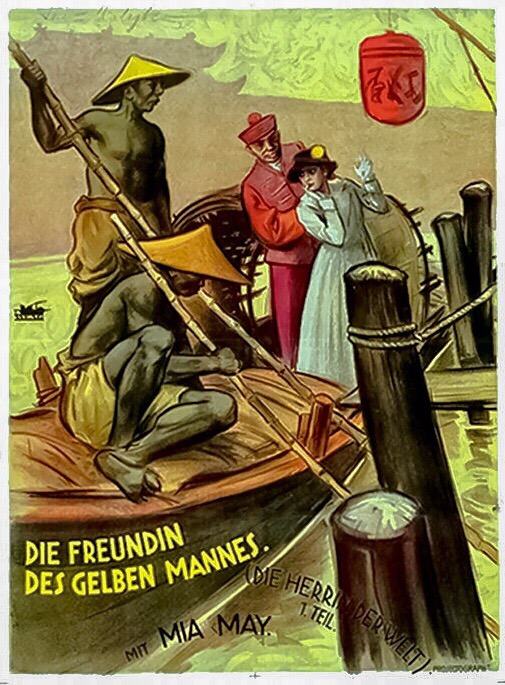
A definitive 6/10 rating for a film that redefined the boundaries of cult cinema. Die Herrin der Welt 1. Teil - Die Freundin des gelben Mannes remains a cornerstone of transgressive art.
Beneath the cracked lacquer of Weimar Germany's collective psyche, Joe May unleashed Die Herrin der Welt (1919) - a serialized fever dream where colonial fantasy curdles into nightmare. This inaugural chapter, Die Freundin des gelben Mannes, positions Hedy Searle's Maud Gregaards as both predator and prey in a Darwinian game played across Canton's opium-stained docks. What begins as treasure hunt for Sheba's fabled artifacts metastasizes into something far more revealing: Europe's terrified subconscious projected onto bamboo scaffolds.
Karl Figdor's script weaponizes Orientalist tropes only to shatter them. The 'Yellow Peril' manifests not in Louis Brody's noble mystic (a revolutionary portrayal for 1919), but in Hans Pagay's Schlievert - a European industrialist exploiting indigenous belief systems through technological sadism. When Maud is imprisoned in his electrified compound, May's camera lingers on Tesla coils crackling against dragon motifs, visualizing capitalism's colonial machinery. Production designer Otto Hunte renders China as expressionist labyrinth: junks materialize like ghosts in sulfurous fog while Schlievert's factory suggests Méliès reinterpreted by Kafka.
Searle performs feminist semiotics through gesture alone. Watch how Maud's initial treasure lust - fingers twitching over maps like Murnau's avaricious pawnbrokers - transforms into survival calculus during the witchcraft trial. Her scream as villagers brandish bamboo spears isn't fear but furious decoding of ritual theatrics. In Eva May's opium den scenes, Maud's dissociation becomes radical critique: eyelids fluttering at half-mast as if observing colonial absurdity through a drugged haze. The miracle isn't her escape from drowning at the climax, but how Searle weaponizes vulnerability into agency.
"Weimar cinema rarely acknowledged its imperial contradictions. May forces our noses into the opium pipe, exposing how Germany's lost colonies haunted its art. Maud isn't conquering the Orient - she's being digested by it."
Consider the ritual sequence where Nien Soen Ling's shaman performs the 'Dance of the Six Demons'. Cinematographer Werner Brandes bathes the scene in cyanide-green tints while undercranking the film to create nightmarish acceleration. As masked figures encircle Maud, their movements evoke both ceremonial authenticity and German expressionist theatre. The genius lies in ambiguity: is this authentic tradition or Schlievert's staged spectacle? May offers no resolution, trapping us in the same epistemological panic as his heroine.
Schlievert's compound represents Weimar's techno-paranoia made manifest. His 'witch detector' - a Rube Goldberg contraption of brass electrodes and Geissler tubes - parallels the industrial dehumanization critiqued in British social realism. When Maud is strapped into this apparatus, May cross-cuts to indigenous workers feeding ore into smelters, drawing explicit lines between colonial exploitation and gender violence. The true horror isn't the machine's verdict, but how efficiently superstition serves capital.
Louis Brody's 'Yellow Man' remains astonishingly progressive - an African actor portraying Chinese wisdom without caricature. His introductory scene sees him dismantling a clockwork bird to demonstrate European fragility, fingers moving with Confucian precision. Brody communicates through negative space: the pause before warning Maud about Schlievert, the infinitesimal head tilt signalling alliance. In an era when Hollywood reduced minorities to stereotypes, Brody's performance whispers revolution.
May fractures chronology like shattering porcelain. Maud's flashbacks to Denmark (shot in glacial blues) intrude upon Canton's ochre chaos, contrasting Viking directness with Qing Dynasty subtlety. This isn't mere exposition but cognitive dissonance made visible - the colonial mind unable to reconcile cultural binaries. Even the treasure hunt disintegrates; Sheba's artifacts become MacGuffins overshadowed by the real quarry: Maud's transformed consciousness. Her final plunge into the Pearl River baptism cleanses imperial ambition.
Brandes' pioneering use of copper sulfate filters created the signature 'dragon-fire' hues. This chromatic language would influence Italian colorists decades later.
Only 3 of the original 8 reels survive. The drowning sequence exists solely through Searle's diary descriptions: "Water like liquid jade... my skirts became funeral shrouds."
Beneath the serial thrills pulses Weimar Germany's Angst. Schlievert embodies Versailles Treaty humiliations - a petty tyrant compensating through colonial brutality. The villagers' readiness to condemn Maud mirrors postwar society's scapegoating, while the treasure represents reparations gold forever out of reach. Even the Yellow Man's alliance suggests socialist solidarity against oppressive systems. This covert commentary makes Herrin more than adventure; it's national trauma in yellowface.
Maud's witchcraft accusation reveals patriarchal mechanics. Schlievert invokes superstition because her intellect threatens his dominance - she deciphers inscriptions he cannot comprehend. The trial sequence's horror derives not from supernatural fear but the spectacle of knowledge being pathologized. When elders declare her a demon for predicting tides (basic oceanography), May indicts all systems weaponizing ignorance. Compare this to American melodramas where female intuition is sanctified; here, it's criminalized.
Michael Bohnen's cameo as a corrupt missionary deserves dissection. His character traffics in Bibles and opium, blessing Schlievert's enterprises with Jesuitical sophistry. The scene where he 'exorcises' Maud using Latin incantations parallels her 'witch trial' - two patriarchal systems colluding. Bohnen plays him with unctuous physicality: fingers stroking silver crosses while eyes dart to payment pouches. It's a savage parody of European cultural imperialism that predates Griffith's moralizing by years.
Maud's transformation from plunderer to cultural intermediary forms the film's molten core. Her survival hinges not on Western ingenuity but on mastering Confucian wu wei - action through inaction. When villagers tie her to the execution post, she doesn't struggle but studies rope patterns like archaeological relics. Later, escaping through monsoon rains, she navigates by qi principles rather than Cartesian logic. This cultural fluidity makes her Weimar's most radical heroine - a woman dissolving boundaries between self and other.
Ultimately, Die Freundin des gelben Mannes concerns psychic archaeology. The treasures Maud seeks - jade cicadas, bronze mirrors - reflect her own buried self. Schlievert's compound isn't just a prison but a museum of colonial pathologies. Even the Pearl River's murky depths become an archive where European certainties dissolve. As the surviving reels fade on Maud's submerged form, we witness not defeat but metamorphosis: a woman becoming amphibious, breathing water like a dragon. It's an image that would haunt German cinema from Bergman to Herzog.
In the corroded print we inherit, May's masterpiece remains tantalizingly fragmentary - much like the treasure it depicts. Yet these shards gleam with prophetic fire: a vision of identity remade through cultural collision, where survival demands becoming the very mystery you sought to possess.
Community
Log in to comment.