DbcultAccessing Vault...
5.7/10
Senior Film Conservator
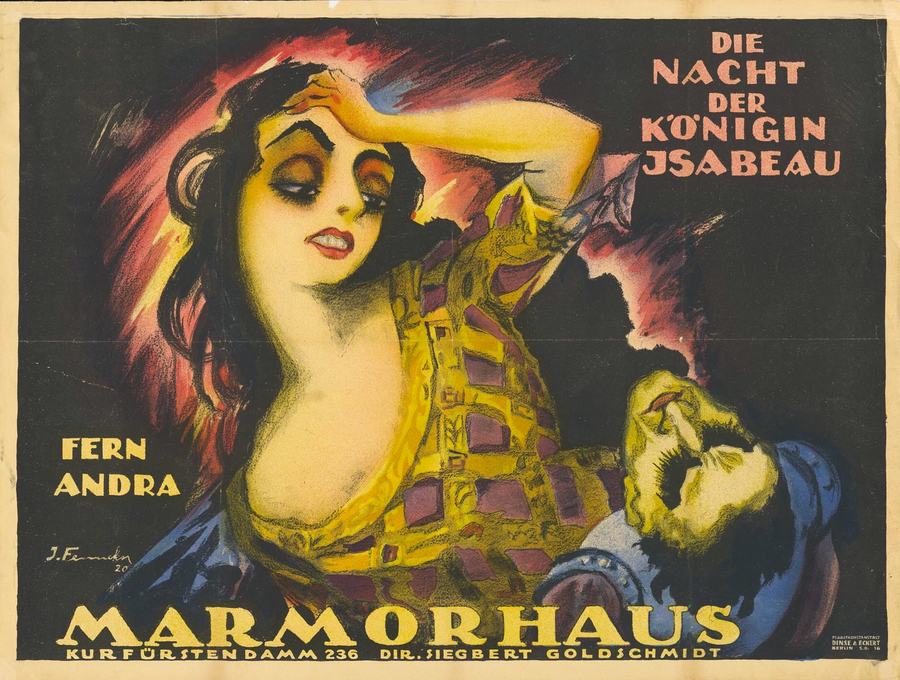
A definitive 5.7/10 rating for a film that redefined the boundaries of cult cinema. Die Nacht der Königin Isabeau remains a cornerstone of transgressive art.
In the pantheon of Weimar cinema, certain names evoke immediate imagery of jagged shadows and distorted perspectives. While Robert Wiene is forever tethered to the cabinet of a certain Dr. Caligari, his 1920 foray into historical psychodrama, Die Nacht der Königin Isabeau, represents a fascinating divergence. It is a film that breathes through its textures—the heavy velvet of courtly robes, the cold stone of Parisian dungeons, and the flickering torchlight that illuminates the moral decay of the Valois dynasty.
The film operates as a visual symphony of internal and external chaos. Alexander Moissi, portraying the 'Mad King' Charles VI, delivers a performance of such high-wire intensity that it borders on the transcendental. His eyes, wide with the terror of a man haunted by invisible demons, provide a stark contrast to the glacial, calculated beauty of Fern Andra’s Isabeau. Unlike the more traditional romanticism found in Manon Lescaut, where passion is a fatal flaw, Isabeau’s desires are wielded like a scalpel, dissecting the power structures around her to ensure her own survival.
Wiene’s direction here is less about the painted backdrops of his most famous work and more about the architectural oppression of the frame. The camera lingers on the vastness of the royal chambers, making the characters seem like chess pieces lost on an infinite board. This sense of isolation is reminiscent of the atmospheric dread in The Face in the Moonlight, yet it is grounded in a historical reality that feels oddly contemporary in its cynicism.
Fern Andra, an American-born actress who became a titan of the German screen, brings a specific, ethereal gravity to the role of Isabeau. She does not play the Queen as a mere villainess; instead, she is a woman trapped in a patriarchal cage, using the only currency available to her: influence and intrigue. Her chemistry with the supporting cast—particularly the brooding Lothar Müthel and the always-impeccable Fritz Kortner—creates a friction that drives the narrative forward even when the pacing slows to a contemplative crawl. One might find parallels to the quiet, simmering tensions of The Bride's Silence, though Wiene amplifies the stakes to a national level.
The inclusion of John Gottowt and Hans Heinrich von Twardowski adds layers of theatrical pedigree to the production. Twardowski, in particular, possesses a feline grace that complements the film's jagged aesthetic. The cast functions as a cohesive unit, portraying a court that is simultaneously opulent and decaying. It is a world where the beauty of a silk gown cannot mask the stench of political rot.
While Die Nacht der Königin Isabeau is often classified as a historical drama, its soul is purely Expressionist. The lighting, orchestrated with a painterly sensibility, utilizes high-contrast shadows to mirror the King’s fractured psyche. Every hallway is a potential trap; every curtain hides a conspirator. This visual density is far more complex than the straightforward narratives of films like Red and White Roses. Wiene isn't interested in a history lesson; he is interested in the feeling of history—the weight of centuries pressing down on a single, sleepless night.
The costume design deserves its own monograph. The heavy, ornate headpieces worn by Andra serve as both crowns and cages, symbolizing the burden of her station. There is a tactile quality to the cinematography that makes the viewer feel the chill of the stone floors. In comparison to the more grounded social commentary of Down with Weapons, Isabeau is a flight of dark fancy, a gothic romance that prioritizes mood over message.
The screenplay, penned by Wiene himself, avoids the pitfalls of the 'heritage film' by leaning into the surreal. The sequences depicting Charles VI’s fits of madness are edited with a rhythmic urgency that feels decades ahead of its time. We see the world through his distorted lens, where the courtly rituals become grotesque parodies of themselves. This psychological depth elevates the film beyond the melodramatic tropes found in The Saintly Sinner or the domestic tribulations of Mrs. Slacker.
There is a recurring motif of the 'gaze' throughout the film. Isabeau is constantly being watched—by her lovers, by her enemies, and by the spectral presence of her husband. This creates a sense of voyeuristic tension that permeates every scene. Even in moments of supposed intimacy, there is a third party present: the state. The personal is inextricably linked to the political, a theme that resonates through other works of the era like The Great Gamble, though rarely with such stylistic flair.
Watching a silent film of this magnitude in the modern era requires a recalibration of the senses. One must listen to the visual rhythm. The way Elsa Wagner moves across a room, or the specific tilt of Harald Paulsen’s head, conveys more than a page of dialogue ever could. It is a masterclass in physical storytelling, akin to the theatrical precision of David Garrick. The lack of spoken word allows the viewer to focus on the subtext—the unspoken threats and the desperate, silent pleas for sanity.
The film’s score (depending on which restoration you view) often struggles to match the sheer audacity of Wiene’s imagery. The ideal accompaniment would be something discordant and avant-garde, mirroring the King’s mental state. Without it, the silence itself becomes a heavy, oppressive blanket, much like the atmosphere in The Chimes, where the supernatural and the mundane collide.
For too long, Die Nacht der Königin Isabeau has sat in the shadow of Wiene’s more overtly 'Expressionist' films. However, upon closer inspection, it is clear that this is where he perfected his ability to blend historical narrative with psychological horror. It lacks the whimsical charm of Persuasive Peggy or the straightforward adventure of The Midnight Alarm, but it gains a haunting, lingering power through its refusal to offer easy catharsis.
The film explores the duality of the human soul—the 'Two-Soul Woman' archetype that was so prevalent in Weimar literature and cinema, perhaps most literally referenced in The Two-Soul Woman. Isabeau is both mother and temptress, protector and betrayer. She is the anchor in a world that has lost its moorings, yet she is also the one cutting the ropes. This complexity makes the film a vital piece of cinematic history, a bridge between the theatrical past and the psychological future of the medium.
In the final act, as the dawn breaks over a Paris that remains as fractured as the King’s mind, the viewer is left with a profound sense of melancholy. Like the characters in Souls Adrift, the players in this royal drama are victims of forces far beyond their control—be it madness, politics, or the inexorable march of time. Wiene has crafted not just a film, but a haunting monument to a forgotten night in history, draped in shadows and dripping with the tragic elegance of a bygone era. It remains a staggering achievement in mood and a testament to the power of the silent image to evoke the deepest recesses of the human experience.
Footnote: For those seeking the rustic simplicity of Mules and Mortgages, look elsewhere. This is a journey into the heart of darkness, wrapped in the finest silk 1920s Berlin could provide.
IMDb 6.4
1920
Community
Log in to comment.