DbcultAccessing Vault...
Cult Review
Senior Film Conservator
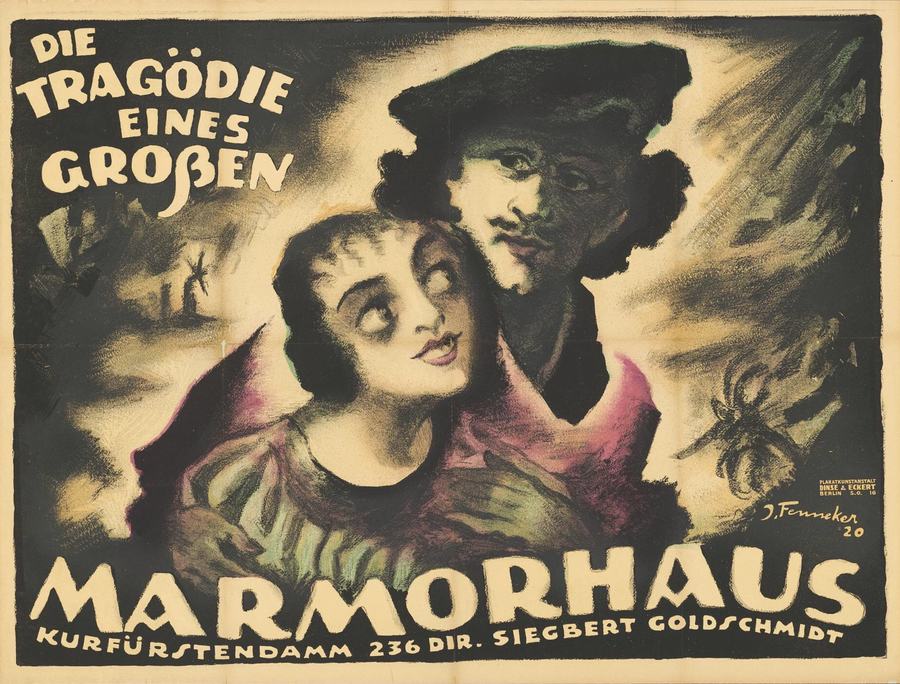
There is a moment—halfway through Die Tragödie eines Großen—when the camera forgets to breathe. Fritz Beckmann’s steel-baron stands alone inside a cavernous ballroom whose mirrors multiply him into infinity; every reflection wears the same silk lapel, the same carnation, the same predatory grin. Then the chandeliers flicker, the orchestra stalls, and the mirrors begin to crack from the outer edges inward, like frost racing across black water. No title card intrudes; the silence itself is a guillotine. In that razor-slice of celluloid, Orthmann and Gruner’s film announces its thesis: empire is a hall of mirrors, and every shard eventually flies back to the throat of the man who gazed too long.
Released in the hemorrhaging dawn of Weimar democracy, this 1921 savage poem predates Hedda Gabler’s claustrophia and the expressionist fever of The Confession, yet feels eerily adjacent to the toxic boardrooms later exposed in War and Peace’s epics. Where Tolstoy’s Rostovs wrestled with nobility, Orthmann’s protagonist—nameless except for the honorific “Großer”—wrestles only with scale: how big can greed grow before it collapses into the grave it sells by the cubic meter.
Story, here, is not a line but a spiral staircase descending into a coal mine. Childhood poverty is rendered in negative white space: we see only the father’s coffin handles, polished until they resemble the very rails our baron will one day own. Adulthood arrives as a staccato montage—stock-ticker, wedding ring, workers’ funerals—cut so rapidly that the images fuse into a single weaponized coin. Marriage to Clementine Plessner’s fragile heiress is no alliance but a hostile takeover; the wedding night intercuts with a strike being crushed by police batons, blood and bridal lace sharing the same monochrome palette.
Orthmann’s script refuses psychological comfort. Motive is not excavated, merely exposed: every handshake hides a ledger entry, every kiss a lien. When the magnate’s younger brother (Kaiser-Heyl, eyes burning like votive candles) defects to the unions, the film stages the confrontation inside a cathedral of machinery—steam-hammers for pillars, conveyor belts for pews. Their dialogue is intercut with shots of molten steel pouring into molds shaped like human silhouettes. The metaphor is blunt, volcanic, irrefutable.
Beckmann’s physiognomy belongs in a mortuary of epochs: cheekbones sharp enough to slice bonds, eyebrows like iron filings magnetized by capital. He modulates between whispered seduction and pneumatic roar without intermediate gear. Compare his stillness to the flamboyant athleticism of Willard-Dempsey Boxing Contest; here, power is exercised through immobility—the less he moves, the faster the world re-arranges itself around him.
Clementine Plessner, consumptive and luminous, exhales every line as if it were ether on the verge of evaporation. Her final close-up—tubercular roses blooming on her cheeks while she signs over her inheritance—deserves canonical status beside Rosemary’s deathbed epiphanies. Meanwhile, Sybill Morel’s anarchist seamstress moves through the film like a lit fuse, eyes glittering with the unholy joy of someone who has already pictured the explosion.
Even tertiary roles refuse to stay decorative. Carl de Vogt’s junior accountant, face a pallid ledger sheet, utters only one line yet haunts the margins of every frame—an omen of the faceless calculators who will inherit the earth. Eva Eberth and Dora Bergner, as child-labor ghosts, appear only in double-exposure, their translucent bodies stacked like cordwood behind the baron’s quarterly profits.
Director Paul Gruner, better known for ethnographic shorts, unleashes a lexicon of optical violence. Negative images invert ball-gowns into funeral drapes; superimpositions show stock prices rising like mercury while workers’ silhouettes drown beneath. The camera tilts during speeches, turning parquet floors into sheer cliffs. Rapid intercutting between Versailles-inspired banquets and abattoir conveyor belts foreshadows the dialectic montage Eisenstein would soon patent, yet Gruner’s cadence is more fever dream than agitprop.
Color tints are deployed like bruises: sea-blue nocturnes for boardroom conspiracies, sulfur-yellow for factory infernos, arterial orange for domestic betrayals. Because modern prints often exist only in black-and-white, these chromatic shocks survive in written production notes; one must imagine them, like scars beneath clothing. Even so, the high-contrast photography—shadows devouring half of every face—renders each character a split portrait: predator and prey sharing the same skin.
Though released without synchronized score, surviving cue sheets recommend a live orchestra pivoting from Wagnerian leitmotifs to atonal sirens. Contemporary critics report that some cinemas spliced in field-recorded factory noise—steam-valves, locomotive wheels, the hiss of hydraulic presses—creating a proto-musique-concrète that predates Allies’ Official War Review, No. 10’s battlefield collages. Silence, when it arrives, feels like tinnitus after artillery: the absence of sound becomes the loudest accusation.
Shot mere months after the Kapp Putsch, while Spartacist blood still dried on Berlin sidewalks, the film channels a nation negotiating the invoice of its own industrial miracle. Inflation looms like weather; the baron’s vault of paper money becomes kindling for a worker’s cooking fire. Viewers in 1921 would have recognized the Krupp and Stinnes cartels refracted through Beckmann’s monocle. A century later, the same audience beholds Silicon Valley unicorns and fossil-fuel dynasties, proving that the top-hat merely morphed into a hoodie.
Curiously, the screenplay sidesteps anti-Semitic tropes common in period agit-prop. The villains are Protestant patricians, bureaucrats, and technocrats—a genealogical preview of the Mitteleuropa managerial class that will soon flirt with fascism as hedge against Bolshevism. In that sense, Die Tragödie eines Großen operates as microcosmic prequel to King Charles II: England’s Merry Monarch’s court intrigues, albeit stripped of Restoration bawdy and painted in ash.
Women in this universe function as both safety-valve and fuse-wire. Plessner’s consumptive bride internalizes guilt like radium poisoning, her pallor the physicalization of inherited sin. Morel’s anarchist tailoress externalizes rage, stitching gunpowder into waistcoats with the same dexterity once demanded by haute-couture sweatshops. Both trajectories end in death—one by hemorrhaged lung, the other by firing squad—yet their corpses are not spectacle but forensic evidence. Gruner’s camera lingers longest on their empty workstations: a sewing machine still whirring, a marital bed stripped to the mattress springs. The message is stark: under capital, even martyrdom is amortized.
Lang’s Metropolis inherited its cathedral-of-machines set design; Stroheim’s Greed cribbed its moral pessimism; Buñuel’s L’Age d’Or lifted the surreal banquet motif. Yet few today speak of Gruner’s film, largely because nitrate prints were melted for their silver halide during the 1923 hyperinflation—an irony the baron himself might have savored. What survives are fragments: a French censorship card, a Swedish intertitle list, a single continuity script reprinted in a 1924 film annual. Even so, its chromosomes scatter across the century like shrapnel. You can detect its DNA in Falling Waters’ water-mill as profit-engine, in What’s His Name’s anonymous everyman crushed by corporate gears, even in sitcoms where the tycoon’s Lear-like roar echoes down mahogany corridors.
To watch Die Tragödie eines Großen today is to confront a mirror whose silver backing has tarnished into Rorschach stains. Streaming on your retina is not antique misery but the algorithmic auction of your own data: every swipe, every click, every drone-delivered parcel. The film’s final image—an empty boardroom chair silhouetted against a dawn sky of chimneys—asks a question we still answer with each quarterly earnings call: how many human hours per share?
In 2016 the Deutsche Kinemathek reassembled a 63-minute version from two partial negatives found in Buenos Aires and Kyiv, tinted according to production diaries. A 4K restoration debuted at Bologna’s Il Cinema Ritrovato, accompanied by a live ensemble performing a reconstructed score blending Hindemith viola dolorosa with factory sirens. Criterion-grade Blu-ray remains elusive; however, bootleg rips circulate among cine-archaeologists, watermarked like stigmata. Seek the 2017 restoration—frame density is higher, and the sea-blue tint correctly renders the infamous boardroom sequence rather than the sickly teal of earlier transfers.
Capitalist tragedy usually flatters us with the fantasy of moral awakening. Die Tragödie eines Großen refuses that narcotic. Its protagonist never repents; he simply exhausts the available bodies. When the screen goes black, the absence of a reformation arc feels less like narrative brutality than documentary honesty. We are not invited to empathize but to inventory our own complicity—every pension fund seeded with fossil shares, every upgrade cycle fueling coltan mines. The true horror is that the film’s title does not refer to one man but to an entire system that still signs its name in the same crimson ink. And the curtain never falls; it merely rises on the next boardroom, the next ballot, the next breath we trade for profit.
For further contrast, see how Toton romanticizes outlaw rebellion, or how My Lady Robin Hood swashbuckles exploitation into adventure. Neither dares the abyssal stare achieved by this forgotten colossus.

IMDb —
1916
Community
Log in to comment.