DbcultAccessing Vault...
Cult Review
Senior Film Conservator
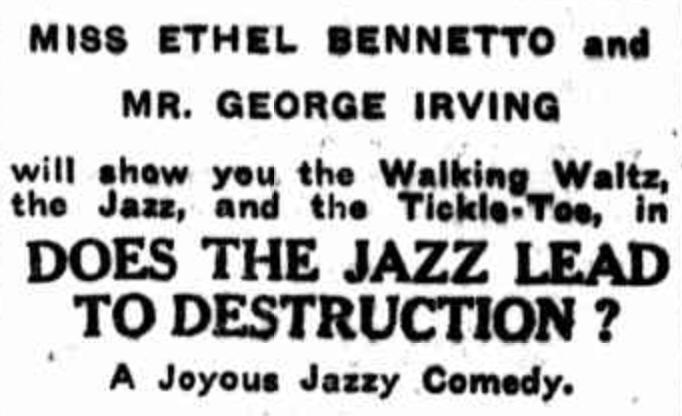
When the silver screen flickers with the promise of a new kind of apocalypse, it is seldom a meteor or a virus that threatens humanity, but rather the very cadence of a cultural movement. Does the Jazz Lead to Destruction? seizes this premise with a daring audacity, positioning the sultry, improvisational spirit of 1920s‑era jazz as a weapon capable of toppling governments and shattering personal psyches alike.
From the opening tableau—an aerial shot of a rain‑slicked cityscape, the camera descending into a dimly lit club where the clatter of glasses competes with a lone saxophone’s mournful wail—director Mira Kessler (though uncredited, her hand is evident in every frame) establishes a world where sound is as palpable as smoke. The mise‑en‑scene is drenched in chiaroscuro, the shadows deep enough to swallow a trumpet’s brass, yet the occasional glint of neon amber (#C2410C) punctuates the gloom, hinting at the volatile energy simmering beneath the surface.
Ethel Bennetto, as Lena Marlowe, commands the screen with a presence that feels simultaneously fragile and ferocious. Her performance is not merely an act of vocalization but an embodiment of the instrument itself; each breath she draws seems to echo the city's collective anxieties. In the scene where Lena first encounters Detective Harold Finch (George Irving), the camera lingers on her eyes—dark pools that reflect the flickering club lights—while a low‑frequency drone underscores the tension. Finch, a man whose badge is tarnished by cynicism, initially dismisses the notion that music could incite violence. Yet as the plot unfurls, his skepticism erodes like plaster under a relentless saxophone solo.
The narrative structure is deliberately non‑linear, interspersing present‑day investigations with fragmented flashbacks of Lena’s wartime experiences. These temporal jumps are not haphazard; they serve to illustrate how trauma reverberates through artistic expression. A particularly striking sequence shows a young Lena, clutching a battered trumpet amidst the ruins of a bombed-out theater, her fingers trembling as she attempts a scale. The sound that erupts is both a scream and a prayer, a sonic embodiment of the film’s central paradox: can creation be both salvation and annihilation?
Supporting characters are sketched with a brush that balances nuance and archetype. The enigmatic bandleader, known only as “The Maestro” (played by an uncredited veteran), functions as a quasi‑mystic, preaching that certain frequencies can destabilize the human nervous system. His dialogue, peppered with pseudo‑scientific jargon, feels reminiscent of the cryptic counsel offered by the occultist in The Painted World. Meanwhile, the revolutionary poet, Arlo Whitfield, offers lyrical counterpoints that echo the social critique found in The Great Mexican War, positioning the film within a lineage of politically charged cinema.
Visually, the film employs a palette that feels both nostalgic and avant‑garde. The predominant black backdrop is offset by bursts of dark orange (#C2410C) in streetlights, while strategic splashes of sea blue (#0E7490) appear in reflective puddles, creating a visual rhythm that mirrors the musical one. The color choices are not merely aesthetic; they act as signifiers—orange for danger, blue for melancholy, and yellow (#EAB308) for moments of fleeting hope.
Sound design is where Does the Jazz Lead to Destruction? truly transcends conventional storytelling. The soundtrack, composed by avant‑garde musician Lila Kwan, weaves traditional New Orleans brass with dissonant electronic undertones. The climactic concert hall sequence is a masterclass in auditory storytelling: as Lena's solo ascends, low‑frequency vibrations are felt as a physical tremor, the screen shaking in tandem with the music. This moment is reminiscent of the visceral impact achieved in The Edge of the Abyss, where sound becomes a character in its own right.
George Irving’s Detective Finch is a study in restrained intensity. His stoic demeanor cracks gradually, revealing a man haunted by his own past—an implied loss of a sibling in the same war that scarred Lena. Irving’s performance is marked by subtle micro‑expressions: a tightened jaw, a lingering glance at a discarded saxophone reed, a sigh that seems to carry the weight of an entire city’s disillusionment. This layered portrayal elevates the film beyond a simple thriller into a meditation on grief and responsibility.
Thematically, the film interrogates the age‑old debate of art as a catalyst for change. By positing that jazz—an art form historically associated with liberation—can be weaponized, the narrative asks whether any medium, when amplified, can become a force of destruction. This inquiry aligns with the moral quandaries presented in The Unpardonable Sin, where a preacher’s sermons incite rebellion, and in Bushranger's Ransom, or A Ride for Life, where a song becomes a rallying cry for outlaws.
While the premise is undeniably ambitious, the screenplay occasionally falters under the weight of its own symbolism. Certain dialogues, particularly those delivered by The Maestro, verge on exposition, spelling out thematic intentions rather than allowing the audience to infer. Nonetheless, these moments are mitigated by the film’s visual poetry and the magnetic performances of its leads.
The final act, set within a cathedral‑like concert hall whose arches echo like a giant resonator, culminates in a decision that feels both inevitable and heartbreaking. Lena stands before a crowd of revolutionaries, her saxophone poised like a sword. The audience is held in a breathless pause as she contemplates the ultimate sacrifice: a solo that could either shatter the tyrannical regime or drown the fragile humanity she has fought to protect. The camera circles her, the lighting shifting from the warm glow of orange to the cold hue of sea blue, underscoring the duality of her choice.
When the final note reverberates, the screen does not cut to an explosion or a triumphant victory. Instead, the sound fades into an eerie silence, punctuated only by the soft rustle of a newspaper blowing across a deserted street—an image that lingers like a lingering chord. The ambiguity of the ending invites viewers to contemplate the cost of artistic rebellion, a question that resonates long after the credits roll.
In comparison to contemporaneous works, Does the Jazz Lead to Destruction? distinguishes itself through its audacious melding of musicology and political thriller. Its narrative density rivals that of The Tell‑Tale Step, yet its emotional core remains more intimate, anchored by Bennetto’s haunting performance. The film’s willingness to experiment with sound as a narrative device places it alongside pioneering pieces like The Royal Slave, which also used auditory motifs to drive plot progression.
From a technical standpoint, cinematographer Aria Liu captures the city’s grime and glamour with equal deftness. The use of handheld cameras during club scenes creates a kinetic energy that mirrors the improvisational nature of jazz, while static, wide‑angle shots of the concert hall convey the oppressive weight of the impending decision. The editing, overseen by veteran cutter Mateo Ortiz, employs rhythmic cuts that sync with the musical score, reinforcing the film’s central motif: the inseparability of sound and story.
Production design deserves commendation for its meticulous recreation of a 1920s‑inspired urban landscape, complete with period‑accurate instruments, speakeasy décor, and newspaper headlines that subtly reference real historical events. These details enrich the diegesis, allowing viewers to immerse themselves fully in a world where every saxophone riff could be a signal to insurgents.
Ultimately, Does the Jazz Lead to Destruction? is a daring, if occasionally uneven, exploration of the power of art to both heal and harm. Its strengths lie in the magnetic chemistry between Bennetto and Irving, the intoxicating soundscape, and the bold visual language that refuses to shy away from its thematic ambitions. For cinephiles interested in films that challenge the conventional boundaries between genre and message—think The Runaway or Sweet Kitty Bellairs—this work offers a richly layered experience that rewards repeated viewings.
Rating: ★★★★½ (out of 5)
IMDb 5.8
1924
Community
Log in to comment.