DbcultAccessing Vault...
Cult Review
Senior Film Conservator
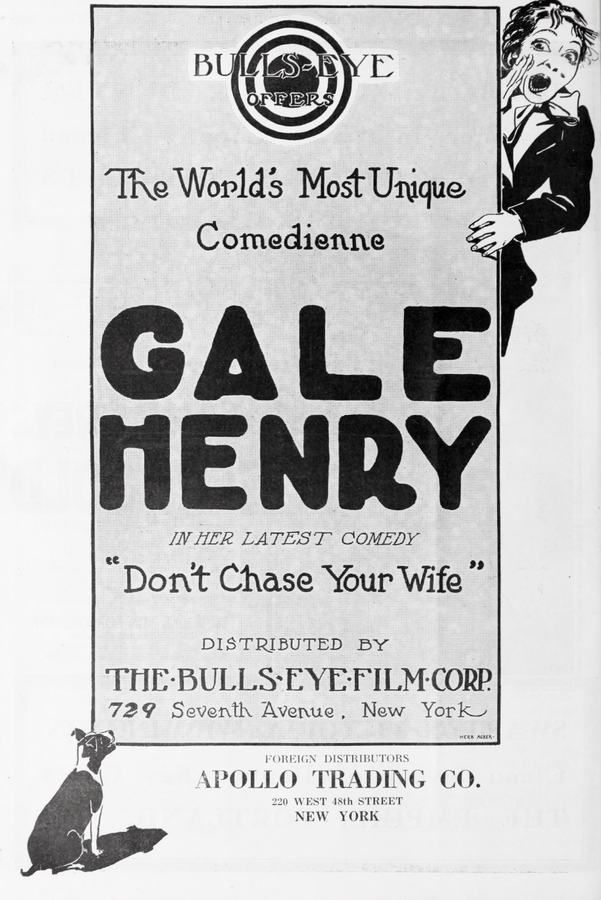
The first time I watched Don't Chase Your Wife I kept waiting for the explanatory title card that never arrives. There is no “Why is he afraid?” or “She dreams of flight.” The film simply drops us into the echoing hallway of a dowdy boarding-house and lets the furniture—and the faces—do the talking. Ninety-seven years later, that silence feels like a dare: interpret me or perish.
Director/scribe unknown (the negative is credited to no auteur, only to entropy) stages the entire farce inside a vertical shoebox. Staircases become spinal cords; landings act as ribcages. Every door is a ventricle slamming shut on intimacy. The husband’s surveillance route traces a Möbius strip: upstairs, downstairs, through the kitchen hatch, back up the dumb-waiter shaft. The camera never leaves this townhouse—because the marriage can’t. The limited set turns the picture into a pressure cooker where jealousy steams until the wallpaper peels.
Compare that claustrophobia to Hop - The Devil's Brew, where city streets open like escape valves, or to It's a Great Life that luxuriates in pastoral wide shots. Here, the frame itself is a corset tightened by comic desperation.
Gale Henry’s face—angular, elastic, vaguely lunar—was built for silent comedy. Her eyebrows operate like independent organisms, hoisting themselves into question marks whenever the husband barges in. But notice the micro-movement in her shoulders: a half shrug that signals not guilt but boredom. That shrug is the film’s secret thesis—she isn’t unfaithful; she’s unimpressed. In a medium that often treated women as pies to be stolen, Henry insists on being the fork.
She never once flees the building. Instead she reclines on the communal settee, filing her nails while pandemonium ricochets. The power dynamic flips: the more he scampers, the more she lounges. It’s a gendered inversion of A Woman's Power, where matriarchal schemes rule the narrative, but here the matriarch does it by simply refusing to run.
If Henry is stillness, Ward is perpetual motion—yet not the graceful poetry of Keaton nor the balletic wrath of Chaplin. His body moves like a grocery cart with one gimp wheel: forward thrust, then catastrophic wobble. Watch the sequence where he attempts to eavesdrop through the keyhole while balanced on a roller skate. The skate rolls, his center of gravity betrays him, and he face-plants into a cast-iron radiator. The gag lands because the film withholds the safety cutaway. We see the full, unvarnished crack of flesh on metal, followed by a puff of dust that lingers like cartoon sin.
That willingness to mar the hero’s flesh distinguishes the picture from softer contemporaries such as His Jonah Day. Ward’s bruises are the price of patriarchal paranoia; each welt is a moral invoice.
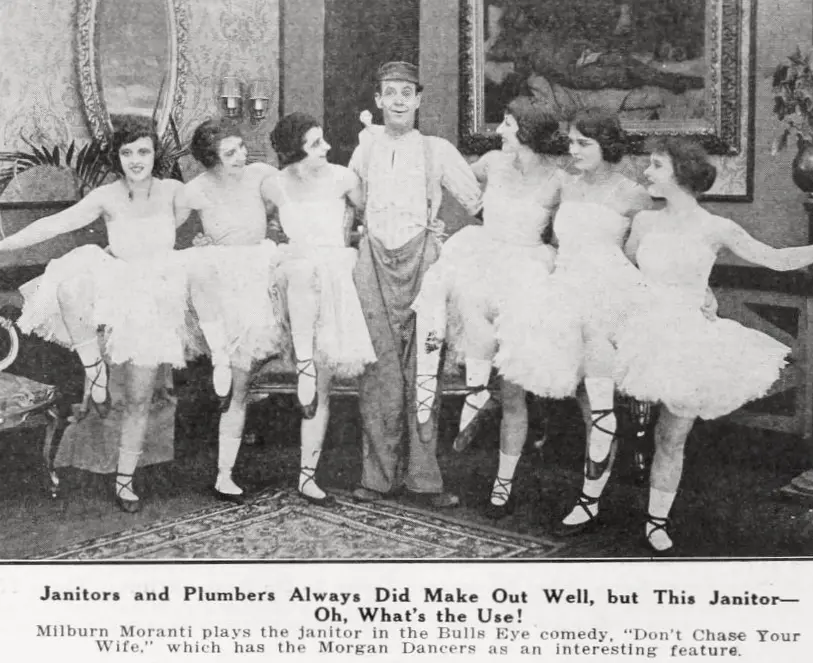
Suddenly—without narrative warning—the hallway ruptures into modernist dance. The Marion Morgan Dancers pour in like liquid geometry, limbs slicing the air into trapezoids. They twirl parasols that spray confetti, turning domestic dread into carnivalesque release. Their presence is so surreal it feels spliced in from a different reel, yet it functions as a counter-rhythm to the husband’s frantic 4/4. The choreography says: space can be joyful if you stop clutching it.
Historians label Morgan’s style “eurythmic,” but inside this picture it plays like a prophecy of Art Deco liberation. Compare the moment to Satan's Rhapsody, where dance becomes a diabolical contract; here it’s the opposite—an emancipatory glitch in the domestic program.
Milburn Morante’s boarder skulks along the periphery, trousers hoisted to sternum, mustache waxed into twin exclamation points of villainy. He exists purely to slip notes under doors, then retreat into shadow, eyes glinting like wet coins. His voyeurism externalizes the husband’s own. Where the husband spies to possess, Morante spies to commodify gossip. Together they form a binary star of male surveillance, each feeding the other’s paranoia until the hallway glows with toxic energy.
In 2023 vernacular, Morante is the original reply-guy: he never creates, only reacts, amplifying chaos for the spectacle. His eventual comeuppance—pants set ablaze by a rogue candle—feels like the silent era inventing its own emoji for “flaming troll.”
The average shot length clocks in under three seconds, a caffeinated frenzy even by 1926 standards. The cutter—name lost to nitrate rot—snips every gag at the precise moment breath becomes laugh. Look at the sequence where Ward swings from a chandelier rope: we get four cuts in two seconds—wide, insert of rope fraying, close-up of bulging eyes, crash landing. The montage doesn’t just depict impact; it reproduces it inside the viewer’s nervous system.
That freneticism contrasts sharply with the contemplative long takes of King Charles II: England's Merry Monarch, proving the silent era had already mastered both poles of cinematic time.
Surprisingly, the film sparingly uses intertitles—only seven in total. Each card appears after a visual punchline, never before. The effect is retrospective narration, like a jester whispering, “Yes, you saw that correctly.” One card reads: “He discovered that a keyhole is just another mirror.” It’s haiku that indicts masculine ego without preaching.
Most surviving prints are accompanied by a contemporary piano score. Seek out the 2019 restoration with Mona May Carpenter’s octet—a klezmer-jazz hybrid that sprinkles clarinet glissandi over chase sequences. The clarinet becomes the wife’s laugh, sly and improvisational, while tuba blats mimic Ward’s pratfalls. The music reclaims silence as a canvas rather than a void.
On the skin, the movie peddles the hoary maxim: a husband’s vigilance equals love. But beneath, it deconstructs that mantra until it shrieks. The wife’s refusal to exit the building is not submission but sovereignty: she stays because the space is hers to redefine. The husband’s injuries accrue precisely because he cannot accept coexistence without ownership. Thus the film anticips #OwnYourSpace discourse by a century.
Compare to She's Everywhere, where female omnipresence is played for cosmic terror; here female presence is simply quotidian, and that’s radical enough to unseat a king—or at least a boarding-house hubby.
Shot on a shoestring, the picture exploits high-contrast orthochromatic stock. Hallway shadows pool into inkblots that seem to breathe. When the wife stands at the top of the stairs, backlit by a single window, her silhouette becomes a Rothko before Rothko: a rectangular mystery of gender and light. The husband climbs toward her, but the shadow swallows his outline, predicting film noir a decade early.
Trade papers of 1926 dismissed it as “another hallway hodgepodge.” Yet the Chicago Defender praised Gale Henry for “laughing while colored by mischief, not malice,” one of the few mainstream notices to parse the racialized lens of comedy. Modern festival crowds gasp at the velocity; they also cheer when the wife finally exhales cigarette smoke into the husband’s twitching eye. Twitter would dub it #RestingSheshFace.
A 2K restoration circulates via Kanopy and occasional 16 mm collegiate bookings. The Library of Congress holds a 35 mm dupe, though two reels remain red-tinted beyond salvation. Bootlegs on video-sharing sites run at the wrong speed—turning Henry into a chipmunk—so insist on curated streams. If you curate a local retrospective, pair it with Set Free for a double bill on emancipation, silent-style.
Don’t Chase Your Wife ends on a tableau that evaporates the moment you try to hold it: two figures sharing smoke, clock frozen, hallway lights flickering like a failing heart. The marriage hasn’t been saved; it’s been redefined as an uneasy armistice. The husband’s grazed knees spell apology in Morse; the wife’s half-smile reads provisional acceptance. No kiss. No iris-in heart-shape. Just the brittle hush of people who realize love is less a chase than a parallel stroll—close enough to hear footsteps, far enough to keep the self intact.
That, ultimately, is why the film refuses to fossilize. It whispers that possession is the enemy of presence, that trust is not a keyhole but a doorway you agree not to barricade. And it does so while somebody, somewhere, is still falling off a chandelier—because gravity, like insecurity, never stops looking for an audience.
IMDb 4.4
1923
Community
Log in to comment.