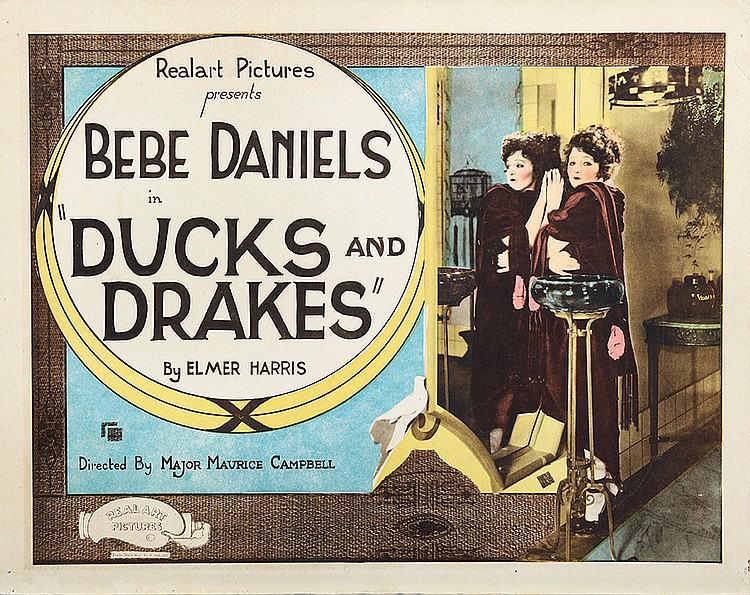
Ducks and Drakes is the cinematic equivalent of a champagne saber—effervescent, dangerous, leaving shards of glittering glass in the psyche long after the cork has popped.
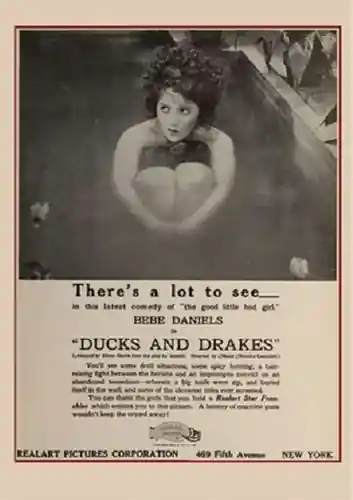
Edward Sloman’s 1923 curio opens with a monochrome iris shot that dilates like a lustful pupil, revealing Teddy Simpson’s boudoir: lace everywhere, yet the lace is black—mourning the death of sincerity. Within seconds Bebe Daniels glides into frame, her kohl-rimmed eyes twin rotary dials spinning toward any male voice that answers. She is not man-hungry; she is ennui-hungry, and men are merely the seasoning.
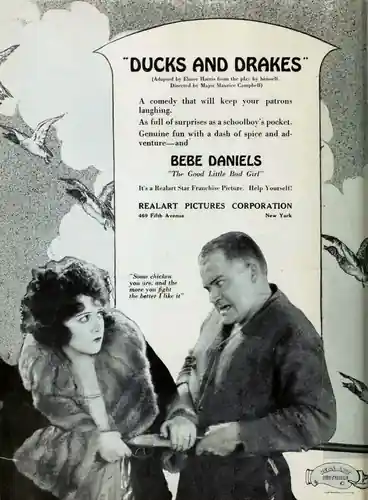
The Telephone as Both Sword and Mirror
In 1923 the phone was still a totem of modernity, a private umbilical cord to the unknown. Teddy treats it like a revolver loaded with flirtation, spinning the cylinder with each call. Notice how Sloman frames the apparatus: looming in mega-close-up, its brass mouthpiece glistening like a predatory bloom. When Teddy purrs “Operator, give me any man,” the subtitle card dissolves into animated waves that slap the screen—an avant-garde flourish predicting the liquid typography of Saul Bass by three decades.
The film’s gender politics skewer the era’s transactional courtship rituals. Each suitor arrives armed with a ledger of imagined debts: I sent flowers, therefore you owe matrimony. Teddy’s genius lies in refusing the ledger; she keeps the flowers, grinds them into perfume, and vanishes. One thinks of White and Unmarried where the heroine likewise weaponizes spinsterhood, yet Daniels adds arsenic-laced sugar—her smile says yes while her feet sprint the opposite direction.
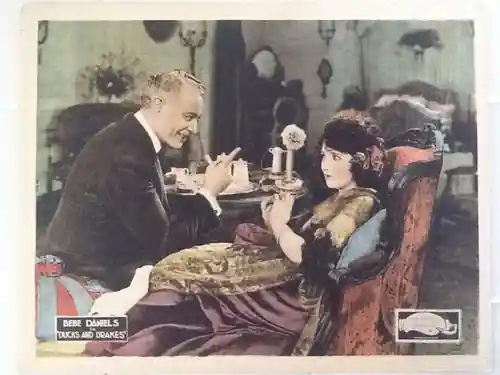
Bebe Daniels: Jazz-Age Chimera
Silent-era historians adore Gloria Swanson’s kabuki theatricality or Clara Bow’s red-hot magnetism, but Daniels operates in micro-gestures: the quarter-inch tilt of a cigarette holder, the eyelash flutter that lasts exactly three frames—too brief for deceit, too long for innocence. In the extended sequence where Teddy impersonates a stenographer, her fingers hover above an imaginary typewriter; the tension in her knuckles conveys the terror of wage-earning women forced to translate flesh into rent. No intertitle is needed—just the rattle of ghostly keys.
Jack Holt’s Rob Winslow could have been a bland foil; instead he plays obtuse gallantry like a violin with one string forever out of tune. Watch his gait when he enters the Ritz cloakroom: chest forward, hips lagging half a second behind—a man forever chasing his own silhouette. Their chemistry ignites not in clinches but in the negative space between bodies: a chasm of unspoken suspicion that feels shockingly contemporary.
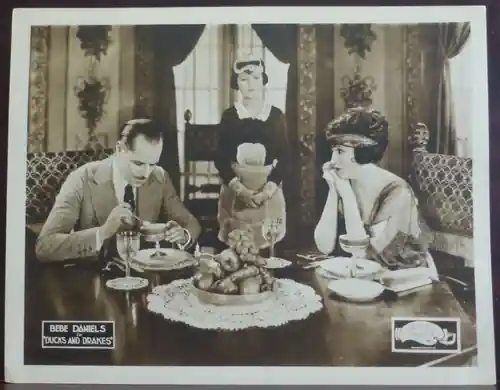
A Triptych of Would-Be Grooms
The three duped swains arrive as living caricatures of 1920s masculinity. First, Percy Williams’ monocled stockbroker, who compares women to “volatile preferred shares—buy on the margin, dump before crash.” Second, Wade Boteler’s doughy Midwesterner clutching a cigar like a life raft, his vowels stretching like taffy. Third, Edward Martindel’s erudite poet who quotes Swinburne between hiccups. Each embodies a distinct capitalist panic: capital, labor, culture—all convinced Teddy is their birthright.
Sloman crosscuts their convergences using a triple-split screen that anticipates 23 1/2 Hours’ Leave and its frantic time structures. The device is not gimmickry but thesis: suitors multiply like debt compounding at usurious interest. Meanwhile Carrie Clark Ward’s caustic aunt—think Maggie Smith dipped in bathtub gin—floats on the periphery, dispensing one-liners that could sever femoral arteries: “Marriage is a fine institution, but who wants to live in an institution?”
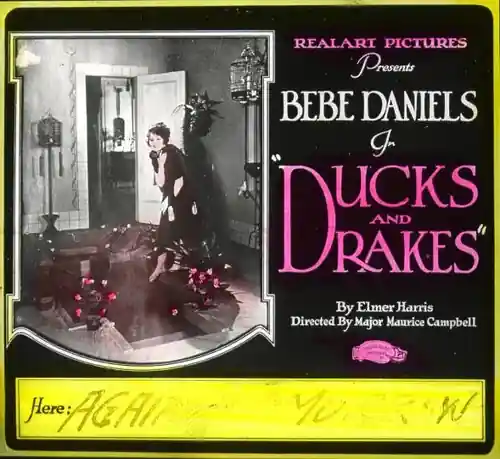
Climactic Carnival: Desire’s House of Mirrors
The finale detonates inside a seaside pavilion bathed in magnesium flares that bleach the frame ghost-white. A calliope wheezes out Ain’t She Sweet while Teddy, now clad in a sailor suit that mocks every gender expectation, leads her suitors through a maze of distorting mirrors. Each reflection elongates, compresses, liquefies their egos until they resemble cubist grotesques. In one astonishing shot, Daniels’ face fragments into seven iterations—an optical confession that identity itself is performance.
When the ruse collapses, the men form a sham tribunal, demanding “justice.” Teddy’s response? She flips the switch on the carnival’s electricity, plunging the scene into darkness. The next intertitle reads: “In the blackout, every woman is a widow—and every man a stranger.” The film ends not with a kiss but with a long shot of Teddy alone on the pier, shoes in hand, watching dawn smear vermilion across the Atlantic. Rob approaches, hesitates. She offers not her lips but her switchboard finger pressed to his—a promise that communication might yet replace ownership.
Visual Restraint, Sonic Resurrection
Surviving prints, housed at MoMA and the BFI, suffer from nitrate warping that curls the edges like burning parchment. Yet the damage intensifies the dream-drunk aura. Recent 4K scans stabilize the frame while preserving emulsion cracks that resemble lightning—fitting for a story about electric desire. Contemporary accompanists have scored the picture with everything from hot jazz to atonal prepared-piano; the best iteration remains Nora Kroll-Rosenbaum’s 2019 commission: a sultry tango that mutates into dissonant spectralism once the carnival lights die.
Compared to Sloman’s later The Ghost Breaker, Ducks displays far less baroque chiaroscuro, favoring instead the flat, bright lighting of consumer modernity—department stores, beach resorts, telephone exchanges. The austerity underscores the emotional vertigo: nothing to hide behind except social masks.
Sex, Satire, and the Hays Code Omen
Critics often peg 1923 as the last bacchanal before the hangover of censorship. Read today, Ducks feels prophetic: its ridicule of possessive romance anticipates the bureaucratic puritanism that would soon police hems and humor alike. The film’s very levity—its refusal to punish Teddy—probably hastened its disappearance from repertory houses once the Hays Office began wielding scalpels. One can imagine Will H. Hays screening this print, monocle fogging at the spectacle of female autonomy unscathed by moral retribution.
Yet subversion hides in plain sight. Note how each male claimant frames marriage as foreclosure on Teddy’s identity, whereas she envisions it as possible collaborative fiction—if negotiated nightly, never signed in perpetuity. In that reframing, the movie whispers a manifesto too radical for its own era and, frankly, for ours.
Where to Watch, How to Contextualize
As of 2024, the film streams on Criterion Channel in a 2K restoration paired with Plain Jane for a double bill of flapper rebellion. Physical media addicts can snag the region-free Blu from Kino Lorber, which packs an audio essay on early telephone erotica by media archaeologist Carolyn de la Peña. Avoid the YouTube bootlegs—those are transferred from 16mm TV prints where entire reels flicker like strobe lights.
For further rabbit holes, consult Shelley Stamp’s Lois Weber in Early Hollywood for gendered lenscraft, then dip into Thirty a Week to trace how wage anxiety threads through romantic comedies of the decade. Pairing Ducks with The Love Bug reveals a century-spanning obsession with courtship as consumer farce—though the Volkswagen in the latter lacks the erotic voltage of Daniels’ rotary dial.
Verdict: Ducks and Drakes is a champagne flute hurled against the mirror of monogamy—effervescent shards that still draw blood a century on. See it for Bebe Daniels’ incandescent scheming, stay for the sober recognition that the gendered power plays it skewers have merely migrated from candle-lit parlors to dating-app glow.