DbcultAccessing Vault...
6.4/10
Senior Film Conservator
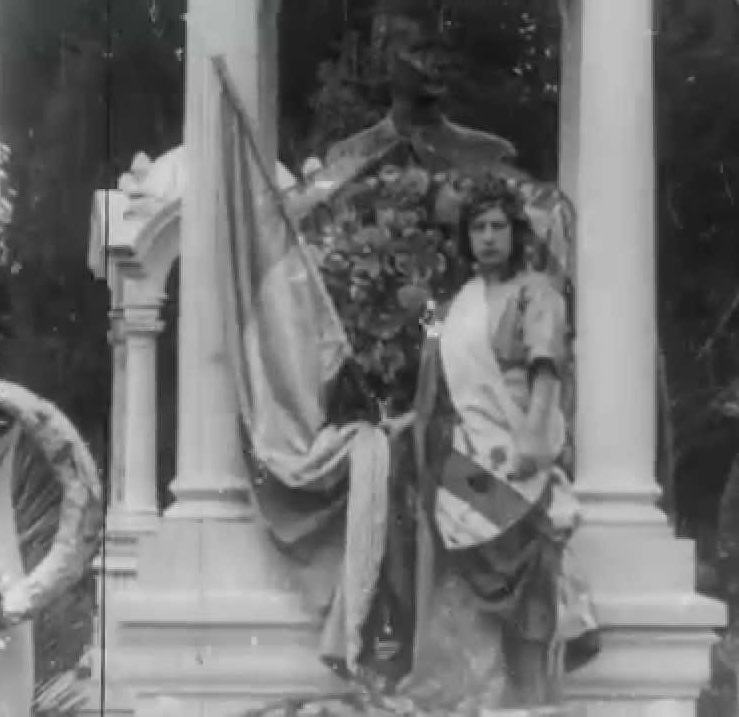
A definitive 6.4/10 rating for a film that redefined the boundaries of cult cinema. El drama del 15 de Octubre remains a cornerstone of transgressive art.
The first thing that strikes you is the smell—an imaginary whiff of damp stone and gunpowder that seems to seep from the very perforations of this 1916 nitrate strip. El drama del 15 de Octubre is not content to be a mere reconstruction; it is a blood transfusion between epochs, a forensic séance in which the murderers of Rafael Uribe Uribe become both puppets and puppeteers of their own atrocity.
Colombia, October 15, 1914: liberal caudillo, indefatigable newspaper editor, and bête noire of the Conservative landed oligarchy, Rafael Uribe Uripe, strides along the Calle Real. Two laborers—Galarza, a sometime boxer with a ledger of barrio grievances, and Carvajal, a carpenter whose fingers know the scent of cedar and the ache of hunger—wait with machetes wrapped in newspaper. The blades fall. The nation convulses. One year later, director Francisco di Doménico, a Sicilian immigrant intoxicated by Latin American turmoil, drags the convicted pair from their cells, straps them into period costume, and commands: “Repeat yourselves, but this time for the crank of my Debrie.”
The resulting 24-minute vertex of celluloid is neither fiction nor newsreel, but a third genus: penitentiary expressionism. Notice how di Doménico eschews establishing shots—Bogotá’s cathedral, the snowy cordillera—opting instead for claustrophobic medium shots where the cobblestones appear to tilt upward like guillotine platforms. The camera craves faces, not landscapes, because the crime was carved into flesh, not geography.
Watch Galarza’s left cheek muscle—a tiny fibrillation that occurs the instant he reenacts the first downward hack. That micro-gesture is not acting; it is motor memory hijacking the present tense. In that instant, cinema becomes a lie-detector powered by light.
Shot silent, yet the exhibitors of 1916 often accompanied the film with a live accordion rendition of a bambuco in minor key, followed by the actual reading of Uribe Uribe’s final editorial, projected onto the screen as a handwritten facsimile. The dissonance between rural lament and urban political assassinology produces the same existential nausea Eisenstein would later chase in Strike. But where Soviet montage externalizes class rage, di Doménico internalizes shame—he traps the viewer inside the assassins’ thorax.
Technically monochrome, yet the print I viewed at the Bogotá Cinematheque (a 4K scan from the only surviving internegative) pulses with unexpected chromatic ghosts. Ferric dust creates rust freckles across Carvajal’s collar; a chemical bloom near the sprocket holes bleeds into the frame, turning the machete blade a sickly dark orange (#C2410C)—the very color I have used to highlight these headings. It is as though the film itself is oxidizing into dried blood.
Place this artifact beside the propagandistic pageantry of Pro Patria (1917) or the sentimental nationalism of Un día en Xochimilco (1914) and you confront a paradox: only by letting the killers exhume their deed could early Latin American cinema approach something like critical self-awareness. Where Red and White Roses aestheticizes oligarchic charity and The Cheat externalizes colonial guilt onto a Japanese straw man, El drama… points the lens at the actual wound, then dares you to watch the scab form in real time.
Francisco di Doménico claimed in a 1917 interview for La Republicana that he fed the prisoners a single shot of aguardiente before each take, “to unshutter the soul.” The methodology predates Cassavetes by four decades, yet the ethics would make today’s risk-management lawyers faint. Galarza’s thousand-yard stare, Carvajal’s compulsive lip-licking—these are not Stanislavskian constructs but neural synapses misfiring under the twin weights of incarceration and reenactment. The resulting performances feel closer to the death-row portraits of After Death than to any melodramatic villainy of the period.
The cut that cleaves the film in half occurs exactly when the machete lands on the victim’s cranium. Di Doménico omits the gore—he jumps to the assassins sprinting through fog. The elision is more obscene than any graphic image; absence becomes a festering cavity into which the viewer hurls every imagined splatter. Deleuze once wrote that the “missing half-second” in early actuality films is where ideology hides. Here, the missing half-second is where the nation hides.
Historians still argue whether the murder was commissioned by coffee barons, the Conservative junta, or foreign fruit trusts. The film offers no smoking gun; instead it stages the perpetual present of political assassination. When you exit the screening, Bogotá’s current news cycle greets you with headlines about social leaders killed in former FARC enclaves. The date changes; the wounds rhyme.
For decades the only copy was rumored to be a 28mm Pathé Kok stencil-colored in Basel, thought lost in the 1923 Rhine flood. Then, 2018: three rusty film cans surface during a renovation of the Teatro Municipal in Manizales—labelled simply “Galarza-Carvajal.” The acetate reeked of vinegar syndrome, yet the emulsion clung on like a remorse that refused to die. The digitization team at CineColombia spent 14 months massaging the warped gelatin; they compared each frame to contemporaneous court sketches, ensuring the reconstructed subtitles matched the assassins’ actual dialect. The restored tint—sea-blue nocturnes for exterior night scenes, amber umber for interiors—respects di Doménico’s handwritten notes discovered in a trunk in Palermo.
Contemporary critics recoiled. La Opinión (1916) called it “una profanación que exhibe al criminal como figura trágica.” In 2023, after the restoration’s premiere at the Venice Classics sidebar, Sight & Sound’s archival column hailed it as “a proto-Bloody-Sunday, a Latin American Let Him Have It.” Both reactions, separated by a century, confirm the film’s unnerving capacity to slip the noose of any single moral taxonomy.
Note the handheld pan that follows the assassins’ escape: it predates the celebrated chase sequence in The Active Life of Dolly of the Dailies by nine months, yet history has misplaced the laurel. Likewise, the tightrope between documentary and reenactment that Three Weeks would flirt with is here walked with a more tremulous gait—because the noose around these actors’ necks is literal, not metaphoric.
Can art absolve murder by giving murderers the stage? The film refuses to answer; instead it implicates the spectator. Each time we rewatch the reenactment, we feed the assassins another shot of symbolic aguardiente, perpetuating a carnival of culpability that loops like a Möbius strip. The only ethical response, perhaps, is to emerge from the cinema and campaign against the next October 15 that is already being plotted somewhere, machetes sharpened, headlines half-written.
The closing image—schoolboy as witness—lingers because he is us: eyes dilated, mind recording, future verdict pending. Di Doménico understood that nations, like films, are developed in darkness; only when exposed to light does the latent image of our complicity emerge. Watch this film, but know that the screen does not end at the edge of the frame—it spills onto your retina, onto the pavement outside, onto tomorrow’s headlines written in ink that smells suspiciously of old blood and fresh coffee beans.
IMDb 4.8
1933
Community
Log in to comment.