DbcultAccessing Vault...
Cult Review
Senior Film Conservator
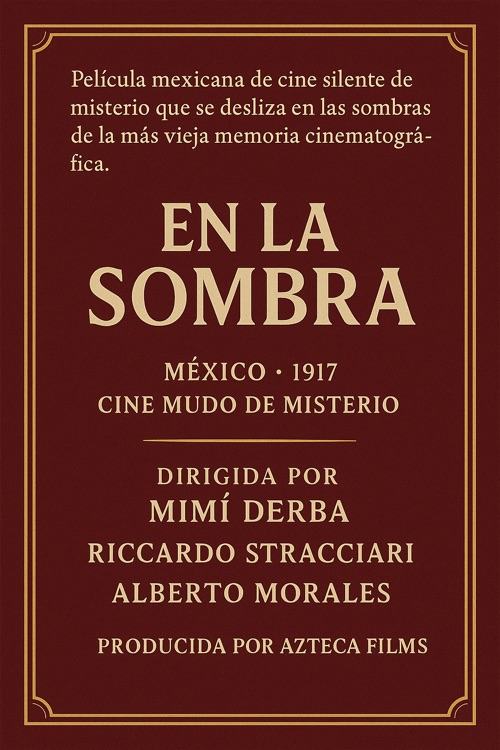
The year 1917 stands as a watershed moment in the global evolution of the moving image, yet within the specific context of Mexican cultural history, it represents something far more foundational. En la sombra is not merely a film; it is a manifesto of the Azteca Films era, a period when the cinematic medium began to shed its swaddling clothes and assert a unique, albeit operatically influenced, voice. To witness this film today is to engage in a form of archaeological cinephilia, unearthing the bedrock upon which subsequent generations of Latin American storytellers built their monuments.
The casting of Riccardo Stracciari is a masterstroke of historical irony. Known to the world as one of the preeminent baritones of his generation, his transition to the silent screen necessitates a profound recalibration of his artistic toolkit. In En la sombra, Stracciari’s performance is a masterclass in muscular restraint. Without the bellows of his voice to fill the auditorium, he relies on a kineticism of the brow and a calculated stillness that evokes a sense of impending doom. Unlike the frenetic histrionics found in many European imports of the time, such as the grandiloquent gestures in The Destruction of Carthage, Stracciari anchors the film with a grounded, almost subterranean intensity.
His presence provides a fascinating counterpoint to the more traditional stage-to-screen transitions seen in contemporary works like The Steel King's Last Wish. Where others might have faltered in the absence of sound, Stracciari utilizes the frame as a proscenium of silence, proving that the architecture of a face can convey more than the most resonant aria. His character, shrouded in the literal and metaphorical shadows of the title, becomes a vessel for the audience's own anxieties regarding the transparency of the self.
One cannot discuss this production without acknowledging the formidable shadow cast by Mimí Derba herself. As a co-founder of Azteca Films, Derba was not merely a performer but a visionary architect of the industry. Her performance in En la sombra is characterized by an ethereal vulnerability that masks an iron-willed resilience. She possesses a rare ability to navigate the treacherous terrain of melodrama without descending into the abyss of parody. Her interactions with Alberto Morales and Pilar L. Cotta create a complex emotional geometry that elevates the film beyond its narrative tropes.
In comparison to the female leads in The Soul of a Magdalen or Panthea, Derba offers a more nuanced interpretation of the 'suffering woman' archetype. She imbues her role with a specific Mexican sensibility—a mixture of stoicism and searing passion that would later become a hallmark of the Golden Age of Mexican cinema. The way she commands the space within the frame suggests a level of directorial influence that was rare for women in 1917, making her a true pioneer whose legacy is etched into every frame of this celluloid relic.
The cinematography of En la sombra is a revelation of light and shadow. The filmmakers utilize the limited technology of the era to create a visual atmosphere that feels both claustrophobic and expansive. The use of natural light filtering through heavy drapes, the stark contrasts of the interior sets, and the way the camera lingers on the negative space all contribute to a sense of pervasive mystery. It lacks the explosive scale of The Battle of Trafalgar, but it compensates with an intimacy that is almost voyeuristic.
This aesthetic choice is not merely decorative; it is intrinsically linked to the film's thematic core. The 'shadow' is a character in its own right, representing the secrets that the protagonists desperately try to conceal from the harsh light of societal judgment. This visual philosophy aligns the film more closely with the psychological depth of Called Back than with the more straightforward adventures of The Tiger. The directors understand that what remains unseen is often more terrifying and poignant than what is revealed.
When we place En la sombra alongside its contemporaries, its sophistication becomes even more apparent. While Sangre y arena deals with the visceral spectacle of the bullring, En la sombra opts for the internal spectacle of the soul. It shares a certain thematic DNA with A Mother's Confession, particularly in its exploration of familial duty and the weight of the past, yet it avoids the saccharine pitfalls that occasionally marred the latter. The film's pacing is deliberate, allowing the emotional stakes to simmer until they reach a boiling point, a technique that feels remarkably modern compared to the episodic nature of Conn, the Shaughraun.
Furthermore, the film’s moral ambiguity sets it apart from the more didactic offerings of the period. Unlike the overt optimism found in Happiness or the rigid moralizing of The Morals of Hilda, this work acknowledges the grey areas of human conduct. It suggests that virtue is not always rewarded and that the 'shadows' we inhabit are often of our own making. This cynicism, or perhaps realism, gives the film a weight that persists long after the final intertitle has faded.
It is easy for the modern viewer to dismiss the technical limitations of 1917—the flickering frame rates, the static camera placements, and the occasionally primitive editing. However, to do so would be to ignore the creative triumphs that emerged from these constraints. The creators of En la sombra utilized the frame with a precision that mirrors the meticulously staged compositions of The Flash of an Emerald. Every prop, from the ornate furniture to the delicate lace of a handkerchief, is imbued with narrative significance.
The film also manages to capture a sense of place that is distinctly Mexican, even within the confines of the studio. The texture of the walls, the specific style of the costumes, and the subtle gestures of the actors all ground the story in a recognizable reality. This is not the heightened, stylized world of The Broadway Sport; it is a world that feels lived-in and heavy with the weight of history. Even the secondary characters, such as those played by Alberto Morales, are given enough screen time to establish themselves as more than mere plot devices, creating a rich ensemble feel that was quite advanced for its time.
Reflecting on En la sombra requires a recognition of its precarious existence. Like many films from the silent era, it exists on the brink of erasure, its nitrate memories slowly decomposing. Yet, its influence remains palpable in the lineage of Mexican melodrama. The themes of hidden identity and social transgression would later be explored with more technical flourish in the 1940s, but the emotional blueprint was drafted here, in the shadows of 1917. It lacks the playful whimsy of Three Strings to Her Bow, but it offers something far more substantial: a mirror held up to the complexities of the human condition.
In the final analysis, the film is a testament to the power of collaborative art. The synergy between Stracciari’s operatic gravitas, Derba’s visionary production, and the technical ingenuity of the crew resulted in a work that transcends its era. It is a haunting, beautiful, and profoundly moving piece of cinema that deserves to be studied not just as a historical curiosity, but as a vital work of art. As we navigate our own modern shadows, the silent cries and whispered secrets of En la sombra continue to resonate, reminding us that the light of truth is often most visible when we are standing in the dark.
Final Verdict: A transcendent pillar of early cinema that proves silence is often the loudest medium of all. A mandatory viewing for anyone seeking to understand the roots of Latin American visual storytelling.
IMDb 5.5
1935
Community
Log in to comment.