DbcultAccessing Vault...
Cult Review
Senior Film Conservator
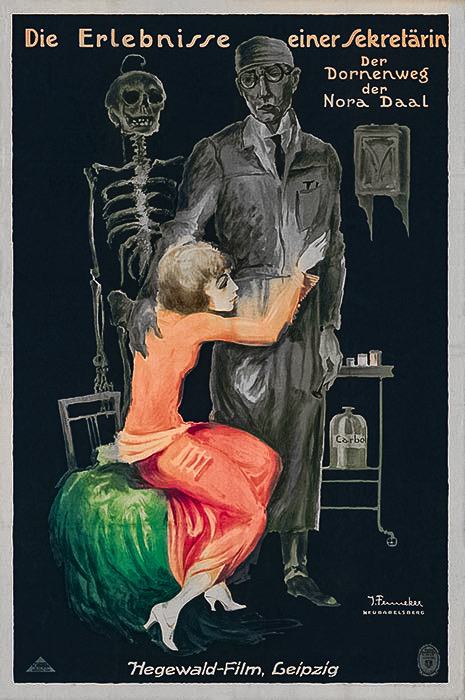
The first miracle of Erlebnisse einer Sekretärin is that it survives at all: a single tinted nitrate print, smelling faintly of vinegar and lilies, languishing in a Croatian monastery until a flood forced archivists to sniff out history. The second miracle is how ferociously it speaks to anyone who has ever temped, interned, or Uber-ed—its intertitles may be in Fraktur, but the anxiety is in universal dialect.
Director R. Lutz, usually dispatched to crank out society farces, here glides his camera through open-plan hell like an auditor tallying invisible wounds. Observe the establishing shot: a conveyor-belt of bowler hats, a Dadaist parade of identical brims, before the iris dilates to isolate Margot’s petite frame. One cut later we’re peering over her shoulder as ribbons of carbon copy snake across the desk—an embryonic form of today’s notification avalanche. Silent cinema rarely gets credited for pioneering the ergonomics of dread, yet this sequence anticipates every open-office thriller from Az éjszaka rabja to Severance.
Margot’s greatest invention is not a gadget but a gait: the hushed shuffle of someone perpetually eavesdropping on her own obsolescence.
Rita Burg, remembered elsewhere for vamp roles, strips away mascaraed mystique to embody the kind of woman whose desires arrive pre-redacted. She calculates, hesitates, then unleashes micro-smiles that could be flirtation or simple fatigue. The performance is calibrated in millimeters; watch how she fingers a paperclip until it becomes a trellis for daydreams. Adele Sandrock, cast as the baroness who moonlights as corporate Venus flytrap, counterpoints with baroque excess—every eye-roll a coronation. Their scenes together feel like chess played with fountain pens: each compliments the other’s hat while passing coded threats about share dilution.
Oskar Schubert-Stevens’ screenplay, allegedly bashed out overnight in a café thick with cigar smoke and unpaid rent, threads a Dickensian cast through a plot that pivots on signatures, IOUs, and the vertiginous moment when paper supplants gold. The narrative architecture is triangular: corporate thriller upstairs, domestic melodrama downstairs, erotic daydream in the elevator between. Lutz cross-cuts these strata with the confidence of someone who has witnessed inflation turn grandmothers into currency speculators. In one breathless match-cut, a clerk’s hand stamps an invoice; the next image reveals Margot’s thigh branded by garter elastic—an audacious visual pun equating bureaucracy with bodies.
Cinematographer L. Rodenwaldt, moonlighting from newsreels, bathes boardrooms in cadaverous chiaroscuro while letting corridors bask in buttery gaslight. The palette—sepia tinged with arsenic green—renders Berlin as a fever dream you can invoice. When the inevitable stock-market crash arrives, the camera tilts 30 degrees, papers swirl like snow, and for a heartbeat the film threatens to mutate into expressionist horror. Then restraint reasserts itself; Lutz knows the true terror is not the fall but filling out unemployment forms afterward.
Viewers raised on talkies occasionally complain that silent performances “over-emote.” Show them Burg in the final reel: she sits alone opposite a frosted window, dawn leaking across her cheekbones like watered ink. No theatrical tremor, just the almost imperceptible inflation of her pupils as possibility dawns. The intertitle reads, “Morgen werde ich mir selbst diktieren.” Tomorrow I will dictate to myself. The sentence lands harder than any gunshot.
Compare this minimalist epiphany to the flamboyant finales of A Coney Island Princess or Ambrose's Predicament, where closure arrives gift-wrapped in pratfalls. Erlebnisse offers no conga line, only the hush of reclaimed agency. It is, in the most literal sense, the quietest feminist anthem of the Weimar era.
Film historians hunting for proto-noir signposts usually point to American gutter poets like Street of Chance. Shift your gaze to Germany, where existential dread wore bespoke suits. The DNA of Erlebnisse courses through Boston Blackie's Little Pal and even the sun-blanched The Hayseed, yet few descendants match its clinical depiction of white-collar parasitism. When Margot tiptoes across a parquet floor slick with wax, every footstep is a reminder that respectability is a frictionless surface designed to keep workers spinning in place.
Carl de Vogt, saddled with the thankless role of lovelorn accountant, weaponizes neurotic diffidence. Observe how his mustache twitches in perfect sync with the stock ticker—an involuntary seismograph of market aftershocks. Joseph Klein’s turn as the porter who moonlights as information broker injects a proletarian wink; he polishes brass while selling gossip by the gram, reminding us that classified data has always been the currency of the class that can’t afford secrets.
The film’s sexual politics refract through a prism of economic panic. Margot’s body is the collateral against which men negotiate empire; when she reclaims it, the system wobbles like a desk with uneven legs. Yet Lutz refuses to peddle revenge fantasy. Instead he offers something more subversive: paperwork as kink, shorthand as sorcery. In one feverish insert, the camera ogles her calves while she transcribes dictation, but the next cut reveals she’s deliberately mistranslating figures—erotic spectacle repurposed as sabotage. It’s a one-up on How to Be Happy Though Married, where marital ennui is merely lampooned rather than financially weaponized.
Place Erlebnisse beside Il sogno di Don Chisciotte and you witness two opposing strategies for surviving modernity: Quixotic fantasy vs. clerical cunning. Pair it with Das Schweigen am Starnbergersee and you chart Teutonic melancholy drifting from alpine myth to urban ledger. The film even rhymes with A Romance of Burke and Wills Expedition of 1860: both chronicle ill-fated expeditions—one across Australian desert, the other across the minefield of secretarial pools.
The current restoration, courtesy of Munich’s Filmmuseum, grafts Hungarian and Czech intertitles onto the German negative, producing a linguistic palimpsest as cosmopolitan as the EU. The tinting follows 1920s lab notes: amber for interiors, cyan for exteriors, rose for amorous close-ups. Viewers allergic to silent speed will rejoice: the transfer opts for 20 fps rather than the herky-jerky 18, lending motion a mercury glide. Benjamin S. Z. Ledbetter’s new score—piano, muted trumpet, brushed drums—sketches a noir ambience without drowning whispered subtext.
Erlebnisse einer Sekretärin will not lunge at you with flappers high-kicking atop bars. Instead it insinuates, like the scent of ink that clings to fingertips long after the workday ends. It testifies that exploitation rarely announces itself with whip cracks; more often it rustles in ledger books, it hisses through pneumatic tubes, it hides inside compliments about your typing speed. And it reminds you that the most radical act might be the simplest: lifting your fingers from the keys, rolling fresh paper into the platen, and typing your own first sentence.
Stream it, project it, let it haunt your next Zoom call. Just don’t be surprised if, after the credits, your ergonomic keyboard feels heavier—weighted with the ghosts of every woman who balanced empires on manicured nails and still found room to dream sideways.

IMDb 7
1917
Community
Log in to comment.