DbcultAccessing Vault...
Cult Review
Senior Film Conservator
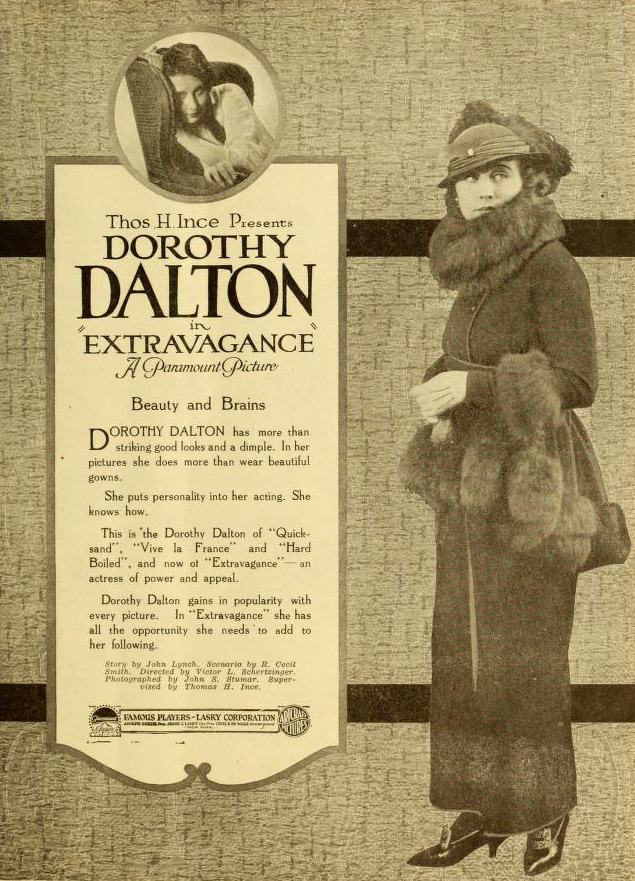
The year 1919 stood as a threshold between the Victorian remnants of the past and the roaring hedonism of the coming decade. In this liminal space, Extravagance emerges not merely as a piece of celluloid entertainment, but as a searing indictment of the sybaritic impulses that defined the American upper class.
Directed by Victor Schertzinger and featuring the luminous Dorothy Dalton, this film navigates the treacherous waters of social climbing and the psychological toll of fiscal deception. Unlike the more fantastical explorations found in contemporary works like The Forbidden Room, Extravagance roots its horror in the mundane reality of debt and the crushing weight of expectation. It is a film that breathes through its textures—the shimmer of a pearl necklace, the cold steel of a prison cell, and the frantic ink of a stock ticker.
At the heart of the narrative is Helen Douglas, portrayed by Dalton with a nuanced blend of naive entitlement and eventual spiritual awakening. Helen is the architect of her own domestic prison, her desires fueled by a New York culture that equates worth with visible wealth. The central conflict—a $30,000 pearl necklace—acts as a MacGuffin of moral decay. It is a physical manifestation of the "extravagance" the title warns against, a burden that Alan Douglas (J. Barney Sherry) attempts to carry until his knees buckle under the strain.
The film’s portrayal of Alan’s desperation is particularly poignant. As a broker, his life is governed by the ephemeral fluctuations of the market, a theme also explored with varying degrees of melodrama in The Black Night. In Extravagance, the brokerage firm is not just a place of business; it is an altar where men sacrifice their integrity to appease the gods of commerce. When Alan is pushed to the brink of embezzlement, the film transitions from a social drama into something far more avant-garde for its time.
The pivot point of the film—the extended dream sequence—is where Schertzinger’s directorial prowess truly shines. By plunging the audience into Helen's subconscious, the film bypasses the limitations of 1919 realism to present a surrealist cautionary tale. This technique, while less abstract than the later experiments in Satan on Earth, serves a similar purpose: to externalize the internal rot of the characters.
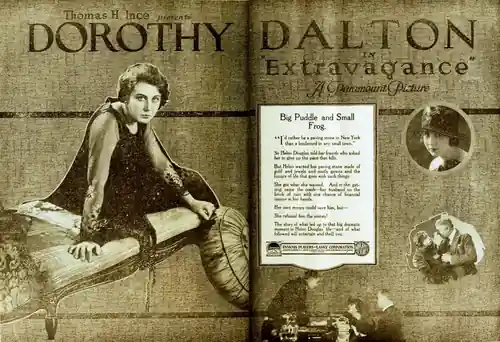
In this nightmare, the consequences of their lifestyle are accelerated. The arrest of Alan for embezzlement and the subsequent murder of a policeman are filmed with a stark, proto-noir intensity. The imagery of the electric chair is a jarring intrusion of institutional violence into the Douglas's manicured world. It reminds the viewer of the high stakes involved in social transgression, a theme often echoed in the tragic undertones of Maternità. The dream serves as a narrative purgatory, stripping Helen of her vanity and forcing her to confront the skeletal reality of her choices.
Dorothy Dalton’s performance during the Wall Street panic scene is a revelation. Upon awakening and rushing to Alan’s office, she finds herself in the midst of a financial cataclysm. The contrast between her internal clarity and the external chaos of the trading floor is handled with expert pacing. Her refusal to give Alan her savings—not out of spite, but out of a newfound understanding that money cannot save a soul already sold—is a daring narrative choice. It subverts the trope of the supportive wife, casting her instead as a moral gatekeeper.
Alan’s public denunciation of Helen in the brokerage house is a scene of visceral cruelty. It highlights the gendered expectations of the era, where a woman’s primary role was to facilitate her husband’s social ascent. In this regard, Extravagance shares a thematic DNA with Pamela Congreve, though it swaps the theatrical setting for the cold brutality of the financial sector. The public humiliation serves as the final shedding of their old identities, a necessary death before their eventual rebirth.
The recurring motif of Billy Braden (Philo McCullough) and his invitation to the West provides the film’s moral compass. The West, in the early 20th-century cinematic imagination, was often depicted as a site of purification, a place where the corruptive influences of the city could be washed away. This is a sentiment shared by the rugged individualism found in Davy Crockett. In Extravagance, the West is not just a geographical location; it is an ontological state of being—one defined by honesty, labor, and domestic peace.
When Alan finally accepts Helen’s offer to leave the city, the resolution feels earned rather than forced. The embrace that concludes the film is not one of romantic bliss, but of mutual survival. They have survived the "extravagance" of their own making, emerging scarred but enlightened. The film suggests that the only way to escape the cycle of greed is to abandon the system entirely, a radical message that still resonates in our own era of hyper-consumerism.
The lighting in Extravagance deserves special mention. The high-contrast shadows in the prison scenes and the soft, diffused glow of the Douglas's bedroom create a visual language of duality. This use of light to denote moral states was a hallmark of the era, seen also in The Secret Sin. The cinematography captures the claustrophobia of the New York apartment, filled with ornate furniture that feels more like museum artifacts than home comforts.
The editing during the dream sequence is remarkably fluid, transitioning between Helen’s pleading face and the cold machinery of justice. This rhythmic montage prefigures the Soviet experiments of the 1920s, demonstrating that American silent cinema was already grappling with complex psychological editing. While perhaps not as overtly stylized as Thais, Extravagance utilizes its visual grammar to reinforce its didactic purpose without becoming overly preachy.
Looking back from a century’s distance, Extravagance remains a potent reminder of the fragility of the social contract. It captures a moment in American history where the old world was dying and the new world was struggling to find its footing. The film’s critique of the "brokerage culture" is eerily prophetic of the 1929 crash that would follow just a decade later. In its depiction of a woman’s internal journey from vanity to virtue, it provides a fascinating companion piece to the works of writers like John Lynch, who frequently explored the intersection of personal morality and public reputation.
While some modern viewers might find the moralizing tone a bit heavy-handed, the emotional core of the film—the fear of losing oneself to the demands of the crowd—is universal. It is a film that asks us what we are willing to sacrifice for the sake of appearances, and whether we have the courage to walk away when the cost becomes too high. In the pantheon of silent cinema, Extravagance stands as a testament to the power of the medium to not only entertain but to provoke deep, often uncomfortable, self-reflection.
Final Thoughts: Extravagance is a haunting, visually arresting journey through the dark heart of the American Dream. Dorothy Dalton’s performance is a masterclass in silent era acting, and Schertzinger’s direction remains surprisingly modern in its psychological depth. It is a must-watch for anyone interested in the evolution of cinematic narrative and the timeless struggle between desire and duty.
IMDb —
1920
Community
Log in to comment.