DbcultAccessing Vault...
6/10
Senior Film Conservator
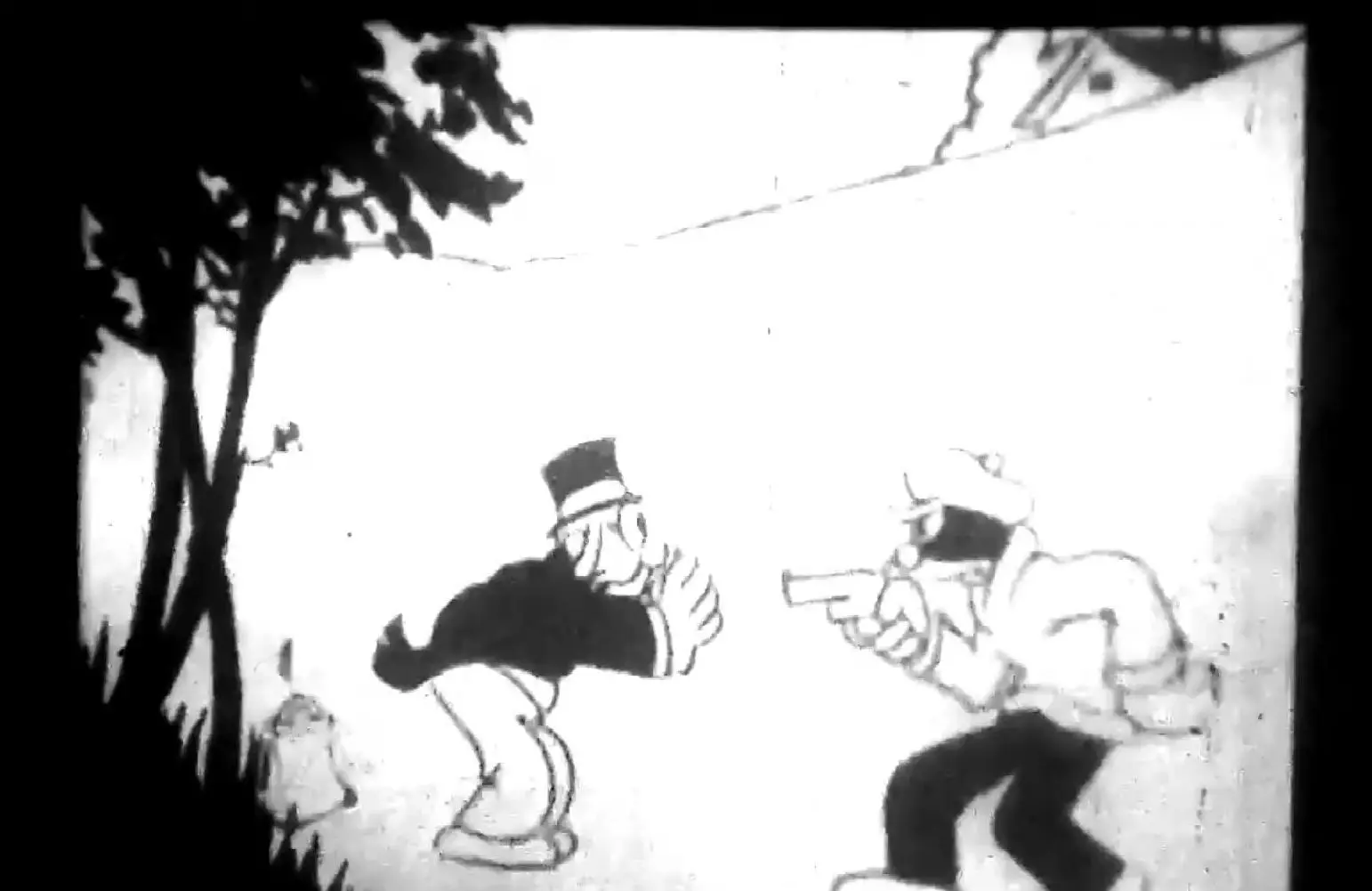
A definitive 6/10 rating for a film that redefined the boundaries of cult cinema. Felix Crosses the Crooks remains a cornerstone of transgressive art.
To witness Felix Crosses the Crooks is to step into a temporal rift where the laws of physics are merely suggestions and the inkwell is a gateway to the subconscious. Otto Messmer, the uncredited genius behind the Pat Sullivan brand, crafted a work here that is less a cartoon and more a visual manifesto on the malleability of reality. While the 1924 cinematic landscape was preoccupied with the crushing naturalism of Von Stroheim's Greed, Messmer was moving in the opposite direction, exploring a ludic space where a cat could become a suitcase, a question mark, or a weapon of the state with equal ease.
The film opens with a bank robbery, a trope already well-worn by the mid-twenties in films like Trigger Fingers. Yet, where a Western would rely on gunpowder and grit, Felix relies on anatomical subversion. By hiding inside the money sack, Felix creates a dualistic tension: he is both the prize and the hunter. This sequence is a masterclass in kineticism. The way the sack moves—lumpy, unpredictable, and imbued with Felix’s mischievous spirit—echoes the frantic energy found in The Storm (1922), but replaces the environmental terror with a rhythmic, slapstick grace.
The transition to the second vignette involving the sponge thief is where Messmer truly flexes his avant-garde muscles. In a world of silent drama, often characterized by the heavy moralizing of As a Man Sows, Felix offers a refreshing lack of piety. The introduction of an elephant to solve a retail crime is a non-sequitur of the highest order. It suggests a world where the animal kingdom is a decentralized police force, ready to be mobilized by the flick of a feline tail. The visual gag of the elephant’s trunk acting as a vacuum or a water cannon predates the sophisticated gadgetry of modern animation, yet it feels more organic, more tactile.
Consider the texture of the animation. The sponges, though rendered in simple black and white, possess a buoyancy that feels revolutionary for the era. When we compare this to the stiff, theatrical blocking seen in The Deemster, the fluidity of Felix becomes even more apparent. Messmer wasn't just drawing characters; he was drawing movement itself. Every frame is a testament to the potential of the medium to transcend the proscenium arch that still shackled much of live-action cinema at the time.
While Felix Crosses the Crooks appears lighthearted, it exists in a fascinating dialogue with the darker themes of its contemporaries. There is a sense of urban peril that mirrors the claustrophobia of In the Python's Den. The "crooks" are not merely caricatures; they represent a persistent anxiety of the 1920s—the threat to the burgeoning middle class and its institutions. However, Felix acts as a stabilizing force, a trickster god who protects the status quo through chaotic means. This juxtaposition of order and chaos is a recurring theme in Messmer’s work, providing a more optimistic counterpoint to the tragic inevitability of Whom the Gods Would Destroy.
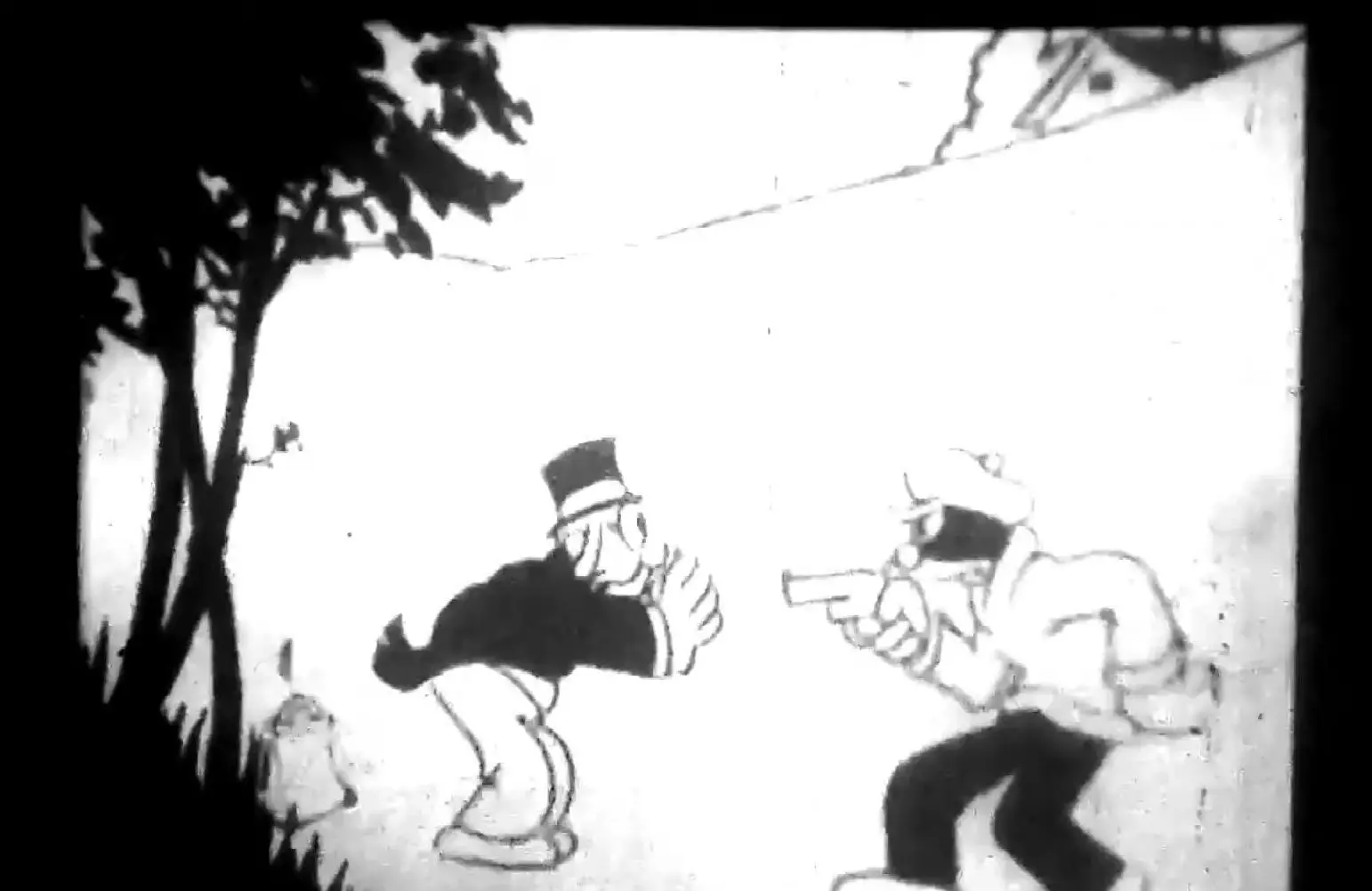
Furthermore, the film’s portrayal of the police is telling. In Hello, Judge, the legal system is often a source of comedy or frustration. In Felix’s world, the police are secondary to his own ingenuity. They are the cleanup crew for his brilliance. This elevates Felix from a simple pet to a Nietzschean superman of the inkwell, a figure who operates outside the standard moral confines of The Other Man's Wife or the rigid social structures of Der Leibeigene.
Technically, the film is a marvel of economy. Messmer’s use of negative space is profound. The black silhouette of Felix against the stark white backgrounds creates a high-contrast dreamscape that forces the viewer to focus on the silhouette's expressive potential. This is a far cry from the lush, often cluttered sets of Drama na okhote. In the world of Felix, less is infinitely more. A simple line can become a horizon, a tail can become a question mark, and a sack of money can become a character in its own right.
The pacing of the chase sequences is particularly noteworthy. There is a rhythmic quality to the movement that suggests a deep understanding of musicality, even in a silent medium. The beats of the action—the robbery, the concealment, the pursuit, and the final capture—follow a symphonic structure. One can almost hear the imaginary jazz score that should accompany Felix's frantic scurrying. This rhythmic sophistication is something that was often missing in the more ponderous dramas like The Man Unconquerable.
Looking back from a century’s distance, Felix Crosses the Crooks remains an essential artifact. It captures the transition of animation from a novelty to a sophisticated narrative form. While films like Flickering Youth were exploring the changing social mores of the decade, Felix was exploring the very boundaries of the imagination. He was the first true global superstar of animation, a character whose personality was so defined that it didn't need dialogue to convey complex emotions or intent.
The film also touches upon the concept of redemption and the outsider, themes prevalent in His Convict Bride. Felix, as a stray cat, is an outsider who earns his place in the social fabric by outsmarting those who seek to tear it down. He is the ultimate "skinner of skinners," a phrase that might recall the darker connotations of Skinning Skinners, but here it is played for laughs and triumph. Felix doesn't just catch the crooks; he makes them look ridiculous, stripping them of their power through the sheer force of his wit.
In the final analysis, Otto Messmer's work on this short is a defiant celebration of the medium's unique strengths. It shuns the literalism of the camera for the infinite possibilities of the pen. Felix remains an icon not because he is a cat, but because he is the embodiment of the creative spirit—unbounded, slightly dangerous, and perpetually crossing the crooks of reality to find a more interesting truth.

IMDb 2.2
1909
Community
Log in to comment.