DbcultAccessing Vault...
Cult Review
Senior Film Conservator
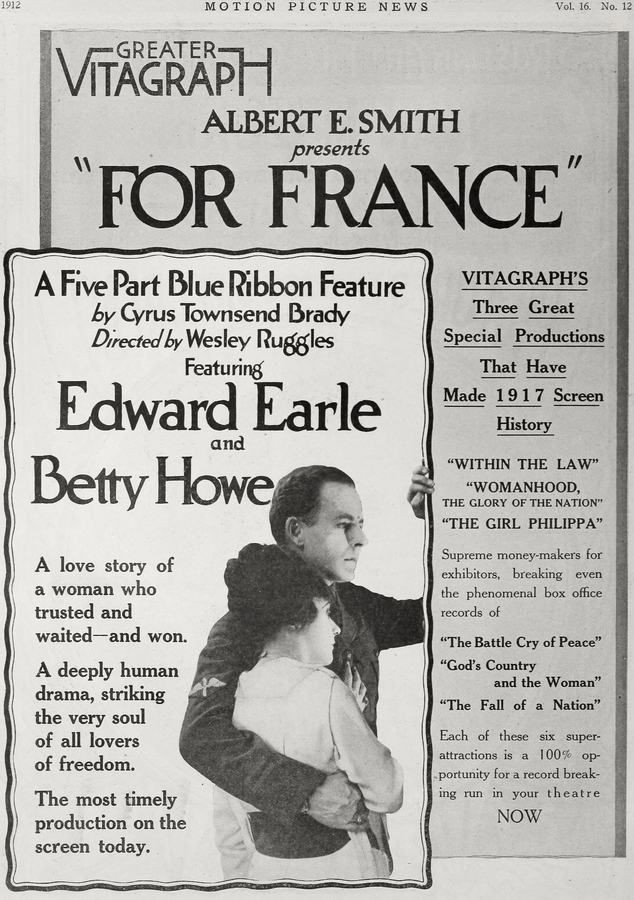
In the grand tapestry of early 20th-century cinema, few works capture the frantic pulse of a world in transition quite like the 1917 Vitagraph production, For France. Directed by Wesley Ruggles and penned by the formidable duo of Cyrus Townsend Brady and William B. Courtney, the film stands as a monumental artifact of its era—a time when the medium of film was beginning to grasp its immense power as both a narrative art form and a potent tool of geopolitical persuasion. To view this film today is to step into a time capsule, one that smells of cordite and lavender, capturing the agonizing friction between the dying Belle Époque and the industrial slaughter of the First World War.
The narrative architecture of the film is built upon the sturdy shoulders of Edward Earle, who portrays Gerald Ackland with a stoicism that feels distinctly American yet profoundly empathetic to the French cause. Ackland is not merely a soldier; he is a symbol of the burgeoning interventionist sentiment that was sweeping the United States in 1917. His journey from the disciplined halls of West Point to the chaotic skies over the Marne mirrors the nation’s own loss of innocence. When we first encounter him in Paris, there is a lightness to his character, a youthful exuberance that is quickly tempered by the shadow of the Pickelhaube. This transition is handled with a visual nuance that rivals the dramatic weight found in contemporary adaptations of Hamlet, where the internal struggle of the protagonist is projected onto the external landscape of a kingdom in decay.
One of the most striking aspects of 'For France' is its treatment of the French countryside. The farm near the Marne, where Martha Landeau (played with heart-wrenching vulnerability by Betty Howe) and her father flee, is initially depicted as a bucolic Eden. The cinematography utilizes soft lighting and wide shots to emphasize the connection between the people and the land. However, this tranquility is shattered with a violence that remains shocking even by modern standards. The German incursion is filmed not as a strategic military maneuver, but as a primal violation of the domestic sanctuary. Here, the film touches upon themes of purity and desecration that were also prevalent in the darker narratives of Unto the Darkness.
The sequence in which the German troops raid the Landeau farm is a masterclass in suspense. The pacing accelerates, the shadows lengthen, and the sense of impending doom becomes almost tactile. It is in these moments that we see the early fingerprints of Erich von Stroheim, whose presence in the film—even in a supporting capacity—adds a layer of sophisticated menace. Stroheim, who would later become one of cinema's greatest directors, already displays his penchant for detail and his ability to embody the 'villain you love to hate.' His portrayal of the German officer is devoid of caricature; instead, it is a chilling study in calculated cruelty, making the eventual intervention feel all the more cathartic.
The centerpiece of the film—the arrival of Gerald in his fighter plane—is a sequence that must have left 1917 audiences breathless. In an age where flight was still a miracle of the modern world, seeing a protagonist descend from the heavens like an avenging deity was a stroke of cinematic genius. The editing during the aerial attack is remarkably fluid for its time, eschewing the static compositions found in many contemporary stage-to-screen transitions like The Three Musketeers (1914). Instead, Ruggles opts for a dynamic perspective that places the viewer in the cockpit alongside Ackland.
This 'Deus ex Machina' from the clouds is not just a plot device; it is a thematic statement. It represents the triumph of modern technology over the barbarian hordes, a motif that recurred in many pro-war films of the period. Yet, the film is wise enough to recognize that a single victory does not end the war. The 'troubles' that follow the rescue are a sobering reminder of the long, bloody slog that characterized the Western Front. The narrative avoids the simplistic 'happily ever after' tropes found in lighter fare like A Man's Man, opting instead for a gritty realism that honors the sacrifice of those who fought.
When comparing 'For France' to other significant releases of the era, such as The Perils of Pauline, one notices a distinct shift in tone. While 'Pauline' relied on episodic thrills and high-stakes adventure, 'For France' is deeply rooted in a sense of national tragedy and moral duty. It shares a certain kinship with The Flaming Sword in its exploration of characters pushed to their psychological limits by external catastrophes. The performances, particularly that of Mary Maurice as the matriarchal figure, provide an emotional anchor that prevents the film from drifting into mere propaganda.
The screenplay by Cyrus Townsend Brady is particularly noteworthy for its lexical richness. Even in the silent medium, the intertitles carry a weight of poetic gravitas. Words like 'rapacious,' 'gallantry,' and 'conflagration' are used to frame the action, elevating the film from a simple war story to an epic poem of resilience. This linguistic sophistication is often missing in more commercial ventures like The Lotus Dancer or the more whimsical Mice and Men. Brady’s background as a clergyman and historian shines through, as he imbues the script with a sense of moral urgency and historical weight.
Visually, the film is a feast of high-contrast lighting and meticulously designed sets. The contrast between the sun-drenched fields of the Marne and the claustrophobic, smoke-filled trenches creates a visual rhythm that mirrors the emotional arc of the characters. The use of tinting—a common practice in the silent era—is employed here with surgical precision. Deep blues for the night sequences and sepia tones for the domestic scenes help to guide the audience's emotional response. It’s a technique that would be further refined in European cinema, as seen in the atmospheric Das lebende Rätsel or the intense Ludi i strasti.
The technical challenges of filming aerial combat in 1917 cannot be overstated. Without the benefit of lightweight cameras or CGI, the filmmakers had to rely on genuine stunt flying and ingenious camera mounts. This lends the film a verisimilitude that modern blockbusters often lack. When Gerald’s plane dives toward the German positions, the sense of speed and danger is authentic. It’s a far cry from the more grounded, character-driven dramas like Wolf Lowry or the rural tensions of The Call of the Cumberlands. 'For France' aims for the horizon and, more often than not, reaches it.
While some modern viewers might find the film’s earnestness a bit jarring, it is important to contextualize 'For France' within the cultural landscape of the time. The film was released just as the United States was mobilizing for war, and its portrayal of the 'Huns' and the 'Noble Frenchman' was designed to galvanize public opinion. However, beneath the surface-level messaging lies a deeply human story about the choices we make when our world is set on fire. It explores the same existential dread found in The Leap of Despair, yet offers a glimmer of hope through the act of courageous intervention.
The chemistry between Edward Earle and Betty Howe is palpable, providing a romantic core that sustains the film through its more harrowing sequences. Their love is not a frivolous thing; it is a bond forged in the fires of conflict, much like the relationships depicted in Panna Meri. As they navigate the 'endless troubles' that follow the initial rescue, we see their characters evolve from archetypes into flesh-and-blood individuals who are scarred, both physically and emotionally, by their experiences.
In conclusion, 'For France' is an essential viewing for anyone interested in the evolution of cinema. It is a film that balances spectacle with soul, and propaganda with poetry. It reminds us that even in the darkest hours of history, there is a place for individual heroism and the enduring power of the human spirit. Whether you are a fan of historical dramas or a student of film technique, this 1917 gem offers a wealth of insight and a visceral cinematic experience that transcends its silent origins. It is a testament to the fact that while the technology of filmmaking may change, the stories that resonate most are those that speak to our shared vulnerabilities and our capacity for extraordinary bravery.
Note: For those exploring the darker side of early 20th-century morality plays, I also recommend looking into The Devil at His Elbow, which provides a fascinating counterpoint to the themes of duty and temptation present in Ackland’s journey.
IMDb 6.3
1935
Community
Log in to comment.