DbcultAccessing Vault...
6/10
Senior Film Conservator
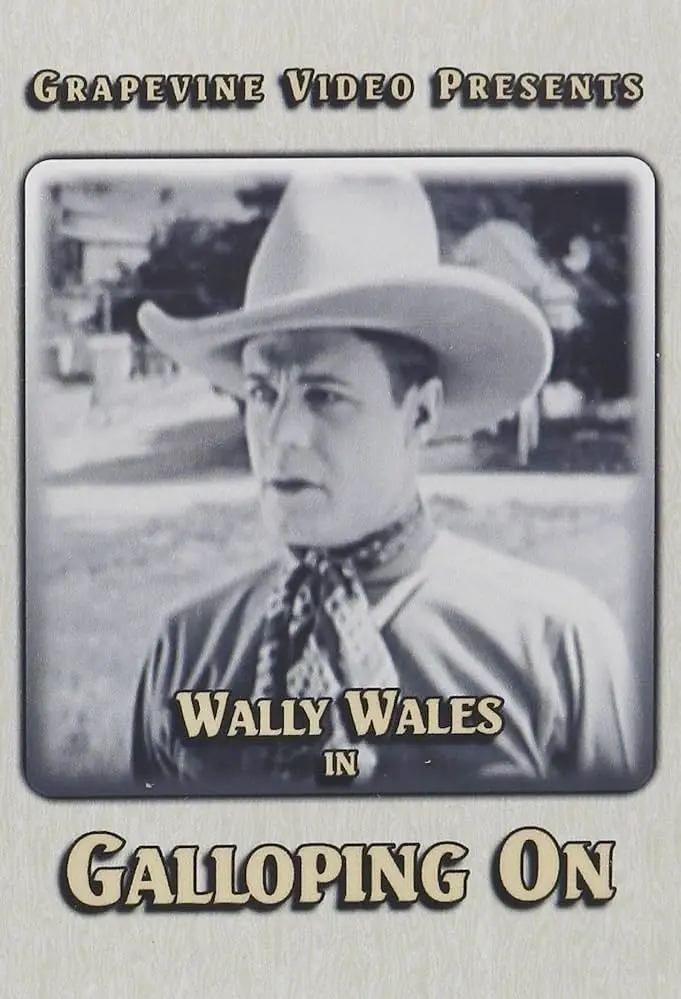
A definitive 6/10 rating for a film that redefined the boundaries of cult cinema. Galloping On remains a cornerstone of transgressive art.
In the dusty annals of the silent Western, few films capture the raw, unvarnished desperation of the wrongly accused with the same muscularity as Richard Thorpe’s 1925 endeavor, Galloping On. This isn't merely a horse opera; it is a claustrophobic exploration of systemic corruption disguised as a frontier adventure. When Hal Taliaferro—performing under the evocative pseudonym Wally Wales—strides back into a town that has already written his epitaph, we aren't just watching a protagonist return; we are witnessing the resurrection of a grievance. The film functions as a precursor to the neo-noir sensibilities we might find in something like Sneakers, where the possession of a single piece of incriminating information (or in this case, a physical note) dictates the survival of the characters.
The narrative architecture is built upon the treacherous alliance between Banker Brown and the outlaw Bowers. This synthesis of legitimate capital and illicit violence creates a vice from which Wally cannot easily escape. Unlike the more romanticized depictions of the West, Thorpe presents a world where the law is a malleable tool for the wealthy. This theme of the innocent man crushed by the gears of a rigged system echoes the tragic undertones of La Destinée de Jean Morénas, where the weight of a false accusation carries the gravity of a death sentence. Wally’s initial brawl with Bowers is choreographed with a visceral intensity that eschews the theatricality common in the mid-20s, landing more like a desperate struggle for breath than a standard hero-villain exchange.
What distinguishes Galloping On from the myriad of B-Westerns of its era is the psychological weight of the 'note.' In a world before digital footprints, the physical paper trail was the ultimate arbiter of truth. Banker Brown’s possession of the note implicating Bowers in Wally’s original 'crime' represents a fascinating dynamic of mutually assured destruction. It’s a high-stakes game of leverage that feels surprisingly modern. While The Carpet from Bagdad dealt in the exoticism of stolen artifacts, Thorpe deals in the gritty reality of stolen reputations. The bank robbery sequence is the film’s centerpiece, staged with a frantic energy that justifies the title’s 'galloping' moniker.
The casting of Jessie Cruzon as Helen provides the film with its necessary moral pivot. In an era where female characters were often relegated to the background, Helen’s agency is the catalyst for the third act. Her decision to free Wally after witnessing the bank robbery is an act of rebellion against the town’s corrupt status quo. This subversion of the 'damsel' trope reminds me of the assertive energy found in Tempest Cody Turns the Tables. Helen isn't waiting to be saved; she is the one doing the saving, facilitating Wally's transition from a caged animal to a force of singular vengeance.
Richard Thorpe, who would later become a workhorse for MGM, displays an early mastery of pacing here. The way he cuts between the Sheriff’s posse being lured out of town and the simultaneous robbery creates a mounting tension that feels almost symphonic. There is a rhythmic quality to the editing that mirrors the hoofbeats of the climactic chase. Compared to the more languid pacing of Pagan Passions, Galloping On is a lean, mean machine of a movie. It doesn't waste time on superfluous subplots or romantic interludes that don't serve the central conflict of the 'note' and the 'name.'
The cinematography, though limited by the technology of 1925, manages to capture the isolation of the frontier. The wide shots of Wally riding alone against the gang emphasize his status as an outcast—a man against the world. This visual isolation is a recurring motif in silent cinema, often used to signify moral purity in a corrupt environment, much like the protagonist in A Prince in a Pawnshop who must navigate a world of transactional ethics. The grit on the faces of the Bucko brothers and Slim Whitaker adds a layer of authenticity that elevates the film above its Poverty Row origins.
If we look closer, Galloping On is a sharp critique of early American capitalism. Banker Brown isn't just a villain; he is a symbol of institutional rot. His willingness to frame an innocent man to protect his financial interests is a narrative thread that remains painfully relevant. While a film like American Maid might explore the social aspirations of the era, Thorpe’s film looks at the dark underbelly of those aspirations. The bank isn't a sanctuary of community wealth; it's a fortress of secrets. The fact that the outlaw Bowers has to rob the bank to get his own incriminating evidence back is a delicious irony—the criminal is forced to commit a crime against his own co-conspirator to maintain the illusion of his innocence.
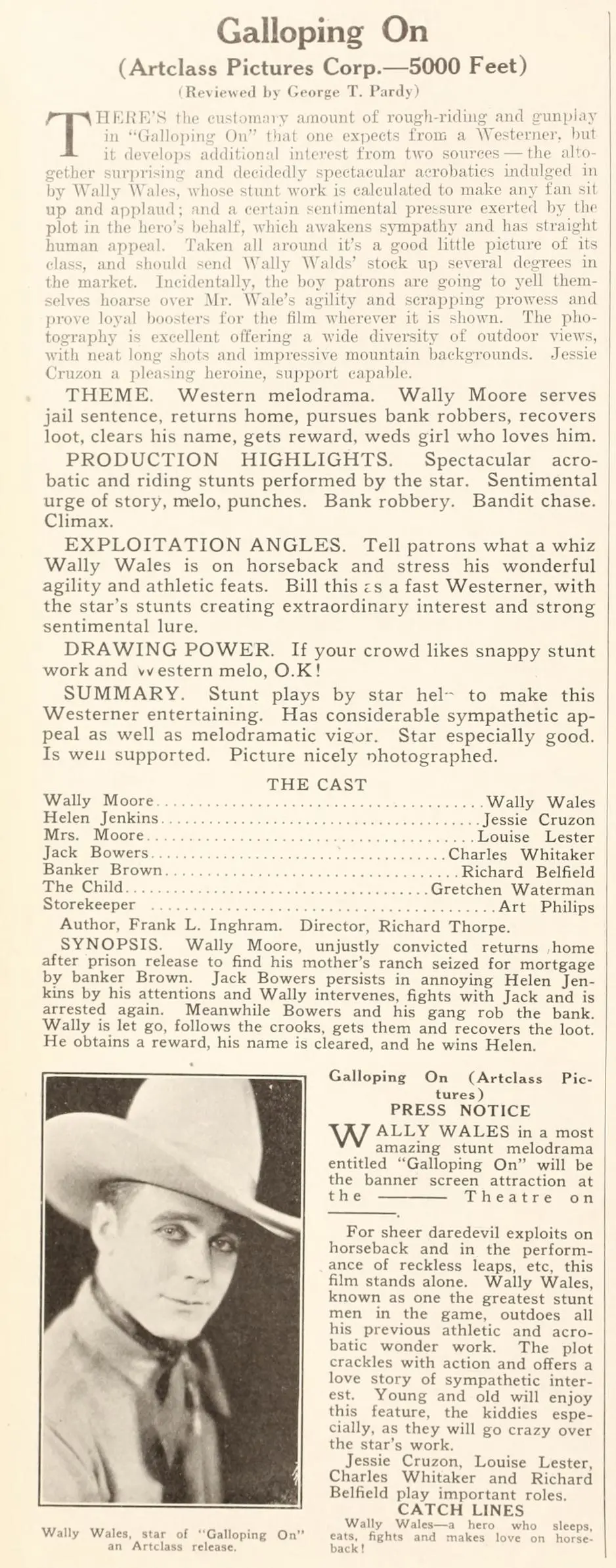
The film also touches on the theme of communal blindness. The townspeople, represented by the easily distracted posse, are quick to believe the worst of Wally. This mob mentality is a frequent target of silent-era social dramas, such as No Woman Knows, which examines the harsh judgments of a closed-off society. Wally’s struggle is not just against Bowers’ gun, but against the collective assumption of his guilt. His 'galloping' is an attempt to outrun a reputation that has been manufactured by his enemies.
Hal Taliaferro’s performance is a masterclass in silent screen presence. He possesses a rugged, stoic quality that perfectly suits the role of a man who has had everything taken from him. There is a hardness in his eyes that suggests the years spent behind bars weren't just a period of waiting, but a period of sharpening. His physicality in the final chase is genuinely impressive, performing stunts that would make modern actors recoil. In contrast to the more polished, 'pretty boy' leads of A Very Good Young Man or the whimsical charm of The Lucky Devil, Taliaferro brings a sense of genuine peril to the screen.
The supporting cast, including the likes of Slim Whitaker, provides a textured backdrop of villainy. These are men who look like they’ve spent their lives in the saddle and the saloon. Their presence gives the film a groundedness that prevents the plot from feeling too much like a melodrama. The interactions between the gang members have a rough-hewn quality, suggesting a hierarchy based on violence and greed rather than loyalty. This lack of honor among thieves is what ultimately leads to their downfall, a common trope that Thorpe exploits to maximum effect.
When we place Galloping On alongside its contemporaries, its efficiency becomes even more apparent. While The Battle of Jutland was capturing the massive, impersonal scale of naval warfare, Thorpe was focused on the intimate, high-stakes conflict of a single man’s honor. One is a macro-view of history; the other is a micro-view of the human spirit. Even when compared to the more fantastical elements of An Amateur Devil or the romantic wandering of The Gypsy Trail, Galloping On feels remarkably grounded in its stakes. It doesn't need devils or gypsy trails to create magic; it just needs a horse, a gun, and a man with nothing left to lose.
The film’s resolution, involving the retrieval of the note and the vindication of Wally, is satisfying not because it is happy, but because it is earned. The final confrontation isn't a clean, choreographed duel, but a messy, desperate scramble for survival. It reflects the reality of the era—a time of transition where the old ways of the gun were slowly being replaced by the new ways of the bank and the ledger. Thorpe’s direction ensures that we feel every mile of the journey, every ounce of the betrayal, and every moment of the hard-won redemption.
Ultimately, Galloping On stands as a testament to the power of the silent Western to tell complex, morally ambiguous stories. It avoids the easy path of black-and-white morality by showing how the 'white-collar' criminal can be just as dangerous, if not more so, than the man with the mask. It is a film that rewards close viewing, revealing layers of social commentary beneath its action-packed exterior. For those looking to understand the evolution of the genre, or for those who simply appreciate a well-told tale of justice, this 1925 gem is essential viewing. It reminds us that while the technology of filmmaking has changed drastically, the core elements of a great story—betrayal, courage, and the relentless pursuit of truth—remain timeless. Like the protagonist himself, the film keeps galloping on, long after the credits have faded into history.
Reviewer's Note: For more explorations of early cinema's technical nuances, consider viewing Bag Filmens Kulisser or the emotional depth of Till We Meet Again.
IMDb —
1928
Community
Log in to comment.