DbcultAccessing Vault...
Cult Review
Senior Film Conservator
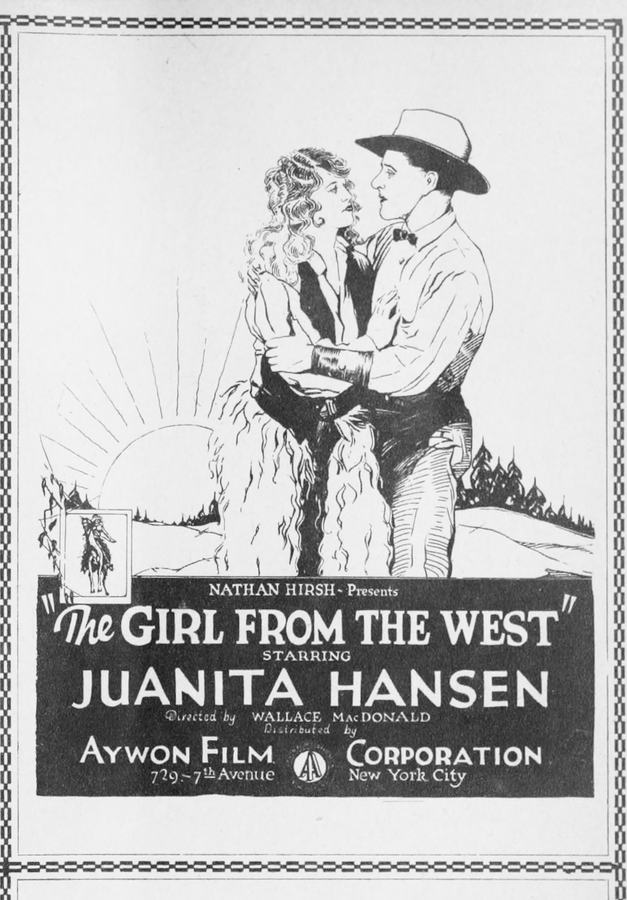
In the nascent years of American cinema, the juxtaposition of the civilized East and the primordial West served as a recurring crucible for the national psyche. Girl from the West, directed with a keen eye for atmospheric tension by Carter DeHaven, stands as a quintessential artifact of this thematic obsession. It is not merely a tale of romantic rivalry; it is a visual treatise on the malleability of character when confronted with the unforgiving vastness of the frontier.
The narrative commences within the claustrophobic, albeit refined, corridors of an Eastern college. Here, we find our protagonist—a man whose erudition is viewed as a liability rather than an asset in the eyes of the woman he loves. Juanita Hansen portrays the titular girl with a mercurial grace, her performance oscillating between maternal affection for her suitor and a yearning for the atavistic strength symbolized by her Western paramour. This dynamic creates a palpable tension, suggesting that the 'civilized' man is somehow incomplete without the baptism of dust and danger.
The script, penned by DeHaven himself, avoids the simplistic tropes often found in contemporary works like Doorsteps. Instead, it posits that the 'tenderfoot' is a chrysalis awaiting the right environmental pressure to emerge as a hero. This psychological depth is a hallmark of the era's better Westerns, echoing the rugged stoicism found in The Virginian.
The casting of Jack Richardson provides the film with its necessary grit. Richardson, a veteran of the silent screen, brings a seasoned authority to the proceedings that anchors the more melodramatic elements of the plot. His presence acts as a foil to A. Edward Sutherland’s initial fragility. Sutherland’s portrayal of the Easterner is nuanced; he does not merely play a caricature of weakness but rather a man out of his element, struggling to find a new vernacular of bravery.
The cinematography captures the transition from the manicured lawns of the East to the jagged, sun-bleached landscapes of the West with a stark clarity. One cannot help but compare the visual lexicon here to the more ethereal qualities of A léleklátó sugár, though DeHaven opts for a more grounded, visceral aesthetic that prioritizes the physical reality of the range over metaphysical abstraction.
As the narrative shifts to the rangeland, the film accelerates into a high-octane procedural of the plains. The introduction of the notorious cattle rustlers provides more than just a plot device; it offers a moral landscape for our protagonist to navigate. Unlike the social machinations found in The Social Pirates, the conflicts in the West are binary and lethal. There is no room for the polite obfuscation of the college salon.
The sequence involving the capture of the rustlers is choreographed with a surprising degree of kinetic energy for the time. It avoids the static staging that plagued many early Westerns, utilizing the terrain to create a sense of tactical depth. This segment of the film mirrors the intensity of The Raiders of Sunset Gap, yet it maintains a focus on the protagonist's internal evolution rather than just the spectacle of the chase.
When analyzing Girl from the West against the broader tapestry of silent cinema, its commitment to the 'strenuous life'—a Rooseveltian ideal—is unmistakable. It shares a certain DNA with Fighting Through, where the reclamation of masculinity is inextricably linked to the conquest of the wild. However, DeHaven’s work is arguably more sophisticated in its treatment of the female gaze. The 'girl' is not merely a prize to be won; she is the arbiter of value, the one who defines what constitutes a 'true' man in this burgeoning American mythology.
Contrast this with the more fatalistic undertones of Slave of Desire or the gothic sensibilities of Der Eid des Stephan Huller. Girl from the West is fundamentally optimistic, a testament to the belief that the American character is forged in the fires of adversity. It lacks the cynicism of The End of the Road, choosing instead to celebrate the triumph of the will over social expectation.
Carter DeHaven, primarily known for his comedic sensibilities, demonstrates a surprising aptitude for the Western genre. His pacing is deliberate, allowing the audience to feel the slow burn of the Easterner’s frustration before exploding into the third-act action. The editing, while rudimentary by modern standards, effectively builds suspense during the rustler pursuit. The use of natural light, particularly in the wide shots of the prairie, evokes a sense of loneliness that underscores the protagonist’s initial isolation.
One might find parallels in the staging of The Texan, but DeHaven’s film feels more intimate, focusing on the specific emotional arc of the 'tenderfoot' rather than the broad strokes of a sprawling epic. Even the secondary characters, often relegated to the background in films like The Lotus Woman or The House Without Children, are given moments of distinct personality here, contributing to a world that feels lived-in and authentic.
Ultimately, Girl from the West is a film about the shedding of skins. The protagonist must discard his Eastern sensibilities—the very things that made him a success in one world—to survive in another. This narrative arc would go on to become a staple of the genre, influencing countless iterations of the 'city slicker' trope. Yet, in this early manifestation, it feels fresh and urgent. The performance of Juanita Hansen, often overlooked in the annals of silent film history, provides a necessary emotional core, reminding us that for all the gunfights and horse chases, the heart remains the ultimate frontier.
The film’s conclusion, while satisfying the generic requirements of a happy ending, leaves the viewer with a lingering sense of the cost of this transformation. To become the hero the girl desired, the Easterner had to kill a part of himself. This subtle complexity elevates the film above mere popcorn entertainment, placing it alongside works like The Innocence of Lizette in its exploration of lost purity. It is a work of significant cultural import, a celluloid bridge between two Americas that, even today, struggle to understand one another.
For those captivated by the evolution of the Western hero, this film is an essential viewing experience. It captures a moment in time when the boundaries of the genre were still being drawn, and the definition of a 'man' was as vast and varied as the landscape itself. Whether compared to the intrigue of La fuga di Hai-San or the raw energy of Like Wildfire, Girl from the West maintains its own unique, rugged charm.
IMDb 5.8
1921
Community
Log in to comment.