DbcultAccessing Vault...
Cult Review
Senior Film Conservator
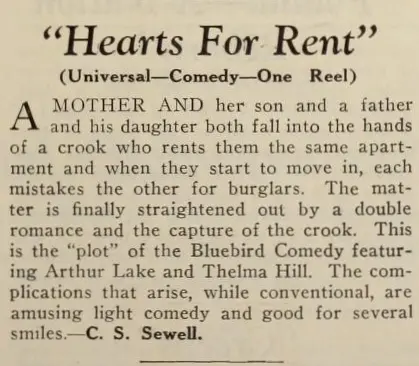
Does 'Hearts for Rent' still hold up as a comedy for modern audiences? Short answer: yes, but primarily as a masterclass in physical timing rather than a narrative powerhouse.
This film is for enthusiasts of silent-era slapstick and those interested in the early career of Arthur Lake. It is certainly NOT for viewers who require complex character arcs or high-definition spectacle to remain engaged.
1) This film works because the chemistry between Arthur Lake and Thelma Hill transforms a thin premise into a kinetic, high-energy confrontation.
2) This film fails because the antagonist—the crook who sets the plot in motion—is discarded too quickly, leaving a narrative vacuum in the final act.
3) You should watch it if you want to see how early cinema utilized single-location sets to maximize tension and humor simultaneously.
The setup of 'Hearts for Rent' is surprisingly modern. The fear of being scammed in a housing market is a timeless anxiety, and here, it serves as the engine for a classic farce. Unlike the heavy drama found in The Pitfall, this film keeps the stakes light but the movement heavy.
Arthur Lake plays the male lead with a gangly, nervous energy that would later define his iconic role as Dagwood Bumstead. He isn't a hero; he's a victim of his own optimism. Thelma Hill, conversely, brings a sharp, reactive presence to the screen. She isn't just a foil; she is an equal participant in the chaos.
The moment they both enter the apartment is a lesson in blocking. The director uses the depth of the frame to keep them inches apart without seeing one another. It’s a bit of a stretch. But it works because the actors sell the suspense of the 'intruder' in the next room.
Yes, 'Hearts for Rent' is worth watching for anyone curious about the evolution of the 'meet-cute.' While modern romantic comedies use dialogue to bridge gaps, this film uses a shared fear of burglary. It is a fascinating look at how 1920s cinema turned a stressful situation into a comedic ballet.
The film excels in its middle ten minutes. The sequence where they both attempt to 'defend' their territory using household objects is genuinely inventive. It lacks the dark undertones of Sherlock's Home, opting instead for pure, unadulterated whimsy.
Arthur Lake’s performance is the backbone of the production. His ability to convey internal panic through external elasticity is remarkable. In one specific scene, he discovers a woman's hat and reacts with a physical shudder that seems to vibrate his entire frame. It is a level of commitment to a gag that we rarely see in contemporary performance.
Contrast this with the more stoic performances in Enemies of Women. Lake is never still. His performance is a constant stream of consciousness expressed through his limbs. It is exhausting to watch, but undeniably effective for the medium.
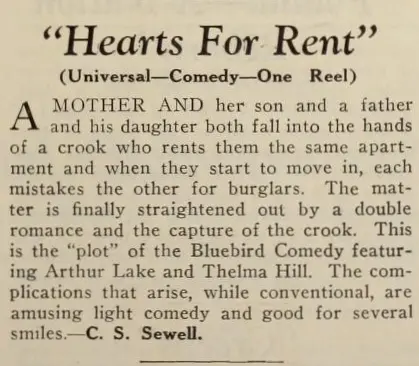
Thelma Hill provides the necessary grounding. While Lake is the balloon, Hill is the string. Her reactions to his 'burglar' antics provide the audience with a relatable perspective. When she finally realizes he isn't a criminal, her transition from terror to indignation is seamless.
The cinematography in 'Hearts for Rent' is functional but clever. The use of low-key lighting during the initial 'break-in' sequence creates a sense of genuine peril. This isn't the high-concept visual storytelling of The Virgin of Stamboul, but it understands how to use a single set effectively.
The pacing is relentless. At roughly 20 minutes, there is no room for subplots or filler. This brevity is its greatest strength. Unlike Together, which takes its time to build a world, 'Hearts for Rent' drops you straight into the conflict and doesn't let go until the credits roll.
One surprising observation: the film actually tackles the concept of gendered space. Both characters feel an immediate sense of ownership over the apartment. Their battle isn't just about a misunderstanding; it's a fight for the only piece of 'home' they have in a cold city.
The chemistry between Lake and Hill is palpable even without a single line of spoken dialogue. The physical comedy is refined and avoids the 'mean-spirited' violence sometimes found in earlier shorts like Fighting Blood. Furthermore, the set design is remarkably detailed for a comedy short, making the apartment feel lived-in and real.
The plot is a skeleton. If you remove the physical gags, there is almost nothing left. The crook character is a missed opportunity for a recurring threat. Additionally, the film relies heavily on the 'coincidence' factor, which might grate on viewers who prefer more logical narrative progression, such as that seen in The Master Key.
When placed alongside other films of the time, such as Daring Love or Bonds of Love, 'Hearts for Rent' stands out for its lack of melodrama. It doesn't want to make you cry or contemplate the human condition. It wants to make you laugh at the absurdity of a bad situation.
It shares some DNA with Sic 'Em Brownie in its use of domestic disruption, but it is far more focused. There is a purity to the 'two people in a room' format that forces the actors to carry the entire weight of the production.
The 'mistaken burglar' trope was already well-worn by 1928, yet this film manages to find new life in it. By making both characters the 'victim' of a third party, it removes the malice from their conflict. We aren't rooting for one to beat the other; we are rooting for them to realize they are on the same team.
This is a sharp contrast to the more aggressive conflict in The Unblazed Trail. In 'Hearts for Rent', the humor comes from vulnerability. Arthur Lake’s character is terrified, and his attempts to be 'brave' are where the biggest laughs are found. It is a very human kind of comedy.
"Hearts for Rent is a lean, mean, comedy machine that proves you don't need a massive budget to create a memorable experience. It is a loud movie that doesn't make a sound."
While it may not have the philosophical depth of Munkens fristelser or the political weight of Tseka komissar Mirostsenko, it succeeds in its primary goal: entertainment. It is a snapshot of a time when cinema was perfecting the art of the gag.
The ending is rushed. The logic is thin. But the joy is real. If you have twenty minutes to spare, you could do far worse than watching Arthur Lake try to fight a 'burglar' who is actually just a confused woman with a rental agreement.
IMDb —
1920
Community
Log in to comment.