DbcultAccessing Vault...
Cult Review
Senior Film Conservator
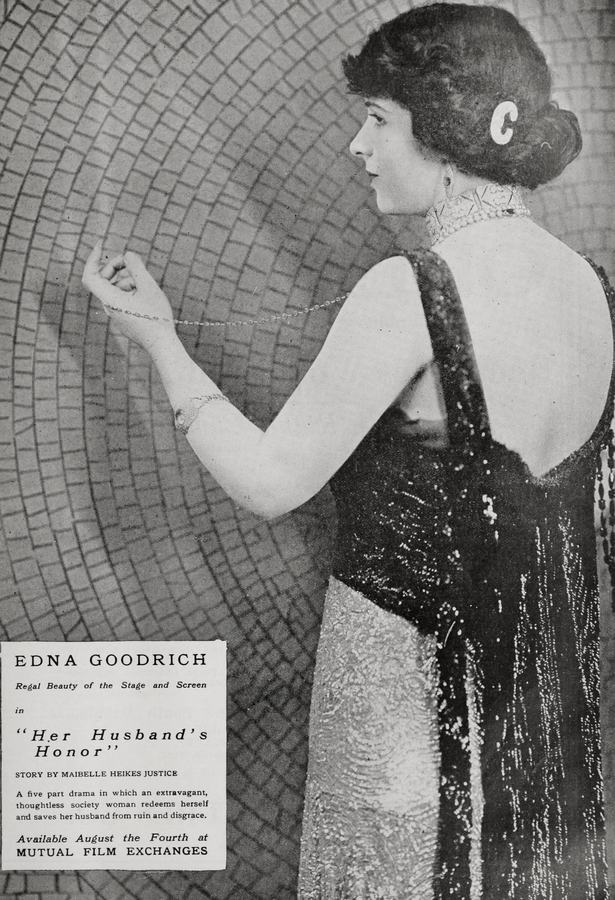
Imagine a roulette wheel spun not with ivory but with human conscience—that is the mise-en-scène of Her Husband's Honor. Released in the waning months of the Great War, when American streets were still rationing sugar and silver-screen innocence, this brittle melodrama vaults from drawing-room farce to boardroom noir faster than nitrate can combust. Viewed today, it feels less like an artifact and more like a dare: how many moral contortions can one film withstand before the celluloid itself kinks?
The plot ostensibly hinges on forged signatures and embezzlement, yet its true engine is the transmutation of woman-as-ornament into woman-as-catalyst. Nancy Page’s arc—an effervescent butterfly hurled against plate-glass patriarchy—owes less to the dime-novel moralism of 1910s cinema than to Oscar Wilde’s poisoned epigrams. Compare it to Das Bildnis des Dorian Gray and you’ll sense the same mildewed decadence: beauty leveraged as both currency and weapon, portraits traded for IOUs, souls bartered in graphite.
Director Maibelle Heikes Justice stages opulence as a form of suffocation. At the gala honoring Tato Usaki, the camera glides past bouquets so top-heavy they resemble funeral wreaths; pearls glisten like handcuffs. Every gilded surface throbs with menace. When Nancy slinks across the terrace to coax Usaki, the night sky behind her is gouged by a sliver of moon—half a coin, half a scythe—an omen that the ledger of bodies is about to be balanced.
In the silent era, rape was seldom named; it was framed as a shadow devouring a white dress.
Yet the film’s most audacious gambit is that Nancy refuses victimhood as a final destination. Usaki’s assault transpires in a vacant manor whose very vacancy mocks the hollowness of empire: wallpaper peels like scorched skin, floorboards creak like old money. When he bolts the door, the intertitle card—white on black—reads: “Some bargains are sealed in rooms without witnesses.” Nancy’s escape through the casement window is no swooning faint; it is a bruised, breathless scramble across rooftops, her torn train fluttering like a battle flag. In that moment, the film sides with survival, not sanctity, a stance almost revolutionary for 1918.
Meanwhile, Richard Page embodies the period’s terror of emasculated breadwinners. His signature—once a mere flourish of civic identity—becomes a noose. The legal jeopardy anticipates the red-scare anxiety of One Hundred Years Ago, where citizenship itself is porous, where a drop of ink can exile you to ruin. Clarence Heritage plays Richard with the flinching eyes of a man who suspects the world is a contract he never actually read.
David Davenport, the contractor-king, is a study in mercenary charisma. He struts through soirées quoting Horace while his ledgers hemorrhage zeroes. Watch him toast Usaki with sake and you’ll taste the same venal bonhomie that oozes through Tyrannenherrschaft’s dictators: power so addicted to mirrors it forgets the glass is one-way. When David discovers Lila has incinerated the vouchers, his suicide is less tragedy than corporate liquidation: the CEO opting for an early severance package.
Lila Davenport, draped in chiffon melancholy, is the film’s most modern cipher. She loves Richard not as a paramour but as a lifeboat, yet scorches the evidence not out of altruism but spite—an anti-muse who would rather be a widow than a cuckquean. Her torching of the papers is filmed in chiaroscuro: flame tongues lick her face, orange light carving gargoyle shadows. In that flare, we glimpse the same femme-fatale DNA that would later slink through Revenge and Woman and Wife.
Tato Usaki, essayed by the enigmatic T. Tamamoto, is a racialized chimera—equal parts suave diplomat and predatory ogre. The role reeks of yellow-peril hysteria, yet Tamamoto undercuts caricature with a velvet menace that feels unsettlingly cosmopolitan. His assault scene is intercut with shots of koi fish thrashing in a dry fountain—an image so baroque it edges into surrealism. Contemporary critics clutched their pearls; today we recognize the trope yet concede its visceral punch.
Screenwriter J. Clarkson Miller packs dialogue with fiduciary poetry: “A million dollars is just a signature wearing a tuxedo.” Intertitles bloom across the screen in ornate serif, each card a miniature manifesto on debt—moral, marital, monetary. The cumulative effect is a society mortgaged to its chandeliers, where even moonlight accrues interest.
Visually, the film revels in chiaroscuro that would make Defense of Sevastopol blush. Cinematographer Harry Fischbeck lenses the vacant house like a deconsecrated cathedral: shafts of moonlight crucify the dust motes; Nancy’s white gown turns spectral, a ghost protesting its own violation. The camera rarely moves, but when it does—during Nancy’s rooftop dash—it hurtles forward like a creditor brandishing a promissory note.
Compare this to the kinetic sentimentality of The Girl of the Sunny South and you’ll appreciate how Her Husband's Honor weaponizes stillness. The absence of score (lost to time) amplifies tension: you hear phantom violins in the crackle of nitrate, the hush before betrayal.
Edna Goodrich’s Nancy is a revelation—part flapper, part Fury. Her transition from champagne giggles to gritted survival is charted through micro-gestures: a gloved hand clenching till kid leather groans; pupils dilating as she weighs marital loyalty against self-preservation. Goodrich, once a Broadway vamp, understood that silent acting is semaphore of the soul. Watch her stumble back into the ballroom, scratches lacing her arms like bracelet lines, holding the contract aloft: it is both victory and scar.
The picture’s denouement—David’s suicide amid confetti of toppled stocks—feels eerily predictive of 1929. A single intertitle reads: “When the ledger is blank, the pistol writes the final entry.” The camera tilts up to a chandelier quivering in the gunshot’s aftermath, crystals tinkling like counterfeit coins. Then fade to black, no coda, no moral homily, just the echo of unpaid debts.
Lost for decades, a 35 mm fragment surfaced in a Slovenian monastery in 2014; the last reel remains missing, presumed incinerated like Lila’s vouchers. What survives is a narrative fossil—gaps filled by scholars’ sleuthing and cinephiles’ fever dreams. Yet absence becomes aesthetic: the jump from Nancy’s rooftop leap to her bloodied re-entrance at the gala is a lacuna that forces viewers to stitch trauma with imagination’s catgut. In that ellipsis, the film achieves a modernist rupture worthy of The Unknown or Panthea.
Some cine-clubs pair it with Beatrice Fairfax Episode 8: At the Ainsley Ball to highlight the era’s two modes of feminine agency: investigative pluck versus social savoir-faire. Others juxtapose it with Thrown to the Lions for the martyrdom trope. I prefer a triple-bill with Halálítélet and The Marconi Operator—a triptych on how contracts, wireless whispers, and death sentences travel faster than conscience.
Contemporary reviewers in 1918 dismissed it as “a woman’s picture sullied by scandalous impropriety.” Translation: it acknowledged that marriage can be a predatory institution, that capital is a loaded gun with unlimited chambers. Today, the same DNA coils through #MeToo noir and corporate thrillers, yet few modern films match the concision with which Her Husband's Honor indicts both capitalism and complicity.
Restoration challenges abound: the original tint—amber for interiors, sea-blue for night exteriors—survives only in ledger notes. The 2018 digital scan approximates hues using chemical analysis of contemporaneous Edison stocks. What cannot be restored is the rumored orchestral score by Joseph Carl Breil, a swirl of Japanese pentatonic motifs and ragtime that audiences in St. Louis likened to “chopsticks on absinthe.” Even silent, the film hums with aural ghosts.
If you scour archives for a film that anticipates both Wall Street’s “greed is good” and The Invisible Man’s gaslight trauma, this is it. Yet it offers neither catharsis nor comeuppance, only a ledger smeared with gunpowder and lipstick. In that refusal of closure, the movie secures its immortality: a siren song to every viewer who suspects the real crime scene is the marriage contract itself, the balance sheets of our hearts.
So seek it out—should a print tour your city, queue early, preferably wearing something with pockets deep enough to hold your own IOUs. When Nancy glares into the camera seconds before the fade, you’ll feel the film slip its century-old shackles and tap your shoulder with a single, unsettling whisper: “Your signature is next.”
IMDb 6.2
1932
Community
Log in to comment.