DbcultAccessing Vault...
Cult Review
Senior Film Conservator
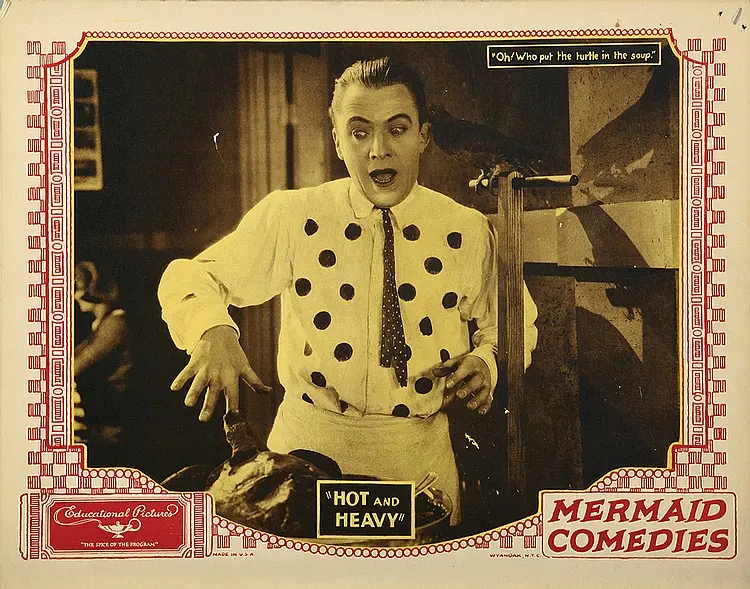
Is Hot and Heavy worth your time in the modern era? Short answer: No, unless you are an obsessive archivist or a student of physical comedy history. This 1925 short is a frantic, often disjointed relic that serves more as a historical curiosity than a piece of enduring entertainment. It is for the silent film completist; it is not for someone seeking the narrative sophistication of a feature-length masterpiece.
This film works because it captures the raw, unpolished energy of the Vaudeville-to-screen transition. This film fails because its central premise relies on a logic-defying coincidence that never quite earns its keep. You should watch it if you want to see Eddie Nelson at the height of his physical dexterity, navigating a world that feels increasingly hostile to the wandering performer.
The concept of the 'accidental hero' is a staple of silent cinema, but in Hot and Heavy, it feels particularly cynical. Eddie Nelson plays a man who doesn't just stumble into success; he is gifted it by a literal act of God—or at least, a poorly maintained telegraph pole. This isn't the calculated, balletic luck of Buster Keaton. It’s messier. It’s more violent. When the pole falls on the bouncer (played with hulking menace by Otto Fries), the impact is played for laughs, but the underlying desperation of Nelson’s character remains palpable. Unlike his work in The Rough Lover, Nelson here feels less like a romantic lead and more like a survivor.
The scene where the townspeople congregate around the fallen bouncer is a fascinating look at mob psychology. They don't check for a pulse; they look for a champion. Nelson, standing there looking bewildered, is immediately canonized as the town’s new tough guy. The cinematography in this sequence is functional, providing wide shots that capture the scale of the cafe's exterior, but it lacks the expressive shadows found in contemporary dramas like Tess of the D'Urbervilles (1924). Here, the sun is high, the shadows are harsh, and the comedy is broad.
If you are looking for a laugh-out-loud experience that rivals modern comedy, the answer is a firm no. However, if you are interested in the evolution of the bouncer archetype, it offers a unique perspective. The film asks: what happens when the 'weakest' man in the room is given the authority of the 'strongest'? The comedy arises from the friction between Nelson's internal terror and his external bravado. It is a one-note joke, but Nelson plays that note with surprising conviction. For a better exploration of social standing and deception, one might look toward A Double-Dyed Deceiver, which handles these themes with more nuance.
Most of the film’s runtime is spent within the confines of the Blue Bird Cafe. The set design is a marvel of 1920s economy—a few tables, a counter, and enough breakable props to ensure a lively climax. Estelle Bradley provides a brief but necessary romantic interest, though her character is largely sidelined in favor of the impending violence. The cafe represents a safe haven that Eddie Nelson’s character is constantly on the verge of destroying. Every time he attempts to perform his duties as a bouncer, there is a palpable sense of dread. He is a fraud, and the film excels at building the tension of his inevitable exposure.
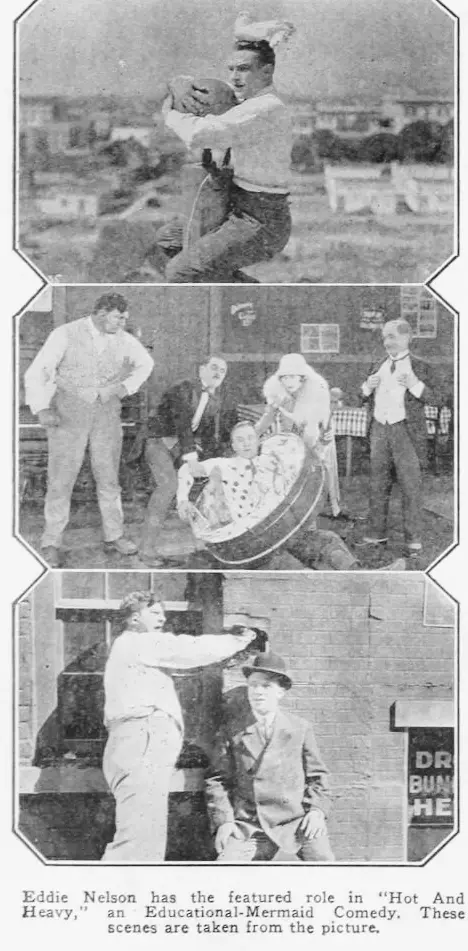
The pacing here is relentless. Unlike the slower, more atmospheric builds in The Blue Moon, Hot and Heavy moves with a frantic, almost nervous energy. This reflects the Vaudeville background of the writers and stars. Every few minutes, a new physical gag must be introduced to keep the audience engaged. Whether it's Nelson trying to look intimidating while drinking a cup of coffee or his awkward attempts to flirt with Bradley while keeping an eye on the door, the film never stops moving. It is exhausting, but it is never boring.
The climax of the film, where the original bouncer returns with his gang, is a masterclass in low-budget stunt work. This isn't the refined martial arts of modern cinema; this is a 'general melee' in the truest sense of the word. Bodies fly over tables, chairs are splintered, and the frame is often crowded with so many actors that it becomes difficult to track Nelson himself. This chaos is intentional. It mirrors the breakdown of the order that Eddie’s lie had established. The film doesn't offer a clean resolution. It ends in a heap of broken wood and bruised egos.
One surprising observation is the lack of a clear 'hero's journey.' Nelson doesn't learn a lesson. He doesn't become truly brave. He simply gets caught. This lack of a moralistic ending is refreshing, especially when compared to more sentimental shorts of the era like Hearts and Arts. In Hot and Heavy, life is a series of accidents, and sometimes those accidents have teeth. The brutality of the final fight is a stark reminder that in the world of 1925 slapstick, the punchline often left a bruise.
Pros:
The film features excellent physical performances from Otto Fries and Eddie Nelson. The use of real-world objects (the telegraph pole) as comedic catalysts adds a layer of 'danger' that modern CGI cannot replicate. It provides a fascinating look at the Blue Bird Cafe set, which is a perfect example of early 20th-century interior design on film.
Cons:
The plot is paper-thin and relies on a singular coincidence to drive the entire narrative. The female lead, Estelle Bradley, is given almost nothing to do. The pacing in the middle act drags significantly as the film waits for the bouncer to wake up and recruit his gang. It lacks the cleverness found in other shorts like Amor e Boemia.
Hot and Heavy is a loud, messy, and occasionally brilliant piece of slapstick history. It doesn't have the heart of Chaplin or the technical genius of Keaton, but it has a grit that is uniquely its own. Eddie Nelson is a compelling lead, even if the script fails him at times. It’s flawed. But it works as a time capsule. If you can find a clean print, it’s worth a look for the final brawl alone, but don't expect it to change your life. It is a film about a man who gets lucky, and as a viewer, you have to hope for a bit of that luck to find the humor in its dated execution.
"A chaotic reminder that in 1925, the only thing heavier than the comedy was the furniture being thrown at the actors."
IMDb —
1926
Community
Log in to comment.