DbcultAccessing Vault...
7.1/10
Senior Film Conservator
A definitive 7.1/10 rating for a film that redefined the boundaries of cult cinema. I promessi sposi remains a cornerstone of transgressive art.
The first time you see Renzo’s silhouette scaling the empty night streets of Lecco, you understand that Mario Bonnard’s 1922 adaptation is not content with merely retelling Italy’s national novel—it wants to inhabit its bloodstream.
A thunderous intertitle slams onto the screen: "Il potere dei forti si nutre dei sogni dei deboli." In that instant, the film declares its manifesto—power is photogenic, oppression cinematic, and hope a flicker begging for close-up. Shot when Mussolini’s Blackshirts were already marching through public squares, I Promessi Sposi smuggles republican defiance into historical costume, a subtext so volatile that censors demanded the removal of entire reels depicting bread riots and clerical corruption. Fortunately, the print survived, and contemporary restorations allow us to witness what early spectators hailed as "Il Kolossal del Silenzio."
Visually, the movie luxuriates in chiaroscuro worthy of Caravaggio. Cinematographer Giuseppe W. Freda turns candlelit cellars into cavernous moral arenas, while dawn-lit fields shimmer like holy parchment. The camera stalks characters through arcaded streets, past murmuring laundry lines, into echoing cathedrals whose vaulted ceilings dwarf human desire.
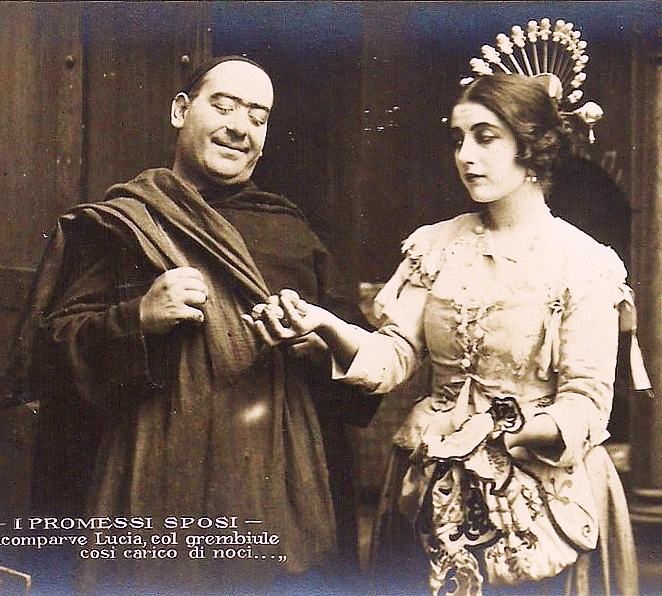
Rodolfo Badaloni’s Renzo is all kinetic nerves, a man whose arms speak louder than his mouth, essential in a medium robbed of speech. Watch his shoulders collapse when the parish door slams shut on his wedding day—a silent implosion more eloquent than pages of dialogue. Opposite him, Olga Capri’s Lucia radiates unvarnished sincerity; her eyes widen not in damsel distress but in ethical outrage, a nuance that rescues the character from Manzoni’s occasional sanctimonious varnish.
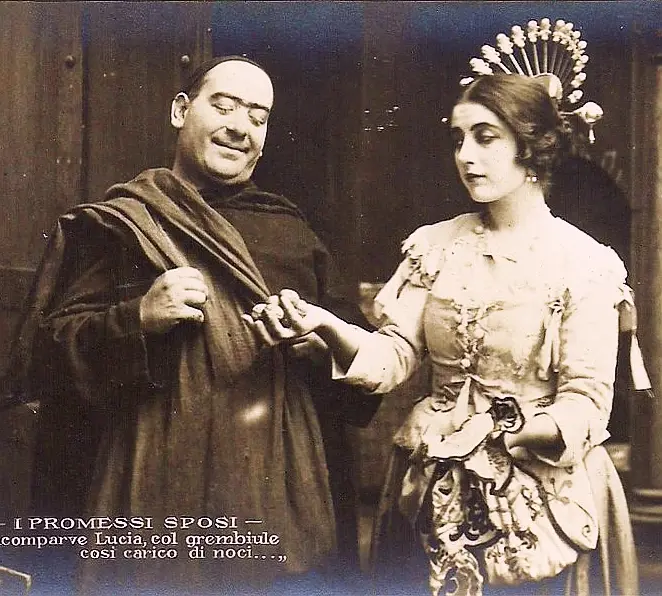
Nini Dinelli’s Nun of Monza is the film’s dark star, gliding through cloisters with the predatory elegance of a raven. She embodies institutional hypocrisy without caricature, every sideways glance a confession of thwarted agency.
No expense was spared: 5,000 extras, full-scale replicas of 17th-century Milan, wool banners hand-painted with heraldic crests. Yet opulence never eclipses narrative urgency. Bonnard blocks crowd sequences like military campaigns; during the bread riot, the camera pirouettes above bobbing heads, finding Renzo’s uplifted fist—a fleeting spark of proletarian solidarity. The sequence so alarmed authorities that they excised it from export prints, fearing it might agitate Italian laborers still reeling from the Biennio Rosso strikes.
Compare this to the domestic unrest portrayed in Sold for Marriage, where immigrant anxiety is framed as personal tragedy rather than structural injustice; here, systemic rot is the very oxygen characters breathe.
When the plague strikes, the film’s palette mutates: whites bleach into cadaverous yellows, blacks absorb candlelight like velvet over voids. Bonnard overlays dissolves of grinning skulls atop processions, prefiguring the memento mori montage of The Love Light yet with none of Pickford’s redemptive sweetness. Corpses are tossed into carts; a child’s doll tumbles among limbs, a visual accusation against the viewer’s complacency.
The score—modern orchestras resurrect Franco Alfano’s original 1922 arrangement—pulses with tympani heartbeats that syncopate superbly with these macabre tableaux, reminding us that history’s graveyards are rarely silent.
Church officials objected to Don Abbondio’s spineless venality, state censors feared the bread riot’s revolutionary mirage. Both cuts survive in the 2021 Cineteca di Bologna restoration, letting viewers appraise the film’s once-blasphemous verve. Contemporary critics compared its spectacle to Smash-Up in China for sheer logistical audacity—though unlike that globe-trotting adventure, this epic never leaves the Po Valley, proving that local oppression can feel as cosmic as any foreign war.
Where Felix in Love toys with flapper frivolity and Hurricane Hutch serial cliffhangers, I Promessi Sposi wields melodrama as moral philosophy. It anticipates the apocalyptic tint of Wer unter Euch ohne Sünde ist... yet roots damnation in realpolitik rather than divine decree.
More than a literary illustration, this 162-minute leviathan wrestles Manzoni’s brick-thick novel into a visceral, politically charged phantasmagoria. Its peaks—mass choreography, plague-induced horror, lovers’ reunion amid the dying—remain breathtaking. Occasional caricatures (a mustache-twirling Rodrigo) betray its era, yet the moral core—love as resistance, fear as contagion—beats defiantly modern. Nearly a century on, the film still interrogates our complicity in structures that starve the Renzos and Lucias of every age, making its restoration not archival fetish but civic duty.
Watch it on the largest screen you can find, volume cranked until the tympani feel like distant cannons; then walk outside and tell me the past ever truly ends.
IMDb 7.3
1929
Community
Log in to comment.