DbcultAccessing Vault...
Cult Review
Senior Film Conservator
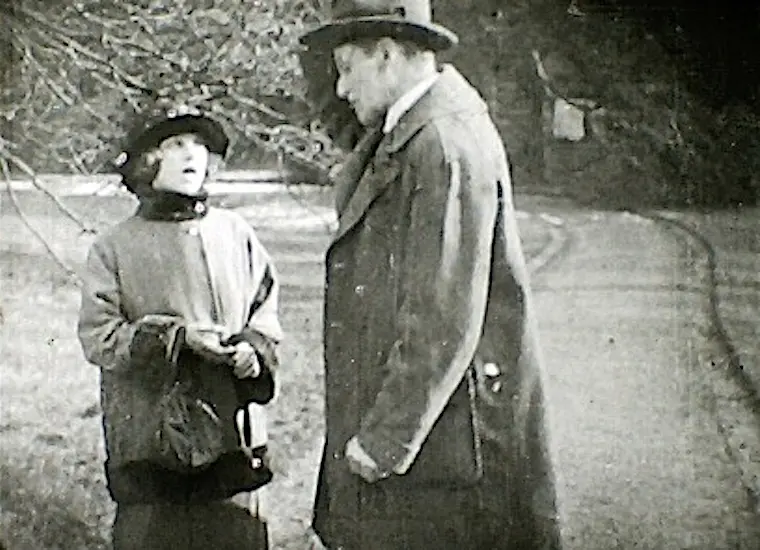
To witness If a Picture Tells a Story in the modern era is to participate in a form of temporal archaeology. Released in 1913, this brief yet potent piece of celluloid serves as a testament to the idiosyncratic genius of Gaston Quiribet. Operating within the fertile grounds of the Hepworth Manufacturing Company, Quiribet was not merely a director; he was a polymath of the silent era, acting as writer, star, and technical visionary. While many of his contemporaries were content with static stage-to-screen adaptations, Quiribet pushed the envelope of what the camera could achieve, treating the lens as a magic wand rather than a mere recording device.
The film exists in that delicious liminal space between the Victorian 'trick film' and the more structured narrative cinema that would soon dominate the industry. Much like Pop Tuttle's Movie Queen, which explored the artifice of the silver screen, Quiribet’s work here focuses on the intersection of art and reality. However, where later films might lean into the melodrama of the era, such as The Right to Happiness, Quiribet maintains a playful, almost mischievous tone that prioritizes visual wonder over moralizing sentimentality.
The technical sophistication of If a Picture Tells a Story is staggering when one considers the rudimentary tools at Quiribet’s disposal. The use of double exposure and stop-motion replacement is executed with a precision that rivals the French master Georges Méliès, yet there is a distinctly British pragmatism to the setting. The studio environment is rendered with a wealth of textures—the grain of the canvas, the smudge of charcoal, the heavy drapes of the Edwardian era—all of which contrast sharply with the impossible events that unfold. This film doesn't just show us a story; it demonstrates the birth of visual syntax.
Consider the way the portrait interacts with the physical world. There is a tactile quality to the illusion that makes it more than just a visual gag. It reminds one of the atmospheric tension found in The Bottom of the Well, though Quiribet swaps dread for curiosity. The fluidity of the transitions suggests a director who was intimately familiar with the chemistry of film stock, manipulating the very fabric of the medium to achieve a seamless blend of the real and the imagined. It is this technical bravery that separates Quiribet from the journeymen of his time.
Beyond the technical wizardry, there is a profound philosophical undercurrent to the film. By having the picture 'speak' or act, Quiribet is challenging the permanence of art. In the early 20th century, the painting was the ultimate symbol of high culture, while cinema was often dismissed as a vulgar fairground attraction. By making the painting the subject of cinematic manipulation, Quiribet is effectively performing a takeover. He is asserting that the 'moving picture' is the evolution of the 'still picture,' a sentiment that echoes through later works like The Last Moment.
The protagonist’s reaction to the living portrait is a masterclass in silent acting. Quiribet avoids the hyperbolic gesticulation common in 1913, opting instead for a series of nuanced expressions that convey a mix of professional pride and existential terror. This subtlety is something we often associate with later dramas like Madeleine or the complex character studies in The Tenth Case. In this short span of time, Quiribet manages to humanize the surreal, making the impossible feel grounded in a very human experience of wonder.
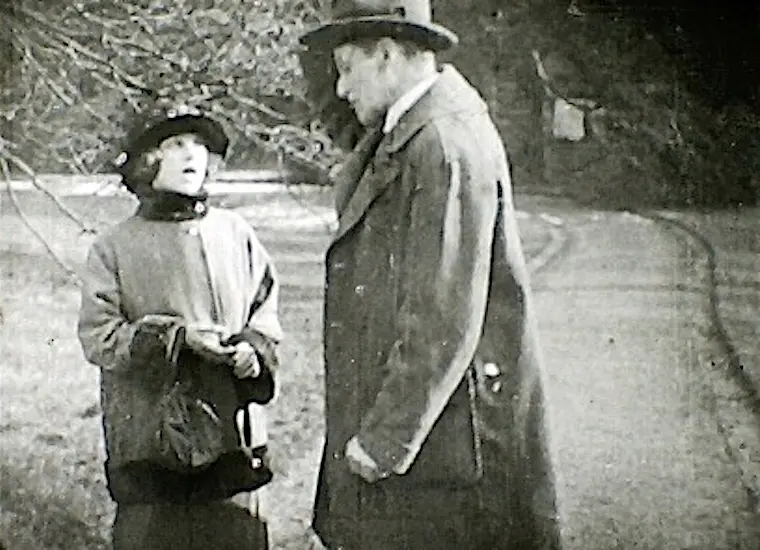
When we place If a Picture Tells a Story alongside its contemporaries, its uniqueness becomes even more apparent. For instance, A Regiment of Two relies heavily on situational comedy and social mores, whereas Quiribet’s work is purely conceptual. While films like Tainted Money or The Seekers were beginning to explore the grit of the human condition and the consequences of greed, Quiribet remained focused on the joy of the aesthetic experiment.
Even when compared to the more dramatic narratives of European cinema, such as Der Schloßherr von Hohenstein, Quiribet’s film stands out for its economy of storytelling. There is no wasted frame. Every movement is calculated to lead the eye and provoke a specific cognitive dissonance. It lacks the sprawling ambition of The West~Bound Limited, but it possesses a concentrated brilliance that those larger productions often lack. It is the difference between a sprawling epic poem and a perfectly constructed haiku.
Why does a film from 1913 still resonate today? Perhaps because we are still obsessed with the same questions Quiribet raised. In an age of deepfakes and AI-generated imagery, the boundary between the 'real' and the 'rendered' is thinner than ever. Quiribet was the progenitor of this anxiety. He showed us that the image is not a static reflection of the world, but a malleable entity that can be reshaped by the artist’s will. This theme of the 'double' or the 'unreliable image' is something that would be explored with much more intensity in The Devil's Double, yet the seeds were sown here in this silent studio.
The film also offers a fascinating glimpse into the social fabric of the time. The artist’s boarder or the domestic interactions surrounding the creative process—reminiscent of the character dynamics in Ma Hoggan's New Boarder—provide a grounded backdrop for the supernatural events. It's this juxtaposition of the mundane and the miraculous that gives the film its lasting charm. Even a film like The Girl with the Champagne Eyes, with its focus on visual allure, owes a debt to the way Quiribet framed his subjects to maximize their photographic impact.
To watch If a Picture Tells a Story is to see the future of cinema written in the language of the past. It is a palimpsest where the traditions of the 19th-century theater are being overwritten by the kinetic energy of the 20th-century screen. While it may not have the rugged naturalism of Strandhugg på Kavringen, it possesses a whimsicality and a technical daring that are purely Quiribetian. He was a man who understood that the camera doesn't just record a story—it creates one.
In the final analysis, this film is a vibrant reminder that cinema has always been a medium of transformation. Gaston Quiribet didn't just want to tell a story; he wanted to show us that stories are living, breathing things that can step right out of their frames and into our lives. For any serious student of film history, or any lover of the surreal, this is an essential piece of the puzzle. It is a short, sharp shock of creativity that continues to echo through the halls of cinematic history, proving that if a picture tells a story, the motion picture tells the truth of our imagination.
"A seminal work of early British trick cinema that remains as enchanting as it was a century ago."
IMDb —
1936
Community
Log in to comment.