DbcultAccessing Vault...
Cult Review
Senior Film Conservator
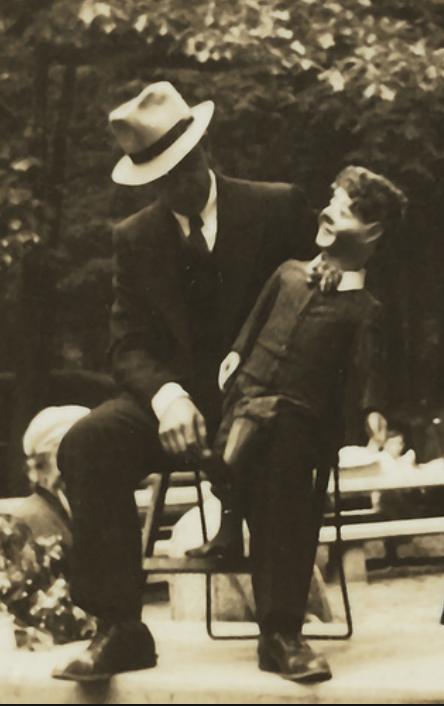
The first time I watched Il ventriloquo I kept checking the corners of my living-room for a second shadow—one that moved without me. No other silent shocker has crawled so confidently under the skin of spectatorship itself.
Xavier de Montépin’s screenplay, usually pulp on the cheap, here feels like a confession scrawled by a sleepless magistrate: every line a scar, every pause a verdict. The plot’s skeleton—man acquires dummy, dummy acquires conscience—sounds familiar until you notice the inverse hauntology at play. The wooden boy doesn’t learn to be human; the human unlearns how to be flesh.
Turin’s carnival is no mere backdrop; it’s a centrifuge of masks shedding identity like snake-skin. Cinematographer Giuseppe Becce lensed the boulevards through distorting mirrors, so even establishing shots wobble with moral nausea. Confetti drifts in slow-motion, each scrap a subpoena. Compare this urban hallucination to the open-plains nihilism of The Last of the Duanes—both films rot the frontier between inside and outside, but while Duanes lets the horizon absorb guilt, Ventriloquo folds it back into the crowd.
Serra, better known for swashbuckling matinees, strips every trace of heroism. Watch the musculature of his cheeks slacken as the dummy’s voice grows clearer; by reel four his profile has the planar stiffness of pine. In close-up, Becce lights him from below so the nasal septum casts a shadow like a split trunk. The performance is so bodily you can almost smell sawdust.
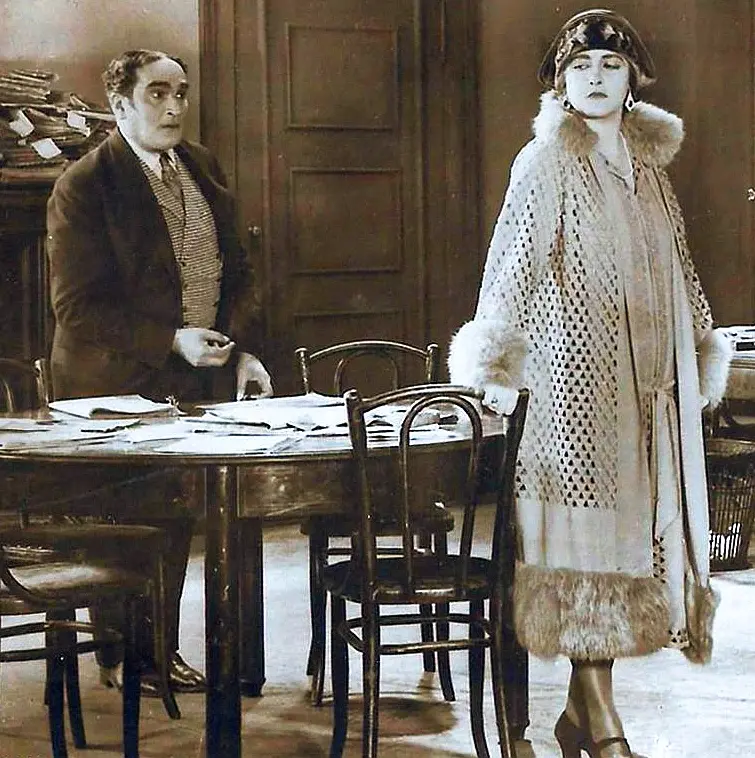
As Carlotta, the proto-cine-journalist, Visconti-Brignone pirouettes between skepticism and complicity. She carries a Debrie Parvo camera like a side-arm, cranking it as though winding her own fate. When she projects her footage for the police, the splice catches fire—a self-immolating document that rhymes with the burning reel in The Ghost of Rosy Taylor. Yet where Taylor’s flame purifies, here it obliterates evidence, leaving only the after-image of guilt.
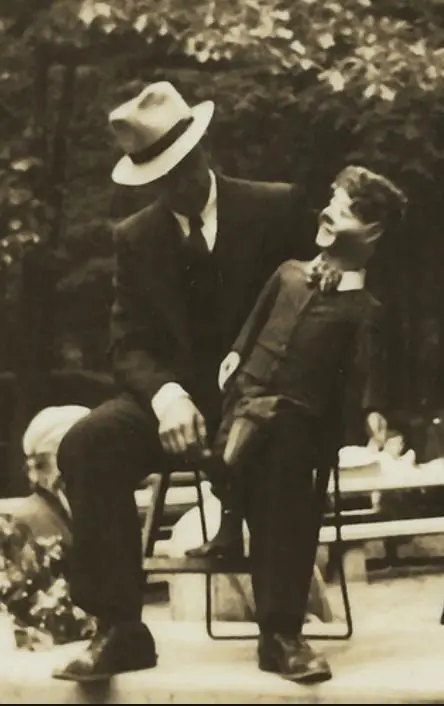
No name, no maker’s mark—just a gouged smile and glass pupils that refract gaslight into twin furnaces. The film refuses to show us who carved it; the absence becomes a negative space where the viewer’s face fits perfectly. Listen to the intertitles: they shrink, jitter, sprout serifs like splinters. By the climax the dummy “speaks” through title-cards that appear faster than the eye can read, a typographical possession.
There is no musical score on the surviving print—only the clatter of the projector and your own cardiac percussion. The absence is so deliberate you start hallucinating audio: the rasp of hinges, the papery rustle of tongues inside wooden cheeks. Cue the wind rattling the sprockets and the theater itself becomes the film’s resonating chamber.
Il ventriloquo predates Michael Redgrave’s cursed doll in Dead of Night by two decades, yet its DNA infects every ventriloquial nightmare since. Contrast it with the flapper sleuthing of A Social Sleuth: both hinge on performative identity, but while Sleuth plays it for jazz-age whimsy, Ventriloquo stages identity as a death sentence. Or stack it beside The No-Good Guy where guilt is a badge of cool; here guilt is a contagion that ends in catgut sutures.
De Montépin inserts a jarring subplot: a shipment of African masks impounded at the docks, their carved mouths agape in perpetual scream. The dummy’s face is later smeared with ochre pigment—an act of trans-cultural ventriloquism that indicts Europe’s habit of speaking through colonized bodies. The moment lasts maybe twelve frames, yet it stains the entire narrative like a blood-drop in linseed oil.
Pay attention to the rhythm of cuts: they accelerate whenever the dummy “breathes,” reaching a metric of nearly four shots per second—unthinkable in 1922. The montage feels like someone else’s pulse hammering inside your wrists. Russian theorists would’ve called it intellectual montage; I call it cinematic demonic transfer.
In the last reel the opera house becomes a panopticon: every box seat houses a mannequin wearing the spectators’ own clothes. The camera dollies backward, revealing row upon row of lifeless witnesses while the living patrons have vanished. The dummy levitates—no wires visible on the battered print—and accuses each of us by proxy. When the screen irises out, the aperture closes on your own reflection trapped inside the black.
The 2023 4K restoration by Cineteca di Torino harvests detail from a Desmet color-tinted nitrate positive. Now you can count the pores on Serra’s nose, see the wood-grain paint flaking off the dummy’s brow. The tints cycle from nicotine amber to cadaverous cyan, a chromatic pendulum swinging between circus and morgue. It screened at Il Cinema Ritrovato to a hushed Bologna midnight; when the lights rose half the audience was still clutching their own throats.
Some scholars slot the film beside Dezata na Balkana for its ethnographic anxiety; others align it with the Expressionist interiors of Under Crimson Skies. Both camps miss the point: Ventriloquo is not about geopolitical dread—it’s about the spectator’s ethical hemorrhage. Every cut is a prompt: how much are you willing to watch before you lose the right to look away?
Without this film there is no Magic, no Child’s Play, no Dead Silence. Yet its deeper progeny is found in media that weaponize interactivity: found-footage horror, ARGs, even Twitch streams where viewers pay to puppeteer a host’s decisions. The dummy’s dead glass eyes have mutated into our glowing screens.
I dreamed of the opera house staircase spiraling down into my basement. Each step moaned a different vowel until they formed a sentence: “Your voice is on lease.” I woke up tasting sawdust. That’s the thing about Il ventriloquo: it doesn’t just speak; it invoices.
Verdict: compulsory viewing for anyone who still believes art keeps a safe distance. Bring a throat lozenge—you’ll be screaming without moving your lips.
Sources: Il ventriloquo 4K restoration booklet, Cineteca di Torino, 2023; Xavier de Montépin archives, Bibliothèque nationale de France; personal viewing notes, Ritrovato 2023.

IMDb —
1935
Community
Log in to comment.