DbcultAccessing Vault...
5/10
Senior Film Conservator
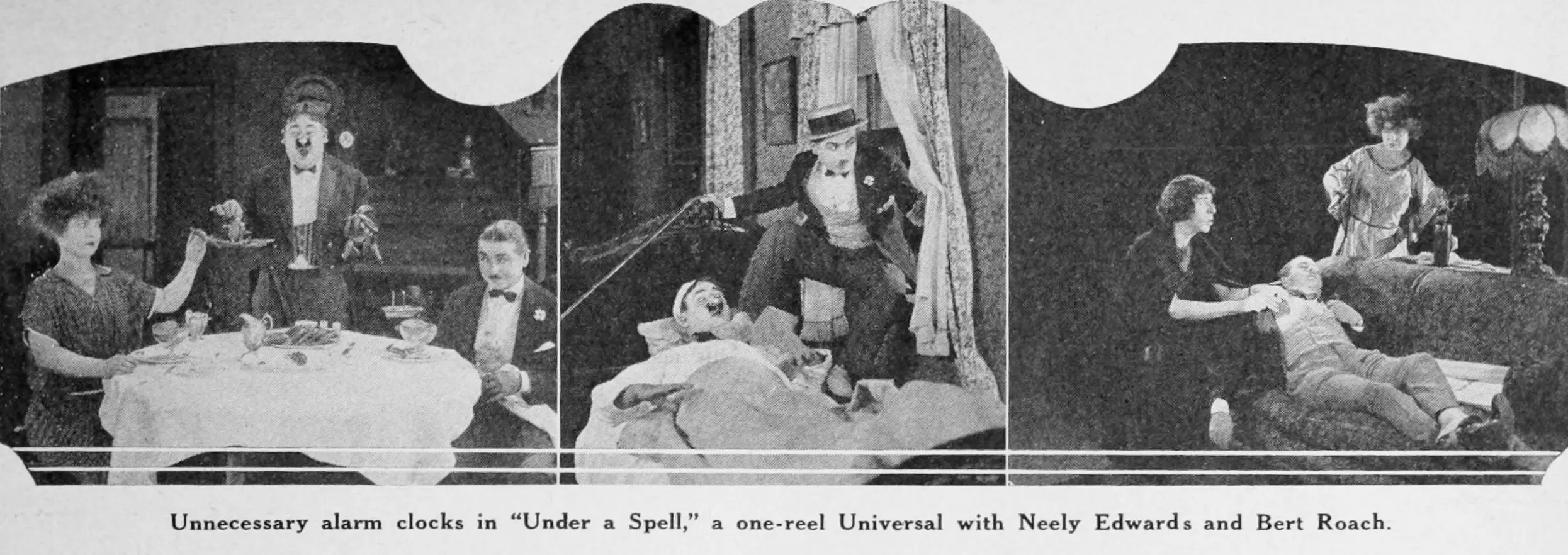
A definitive 5/10 rating for a film that redefined the boundaries of cult cinema. Under a Spell remains a cornerstone of transgressive art.
To watch Under a Spell is to witness the sheer, unadulterated elasticity of the human form when stripped of the dignity of the 20th-century ego. In the early 1920s, the cinematic medium was still grappling with its own potential for surrealism, and this short film serves as a quintessential artifact of that experimentation. The premise—a man hypnotized into believing he is a monkey—might seem like a standard vaudevillian trope, but in the hands of Neely Edwards, it becomes a transcendental exercise in physical commitment. Unlike the more grounded domesticity found in Kids and Kidlets, this film leans heavily into the absurd, pushing the boundaries of what a comedic body can endure.
The era was rife with explorations of the subconscious, often influenced by the burgeoning field of psychoanalysis, yet 'Under a Spell' bypasses the heavy-handed symbolism of European contemporaries like Minaret Smerti or the dark romanticism of Der verlorene Schuh. Instead, it chooses the path of the kinetic. The hypnosis isn't a dark curse; it is a liberation. It allows Neely to interact with the architecture of the city as if it were a sprawling, concrete canopy. The film's rhythm is dictated not by dialogue—of which there is none—but by the staccato bursts of movement as Neely scales walls and hurls objects with a frantic, unthinking precision.
The success of such a high-concept physical comedy rests entirely on the shoulders of its ensemble. Alice Howell, often unfairly overshadowed by her male counterparts in historical retrospectives, brings a sharp, reactive energy to the screen. Her presence provides the necessary foil to the escalating insanity. While Bella Donna offered a more dramatic spectacle in the same period, Howell reminds us that comedy requires a specific type of dramatic gravity to remain grounded. She isn't just a witness to the simian madness; she is the tether that keeps the film from floating off into total abstraction.
Bert Roach and Tony Campanaro round out a cast that understands the geometry of a gag. In the silent era, timing was not just about the delivery of a line, but the intersection of a gesture with the camera's frame. In 'Under a Spell', the coordination required for the chase sequences is nothing short of athletic. When compared to the more static narrative structures of Everyman's Price, the fluidity here is striking. The performers move with a synchronized chaos that suggests weeks of rehearsal disguised as spontaneous combustion.
There is a specific thrill in watching Neely Edwards climb. In an age before CGI or sophisticated wirework, the danger felt—and often was—palpable. This verticality was a hallmark of the era's most daring comedies, echoing the high-altitude antics of Look Out Below!. However, while other films used height for suspense, 'Under a Spell' uses it to redefine character. Neely doesn't climb like a man afraid of falling; he climbs like a creature that belongs in the heights. This subtle shift in performance psychology elevates the film from a mere stunt-show to a character study of a fractured mind.
The urban environment is transformed. Windows are no longer portals for looking out; they are handholds. Rooflines are no longer boundaries; they are thoroughfares. This reimagining of the city is a recurring theme in silent cinema, seen in the sophisticated metropolitan backdrop of Hick Manhattan, but here it is far more primal. The throwing of objects—a barrage of household items, debris, and whatever else Neely can get his hands on—serves as a rejection of the material world. He is not just a monkey; he is a critic of civilization, dismantling the order of the domestic sphere one thrown vase at a time.
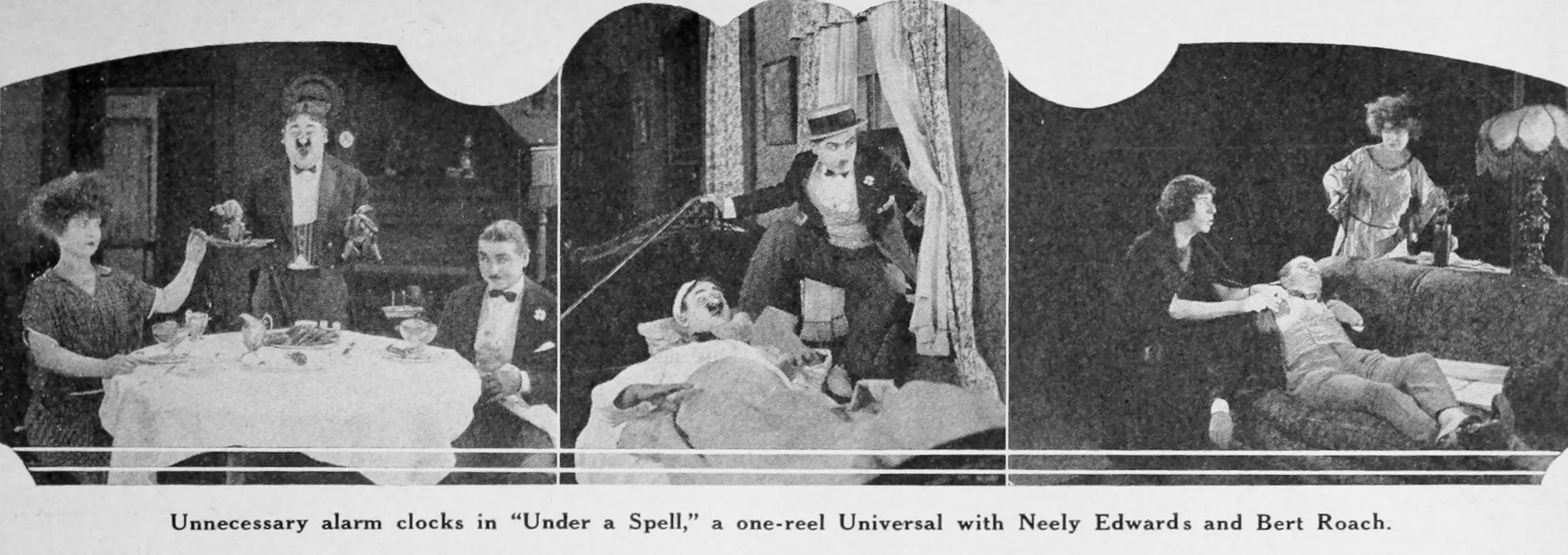
When we place 'Under a Spell' alongside contemporaries like Up and Going, we see a distinct bifurcation in 1920s entertainment. Where 'Up and Going' relies on the momentum of the Western or the adventure serial, 'Under a Spell' finds its power in the internal made external. It shares a certain DNA with the whimsical absurdity of A kölcsönkért csecsemők, where the logic of the world is subverted by a singular, ridiculous premise. Yet, Edwards’ performance is more visceral, more committed to the physical reality of his delusion.
Even in the more dramatic or folkloric offerings of the time, such as Willy Reilly and His Colleen Bawn or the domestic dramas like John Heriot's Wife, there was a burgeoning understanding that the camera could capture more than just a stage play. 'Under a Spell' exploits the medium's ability to compress and expand time through editing. The chase sequence is a masterclass in rhythmic cutting, ensuring that the audience's breath hitches in sync with Neely’s leaps. It lacks the pastoral serenity of Builders of Castles, opting instead for a relentless, caffeinated pacing that mirrors the protagonist's agitated mental state.
Technically, the film is a marvel of its era's constraints. The lighting, though primitive by modern standards, effectively uses high contrast to accentuate the jagged movements of the 'monkey-man.' The cinematography captures the frantic nature of the chase without losing the clarity of the gag—a difficult balance that even big-budget productions like Singer Jim McKee sometimes struggled with. There is a raw, documentary-like quality to the outdoor scenes, providing a fascinating glimpse into the physical world of 1922, even as the narrative veers into the fantastical.
The use of hypnosis as a plot device also reflects the cultural anxieties of the time. In a post-war world, the idea that a man’s identity could be switched off by a third party was both a source of comedy and a latent fear. While Eine weisse unter Kannibalen explored the 'other' through a colonial lens, 'Under a Spell' finds the 'other' within the self. Neely is both the hunter and the hunted, the man and the beast, all contained within a single, sweating, climbing frame. This duality is what gives the film its lasting resonance, even as its slapstick beats provide immediate, visceral gratification.
'Under a Spell' remains a potent reminder of the power of physical performance in the absence of speech. Neely Edwards’ portrayal of a man possessed by an animal spirit is a tour de force of silent acting, requiring a level of stamina and spatial awareness that modern actors, cocooned in digital safety, rarely achieve. The film stands alongside Wild as a testament to the uninhibited spirit of early cinema—a period where the rules were still being written, and the only limit was the height of the nearest building and the strength of the leading man's grip.
In the final analysis, the film is a joyous, chaotic explosion of pure cinema. It doesn't ask for your pity or your deep intellectual engagement; it demands your attention through sheer, unrelenting motion. It is a work that understands the fundamental truth of the medium: that movement is meaning, and that sometimes, the most profound thing a human can do is climb a wall and throw a brick. For any student of film history or lover of the absurd, 'Under a Spell' is not just a curiosity—it is an essential, heart-pounding experience that captures the lightning-in-a-bottle energy of the silent age.
IMDb 8.6
1931
Community
Log in to comment.