DbcultAccessing Vault...
7.8/10
Senior Film Conservator
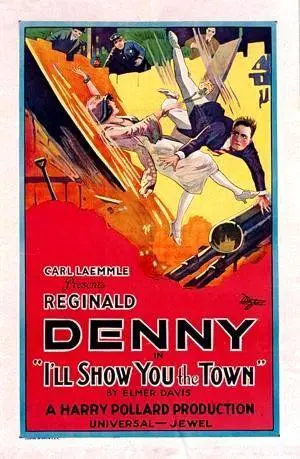
A definitive 7.8/10 rating for a film that redefined the boundaries of cult cinema. I'll Show You the Town remains a cornerstone of transgressive art.
The year 1925 was a watershed moment for the American silent comedy, a period where the primitive slapstick of the previous decade began to coalesce into a more sophisticated, character-driven brand of humor. At the forefront of this evolution stood I'll Show You the Town, a film that eschews the broad physical destruction of its contemporaries in favor of a meticulously choreographed social anxiety. Starring the incomparable Reginald Denny, the picture is a testament to the athleticism required of the silent era’s leading men—not just physical prowess, but a mental dexterity that translates through the silver screen with the force of a gale. Unlike the atmospheric gloom found in The Isle of the Dead, Pollard’s direction here is bright, crisp, and relentlessly paced.
The premise is deceptively simple, yet it serves as a robust framework for an escalating series of comedic crescendos. Alec Sloane, a man whose primary flaw is a pathological desire to please, finds himself the unintended host of three different women on the same evening. The setting—a singular, bustling restaurant—becomes a character in its own right. It is a labyrinth of white linens and silver service, where every waiter is a potential whistleblower and every doorway a potential trap. This spatial restriction reminds one of the domestic tensions in The Shuttle, though the stakes here are measured in social embarrassment rather than historical destiny.
Denny’s performance is nothing short of Herculean. He doesn't merely act; he vibrates with the frequency of a man whose world is about to implode. His Alec Sloane is a master of the 'selective truth,' a man who treats social etiquette as a contact sport. As he bounces between tables, his excuses grow increasingly surreal, a creative desperation that mirrors the frantic energy of Loose Lions. The film understands that the heart of comedy lies in the audience's awareness of the impending catastrophe, and it milks that anticipation for every ounce of tension it can muster.
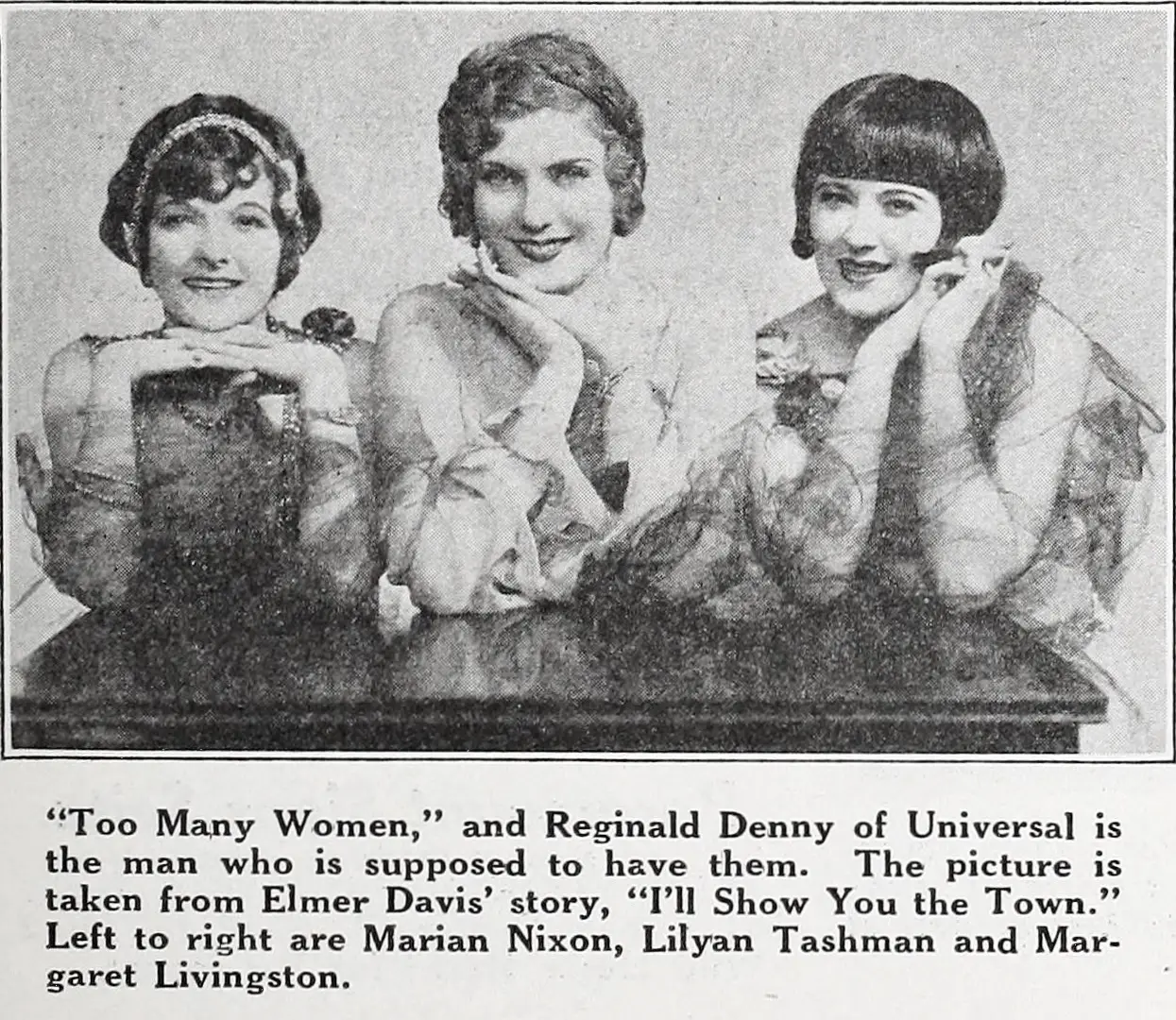
The three women—played with distinct flair by Lilyan Tashman, Marian Nixon, and Margaret Livingston—represent a fascinating cross-section of 1920s femininity. Tashman brings a sophisticated, almost predatory elegance to her role, her every glance a challenge to Sloane’s fragile composure. In contrast, Marian Nixon offers a sweetness that makes Sloane’s deception feel all the more villainous, while Livingston provides the fiery unpredictability that keeps the narrative engine from ever stalling. This dynamic is far more complex than the binary romantic interests found in Married in Name Only.
The interactions are not merely romantic; they are transactional. In the world of I'll Show You the Town, a date is an exhibition of status. Sloane isn't just entertaining women; he is performing the role of the 'man about town' for an audience that consists of the entire restaurant. This performative aspect of the film aligns it with the social critiques found in Broadway Gold, where the glittering surface of New York life often masks a desperate scramble for relevance.
Technically, the film is a marvel of its time. The editing, handled with a rhythmic precision that predates the sophisticated montages of the 1930s, ensures that the viewer never loses track of the geography. We always know where Sloane is in relation to his 'victims.' The use of title cards is sparse but effective, allowing the visual storytelling to carry the emotional weight. It lacks the melodramatic heavy-handedness of The Branded Woman, opting instead for a lightness of touch that feels remarkably modern.
The cinematography utilizes depth of field to keep the background action relevant. In the corner of the frame, we might see a waiter approaching a table Sloane has just vacated, or a glimpse of a familiar hat through a crowd. This layered approach to visual comedy creates a sense of constant motion, a feeling that the town itself is a living, breathing organism that Sloane is trying to tame. It is a far cry from the static, stagey presentations of earlier silent efforts like Christopher Columbus.
Beneath the surface of the juggling act lies a subtle commentary on the economic pressures of the era. Sloane is a man who must look the part even if his bank account suggests otherwise. The restaurant is a temple of consumption, and his presence there is a requirement of his social standing. This subtext of class and expectation can be seen through a different lens in Trapped by the London Sharks, where the urban environment is predatory rather than merely demanding. In Sloane’s New York, the 'sharks' wear tuxedos and expect impeccable service.
The film also touches upon the theme of observation. Everyone is watching everyone else. The restaurant is a panopticon of gossip. This sense of being constantly perceived adds a layer of genuine dread to the comedy. It echoes the voyeuristic tensions of Green Eyes, though here the result is a laugh rather than a gasp. When Sloane ducks behind a menu to avoid detection, we feel his panic because we understand the weight of the social gaze.
The cast is rounded out by a gallery of character actors who provide the necessary friction for Sloane’s maneuvers. Rolfe Sedan and Vincent Rose offer impeccable timing as the various obstacles in Sloane’s path. Even the minor roles, such as the harried waiters and the skeptical maître d', are played with a commitment to the film’s frantic reality. This ensemble work is reminiscent of the chaotic group dynamics found in Sadhu Aur Shaitan, albeit in a vastly different cultural context.
Special mention must be made of Jackie Taylor and Edward Kimball, who populate the world with a sense of lived-in history. The film doesn't feel like it exists in a vacuum; it feels like a slice of a much larger, equally chaotic world. This expansiveness is what separates a great comedy from a mere series of sketches. It has the narrative density of a film like Seven Bald Pates, where the sheer number of moving parts becomes a source of wonder.
Ultimately, I'll Show You the Town is a celebration of the human spirit’s ability to improvise in the face of certain doom. Alec Sloane is a surrogate for every person who has ever said 'yes' when they should have said 'no,' and his frantic evening is a cathartic exercise for the audience. The film avoids the pitfalls of moralizing, choosing instead to revel in the absurdity of the situation. It doesn't punish Sloane for his deceit; it rewards him for his ingenuity.
In the grand tapestry of silent cinema, this film stands as a bright, shimmering thread. It lacks the cynicism of later screwball comedies, possessing instead a buoyant optimism that is infectious. Even when the walls are closing in, the film maintains a sense of playfulness that is rare. It is as refreshing as a stroll through In a Naturalist's Garden, yet as pulse-pounding as A False Alarm. To watch Reginald Denny navigate this social minefield is to witness a master at work, a performer who understood that the greatest comedy is found in the smallest of margins.
Whether one views it as a historical curiosity or a timeless piece of entertainment, the film’s merits are undeniable. It captures a specific moment in American history—the brief, shining window between the Great War and the Great Depression—where the only thing that mattered was the next dance, the next drink, and the next date. It is a film that doesn't just show you the town; it shows you the heart of a generation that was determined to have a good time, no matter the cost. It is as daring as Syndig Kærlighed and as endearing as The Runt, proving that even a bachelor’s worst nightmare can be a viewer’s greatest delight.
IMDb —
1929
Community
Log in to comment.