DbcultAccessing Vault...
Cult Review
Senior Film Conservator
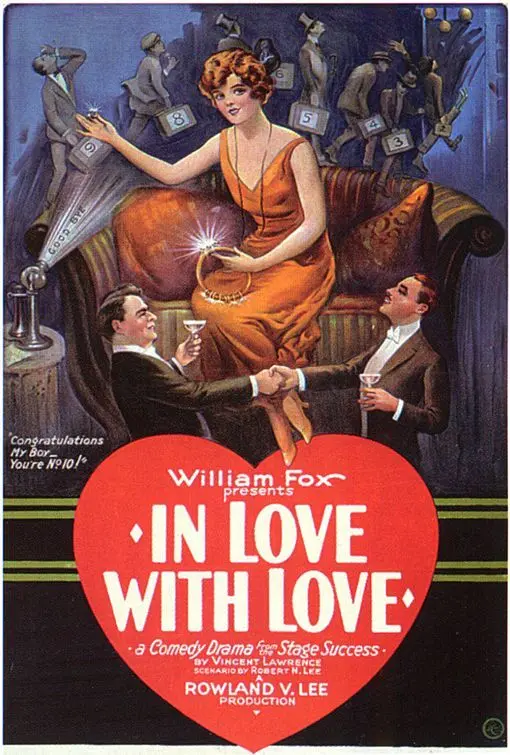
The cinematic landscape of 1924 was a period of profound transition, a moment where the visual vernacular of the silent era reached a zenith of expressive sophistication. Within this milieu, In Love with Love emerges not merely as a romantic divertissement, but as a nuanced examination of the feminine psyche navigating the rigid structures of post-Victorian society. Directed with a deft hand and written by the formidable duo of Robert N. Lee and Vincent Lawrence, the film eschews the melodramatic tropes of its contemporaries, opting instead for a psychological realism that feels startlingly modern.
At the heart of this swirling narrative is Marguerite De La Motte, an actress whose range is frequently overlooked in favor of her more flamboyant peers. Here, as Ann Jordan, she captures the essence of a woman 'in love with the idea of love'—a condition that borders on existential restlessness. Unlike her roles in more grandiloquent productions like Ashes of Vengeance, De La Motte employs a subtle economy of movement, allowing her expressive eyes to convey the dizzying shift from pampered indifference to visceral yearning. Her Ann is not a villainess of the heart, but a seeker, an individual attempting to find substance in a world of superficial engagements.
The film’s architecture—both literal and metaphorical—is constructed around the figure of Jack Gardner, played with a quiet, grounded intensity by Allan Forrest. Forrest provides the necessary gravitational pull to counter Ann’s mercurial nature. While the film shares some thematic DNA with the romantic entanglements found in The Little Minister, it diverges significantly by grounding its conflict in the gritty realities of industrial competition and intellectual property. The bridge competition is not merely a plot device; it is a crucible for character development.
The cinematography by the uncredited but clearly skilled crew utilizes light and shadow to delineate the two worlds Ann inhabits. The Jordan household is bathed in the soft, diffused glow of wealth—a golden cage where Robert Metcalf (William Austin) and Frank Oaks (Harold Goodwin) represent the binary choices of boredom and aggression. Austin’s performance as Metcalf is a masterclass in the 'boring suitor' archetype, a role that could easily have slid into caricature but instead remains a poignant reminder of the safety that stultifies. Conversely, Goodwin’s Oaks is a whirlwind of entitled masculinity, a precursor to the more aggressive romantic leads of the pre-Code era. One might find echoes of this dynamic in the social maneuvering of The Marionettes, though In Love with Love possesses a more robust industrial backbone.
The central conflict—the theft of the bridge plans—introduces a layer of ethical ambiguity that elevates the film above standard romantic fare. Will Walling, as the elder Jordan, delivers a performance of patriarchal complexity. His decision to 'steal' Jack’s plans is initially presented as a betrayal of the highest order, a move that threatens to destroy the budding relationship between Ann and Jack. However, the revelation that this was a convoluted vetting process adds a Machiavellian twist to the narrative. It suggests a world where love must be earned through professional trial, where the romantic and the industrial are inextricably linked. This thematic depth is reminiscent of the moral dilemmas explored in Um eines Weibes Ehre, albeit within a distinctly American framework of capitalist expansion.
"The bridge serves as a bridge, not just over a river, but over the chasm of misunderstanding that separates the protagonist's flighty youth from the responsibilities of adulthood."
One must also consider the supporting cast, who provide a rich tapestry of 1920s social life. Sayre Dearing and Mabel Forrest add layers of domestic texture, while Allan Sears and Mary Warren fill out the world with a sense of lived-in reality. The film’s pacing is impeccable, a testament to the editing and the sharp script by Lawrence and Lee. They manage to balance the lighter moments of Ann’s indecision with the heavy stakes of Jack’s professional ruin. This balance is something that lesser films of the era, such as New York Luck, often failed to achieve, frequently leaning too heavily into either slapstick or melodrama.
In terms of visual storytelling, the film excels in its use of space. The scenes in the Jordan library, where the theft occurs, are framed with a sense of claustrophobia that mirrors Jack’s eventual feeling of entrapment. In contrast, the outdoor sequences where the bridge is discussed feel expansive and full of potential. This visual dichotomy reinforces the film’s central theme: the struggle to find personal freedom within the confines of societal and familial expectations. It’s a struggle that resonates as much today as it did a century ago, placing the film in conversation with works like Diane of the Follies in its depiction of women under the social microscope.
The reconciliation between Jack and Ann is particularly noteworthy for its lack of overt sentimentality. It is a meeting of minds as much as hearts. Jack’s realization that his professional future is secure, and that Ann’s 'betrayal' was a misunderstanding, is handled with a restraint that is refreshing. The film avoids the histrionics common in silent cinema, opting for a denouement that feels earned. This maturity is a hallmark of the better films of the mid-20s, a period that also gave us the gritty realism of Salvation Nell.
Furthermore, the film’s exploration of the 'eligible but indifferent' male lead is a fascinating subversion of the era’s usual romantic tropes. Jack Gardner is not a swashbuckler or a high-society dandy; he is a worker. His modesty is his most attractive quality, but it is also his greatest obstacle. The fact that Ann is forced to propose to him is a radical act of agency for a 1924 heroine, one that challenges the passive roles often assigned to women in silent film. This inversion of the traditional courtship ritual provides a sharp contrast to the more conventional dynamics seen in Her Tender Feet.
Technically, the film stands as a testament to the high production values of the time. The sets are meticulously designed, reflecting the opulence of the Jordan estate and the functional aesthetic of the engineering world. The use of intertitles is sparse and effective, allowing the performances to carry the emotional weight of the story. This is a film that trusts its audience to interpret the nuances of a glance or the tension in a character's posture, a quality it shares with the atmospheric The Knocking on the Door.
As we look back at In Love with Love from the perspective of the 21st century, its charms remain remarkably intact. It is a film that understands the complexity of human emotion and the often-messy intersection of love and ambition. It doesn't offer easy answers, but it does offer a compelling, beautifully acted, and visually arresting experience. Whether compared to the high-seas adventure of The Mutiny of the Elsinore or the whimsical charm of An Eskimotion Picture, this film carves out its own unique space in the silent canon.
Ultimately, the legacy of In Love with Love is defined by its refusal to be just one thing. It is a romance, yes, but it is also a critique of class, a celebration of professional merit, and a character study of a woman finding her own voice. It stands alongside other hidden gems of the era, such as Bawbs O' Blue Ridge or the international intrigue of Prinzessin Tatjanah, as a vital piece of cinematic history that deserves a wider audience. For the modern viewer, it offers a window into a world of elegance and industrial fervor, all while reminding us that the heart’s architecture is often the most difficult structure to build.
In the final analysis, the film’s enduring power lies in its recognition that love is not a destination, but a process of alignment. Ann Jordan’s journey from the superficial to the substantial is a narrative arc that transcends the limitations of the silent screen. Through the lens of 1924, we see the burgeoning modern world, where the old rules of courtship are being rewritten by the demands of the new century. It is a captivating, intelligent, and thoroughly engaging work that remains a high-water mark for its stars and its creators alike, far surpassing the simple thrills of films like Outlawed or the comedic brevity of So sind die Männer.
IMDb 6.9
1935
Community
Log in to comment.