DbcultAccessing Vault...
7.6/10
Senior Film Conservator
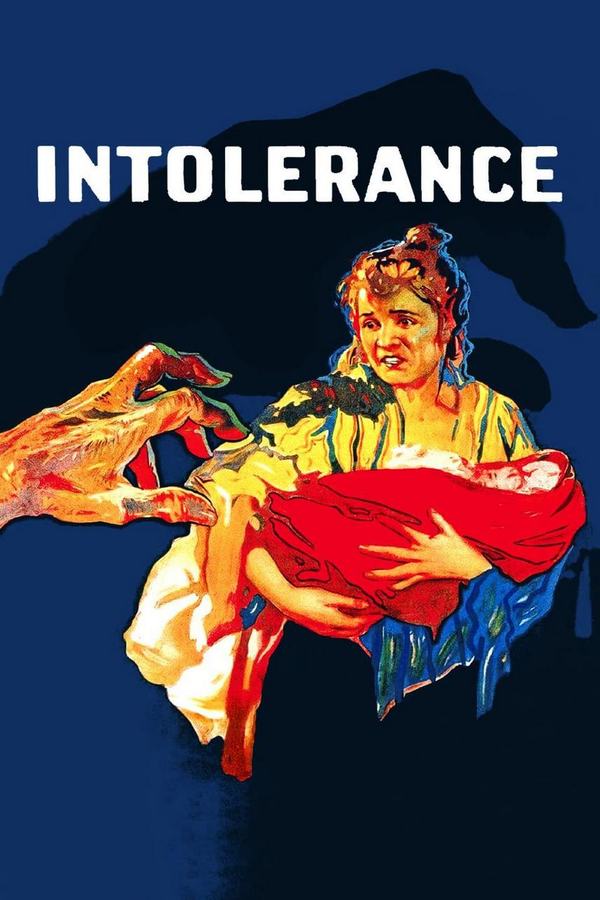
A definitive 7.6/10 rating for a film that redefined the boundaries of cult cinema. Intolerance remains a cornerstone of transgressive art.
Intolerance does not merely unfold—it detonates. From the first iris-in on the cradle, Griffith’s leviathan project announces itself as a dare against temporality, a reckless wager that four disparate centuries can vibrate in harmonic fury. The film’s spine is an editorial jackhammer: 2,500 cuts ricochet across millennia, forging rhyme where history sees only rupture. Babylon’s sun-dried bricks glisten like nougat under Billy Bitzer’s handheld torches; a single dolly plunges through Belshazzar’s banquet, past elephants draped in hammered gold, toward the camera like a warhead of opulence. Meanwhile, in 1914, mill-owner Jenkins peers through a steel-grate iris, his face a nickel-plated mask of capital sin. The juxtaposition is not intellectual—it is visceral, a punch to the vagus nerve.
Yet for all its thunderous reputation, the film’s quietest moments cleave deepest. Mae Marsh’s “Dear One,” stripped of husband and child, stands before a blank parlour wall; the frame holds longer than comfort allows, forcing the viewer to inhabit her stilled breath. When she later races the governor’s pardon toward a gallows, Griffith intercuts her sprint with the knife-edge shadow of a guillotine in 1572 Paris. Space folds, centuries kiss, and the suspense becomes existential. We are not asked “Will she make it?” but “Will humanity ever outrun its thirst for punitive spectacle?”
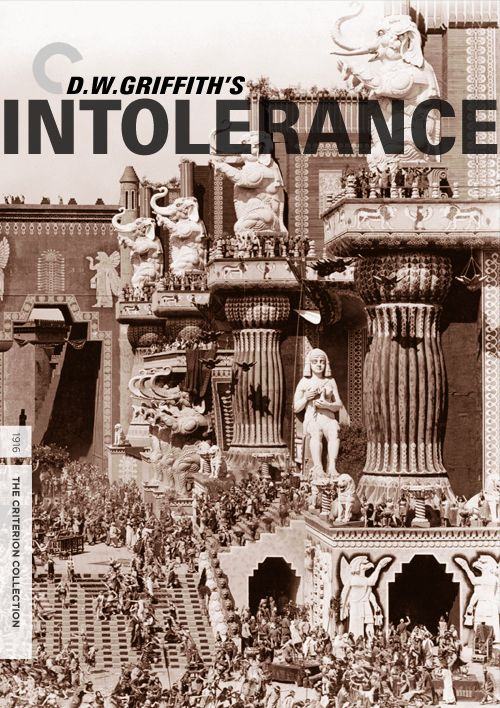
Act one storms in like a copper-sky sandstorm. Conceived as Hollywood’s first super-set, the walls of Babylon sprawl 300 feet across a sun-bleached valley. Over 3,000 extras surge in kinetic fractals: priests whirl like dervishes, vendors hawk glazed dates, a chariot drawn by zebras clips past. The camera, liberated from static frontality, glides through arches, cranes up towered parapets, even tilts heavenward to catch a moon that looks too close, too carnivorous. When the Persian army arrives, siege towers become cinematic switchblades, unfolding against the skyline. Bitzer under-cranks the assault; soldiers sprint in herky-jerky spasms, imparting a newsreel urgency that predates embedded journalism by eight decades. The massacre itself is a chiaroscuro bloodletting: arrows blot out the sun, then moonlight glints on helmets slick with gore. Griffith ends the siege not on spectacle but on a single curl of incense smoke rising from broken ziggurat stones—an olfactory ghost of vanished empire.
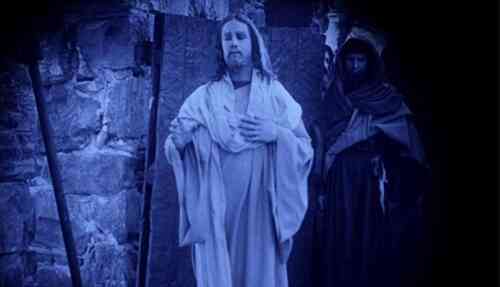
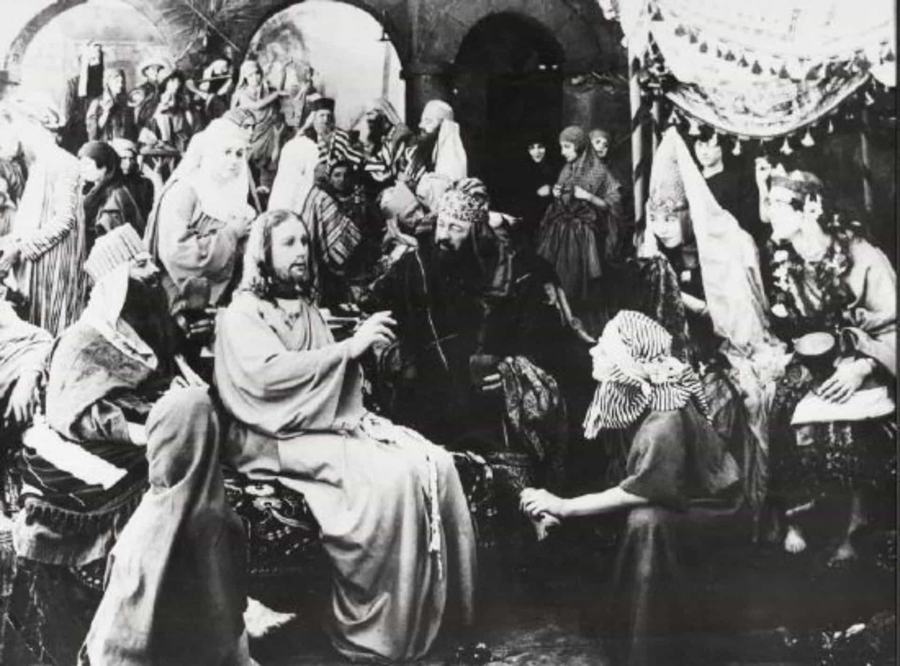
Compared to Babylon’s pyrotechnics, the Judean episodes play like whispered scripture. Griffith prunes the Gospels to vignette form: the marriage at Cana, the woman taken in adultery, the Passion. Howard Gaye’s Christ moves with the languor of someone who already knows the ending; his eyes, ringed by kohl, hold a weary cosmopolitan pity. The director’s stroke of genius is to stage miracles amid industrial modernity—water into wine occurs beneath a wine-press pulley that looks suspiciously like the conveyor belt in the contemporary story. The message is subtle but scalding: divinity must operate within the cogs of material power. When Pilate washes his hands, the basin water is tinted crimson by the tinting lab, a sanguinary foreshadow that drips into the next cut of strikers’ blood on factory floors.
The French Renaissance section, shortest yet sharpest, operates like a stiletto between ribs. Catholic royals dance the volta while Huguenots, branded heretics, sew by candlelight. Griffith’s anti-clericalism peaks when he juxtaposes a priest blessing daggers with a close-up of the Madonna’s porcelain smile—idolatry weaponised. The St. Bartholomew’s Day massacre is shot mostly in negative space: we see shadows of pikes dragging corpses across plaster walls, hear church bells that sound like iron lungs. Margery Wilson’s Brown Eyes, a Protestant every-girl, flees through cobblestone corridors until a soldier’s halberd pins her shadow. Death is elided; the camera stays on the weapon’s quiver, letting imagination mop the blood. The section ends on a child’s rag doll floating down a gutter toward the Seine—a proto-horror image that anticipates the teddy bear in Alone in London.
Griffith returns to the present with a vengeance. The “Dear One” and “The Boy” (Robert Harron) navigate an America where Puritan vestiges mutate into capitalist paternalism. Strike-breakers with billy-clubs wear bowler hats like secular mitres; judges sip tea behind mahogany altars. When the Boy is framed for murder, the trial becomes a media circus—flash-pans pop like machine-gun fire. The director’s montage escalates into a metronome of doom: each cut shaves seconds off the condemned man’s life while the cradle re-appears, rocking faster, faster, until the motion blurs into pure anxiety. The prison set is a panopticon of steel grids, shot from high angles that dwarf the prisoner into a Kafkaesque figurine. Yet Griffith refuses nihilism: a car chase replaces the locomotive staple, pistons pounding toward a last-second pardon. The exhilaration is tempered by the final iris-out on the cradle still rocking—history’s carousel cannot brake.
In a film often lauded for its macro design, the performances are microscopic hurricanes. Mae Marsh’s face oscillates between porcelain innocence and feral desperation; watch her pupils when guards drag the Boy away—they dilate like black suns. Walter Long’s Musketeer of the Slums exudes oleaginous menace without twirling a proverbial mustache; instead he whistles a ragtime tune, letting the melody’s jauntiness curdle into predation. Constance Talmadge, doubling as the Mountain Girl in Babylon, pirouettes on the edge of slapstick—her grin could sell figs or knives depending on the tilt—thereby injecting carnivalesque levity into impending apocalypse. Even bit players leave indelible glyphs: a Babylonian priestess, eyes rimmed in lapis, glances at the camera for a single frame, as if to indict the 20th-century viewer for worshipping new idols.
Griffith and Bitzer invent a visual lexicon that future auteurs would Xerox without credit. The track-in—camera gliding toward a sealed doorway—becomes shorthand for impending rupture. Overlap-dissolves smear epochs into palimpsest: Christ’s footprint dissolves into a factory worker’s boot in the mud, implying trans-historical suffering. Meanwhile, tinting is weaponised for mood: Babylon basks in sulphur yellow, Paris in cadaverous blue, Calvary in ethereal lavender, Modern America in cadaver grey. The sea-blue (#0E7490) that bathes prison corridors is no mere chromatic whimsy; it is the colour of bureaucratic asphyxiation, a cyanide rinse for hope.
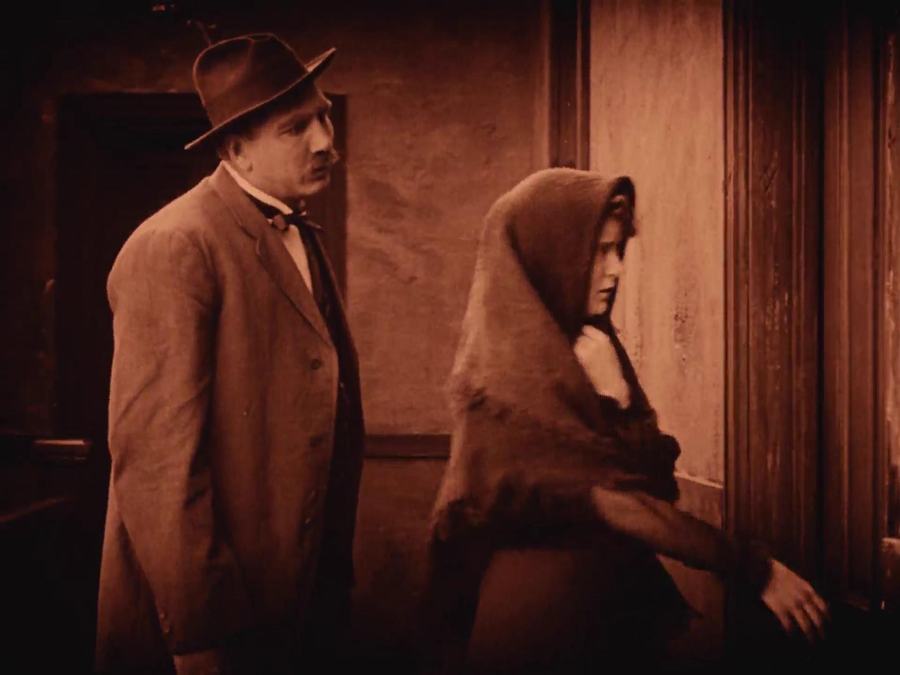
Scholars routinely cite Ipnosi for proto-psychoanalysis, yet Intolerance’s editing is the true Freudian slip of early cinema, exposing history’s death drive. Cross-cuts accelerate geometrically: the film’s first hour averages 3.2 seconds per shot, climaxing at 0.8 seconds during the “race to rescue” finale. Griffith’s rule of four prevails—every fourth cut returns to the cradle, a metronomic anchor amid temporal whiplash. The result is a cinematic fugue where leitmotifs (cradle, axe, dove, mill wheel) recur in stretto, compressing until epochs implode into simultaneity. Sergei Eisenstein would later theorise “dialectical montage,” but Intolerance enacts it viscerally: Babylonian spear, Huguenot dagger, capitalist club—each weapon converses across centuries, forging an arms trade of human cruelty.
Though premiered with Wurlitzer accompaniment, Intolerance was designed for modular orchestration—scores circulated to theatres with cue sheets. Joseph Carl Breil’s leitmotifs braid Wagnerian horns with Salvation Army hymns. In silent viewings today, the absence of sound becomes a vacuum that amplifies visual rhythm; you “hear” the swish of Babylonian silks, the metallic rasp of gaol doors. Home-viewers often overlay post-rock or techno, unaware that Griffith’s tempo-map syncs with a 96-bpm heartbeat. Try it: drop a synth arpeggio during the cradle sequence—the cradle’s rock locks to the kick drum like a ghost metronome.
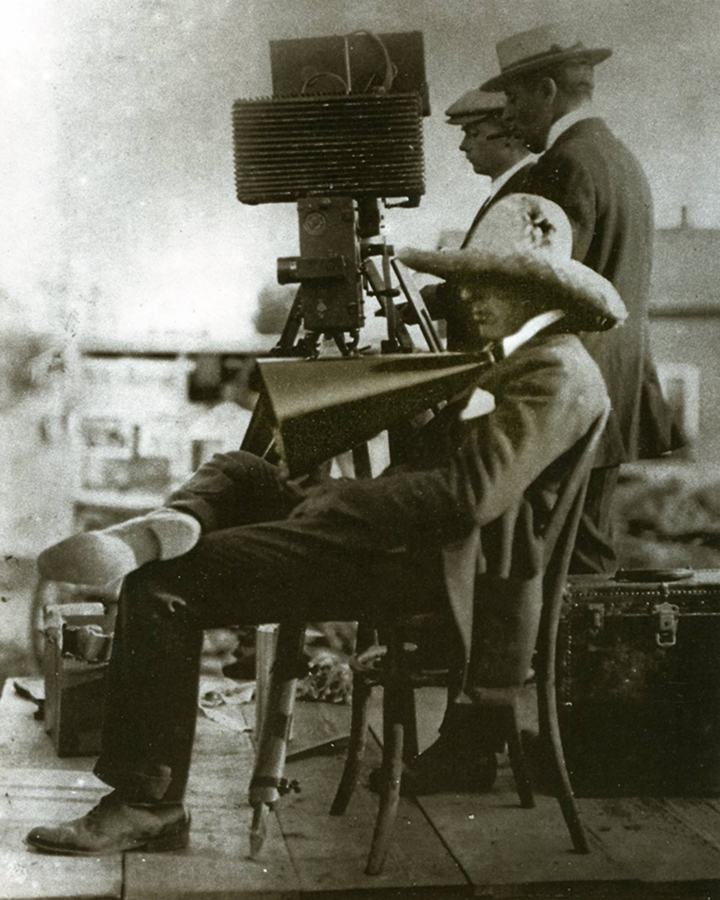
Post-1915, Griffith needed to launder reputation after Birth of a Nation’s racist cudgel. Intolerance answers with humanist breadth, yet paradoxes fester. Babylon’s orgiastic excess is coded “decadent East,” while virtuous America is lily-white. The Huguenot persecution flirts with anti-Catholic sentiment; Irish cops brutalise strikers with papist fervour. Women fare better: female solidarity spans eras—Mountain Girl, Brown Eyes, Dear One form a triptych of resistance against patriarchal blades. Still, one wishes Griffith had cast a Black actor as the modern martyr instead of replicating whiteness. The omission stings more because the director’s visual grammar could have subverted racist iconography had he willed it.
Stack Intolerance beside contemporaneous one-reelers and its ambition becomes almost comical. The Explosion of Fort B 2 detonates scenery but lacks ideological spine; Peer Gynt chases fairy-tale whimsy without temporal vertigo. Even Camille—with its consumptive romance—feels myopically interior. Only A Study in Scarlet
Original negatives were melted into boot-heels during WWI rubber drives. For decades the film existed in 90-minute re-cuts titled The Mother and the Law. Then, in 1989, archivists at MOMA stitched 16mm fragments with Czech print segments, restoring near-original length. The 2014 Cohen 4K transfer reveals textures unseen since 1916: the glint of copper leaf on Belshazzar’s goblet, the nacre sweat on Marsh’s upper lip. Streaming platforms compress these nuances into mush; cinephiles should seek Blu-ray or DCP screenings where sea-blue prison bars retain their cyanide hue. Today, when TikTok feeds us micro-epochs of outrage every 15 seconds, Intolerance feels prophetic. Its cradle has become an algorithm—endlessly rocking, pumping content into our limbic system. From Q-Anon conspiracy parades to Xinjiang surveillance, the film’s quartet of bigotry updates like malware. Yet Griffith also gifts an antidote: montage as consciousness. By forcing viewers to intuit connections across spacetime, the film trains pattern-recognition muscles. In that sense, Intolerance is less museum relic than neurolinguistic vaccine against future fascism. Intolerance is neither holy writ nor relic to cancel; it is a colossus with clay feet, straddling cinematic birth and political adolescence. You will gasp at Babylon’s scope, weep at the Dear One’s plea, rage at Griffith’s blind spots. But you will emerge rewired, seeing newsfeeds as cross-cuts, headlines as tinting. Watch it on the largest screen possible, let the sea-blue prison scenes drown you, let the yellow-tinted orgy blind you. Then step outside: every city tower becomes a ziggurat, every drone buzz a Persian arrow. The cradle is still rocking—we are still inside it.Survival and Restoration: From Nitrate to 4K
Contemporary Reverberations
Verdict: Imperfect Colossus
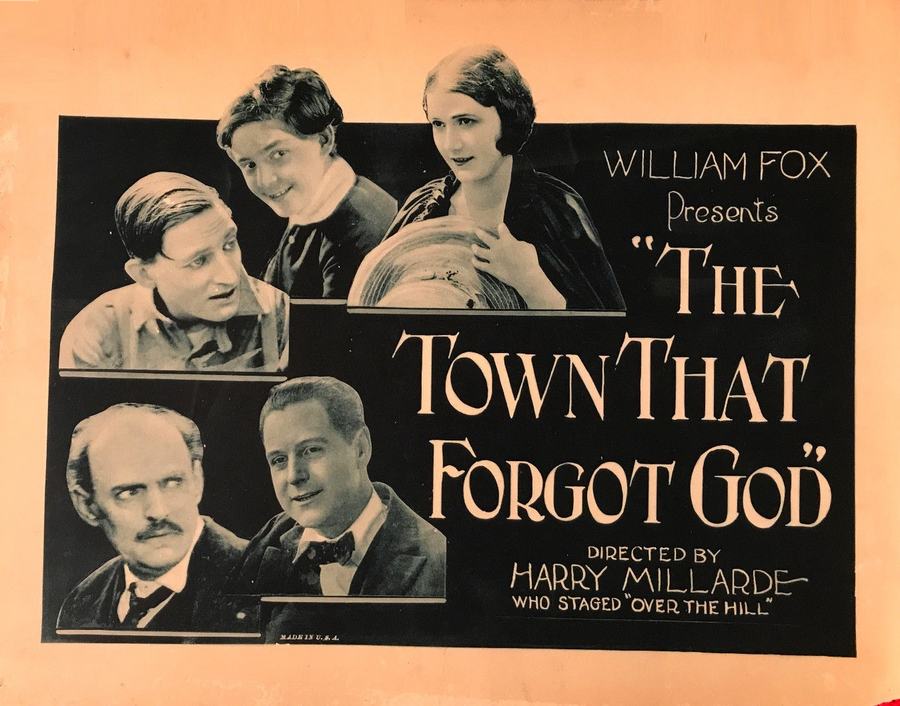
IMDb 7.4
1922
Community
Log in to comment.