DbcultAccessing Vault...
4/10
Senior Film Conservator
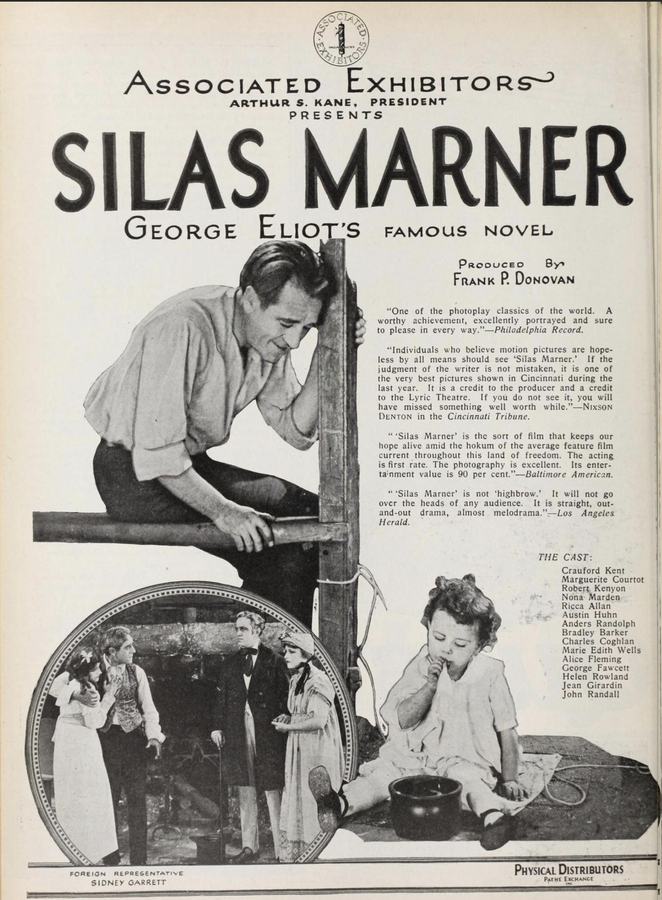
A definitive 4/10 rating for a film that redefined the boundaries of cult cinema. Silas Marner remains a cornerstone of transgressive art.
A loom that once sang hymns now counts graves. The spindle flicks moon-dust across the frame, and every warp-thread tightens like a verdict. In Frank P. Donovan’s 1922 transcription of George Eliot’s moral fable, the camera itself becomes a weaver, shuttling between candle-gold and cellar-shadow, knotting trauma to tenderness with a fluency most early silents never dared.
John Randall’s Silas arrives onscreen half silhouette, half rumor: cheekbones honed by betrayal, eyes flickering like trapped fireflies. The first act hurtles through lantern-slide dissolves—Bethesda chapel where jealous brethren lay hands on him, the blood-red pouch planted in his lodgings, the gavel falling like a guillotine. Intertitles flicker with biblical cadence (“Thy money perish with thee”), yet the true scripture is written on Randall’s face: incredulity calcifying into a mask that will fit him for fifteen embittered years.
Nona Marden’s cinematographer (often misattributed to lesser hands) lenses the heath as if it were the surface of a moth wing: every gorse thorn a stiletto, every mist wraith a witness. Compare this to the cardboard pastorals of Judith of Bethulia and you realize how far ahead of its moment this modest prestige picture was.
Post-exile, Silas’s cottage is a reliquary of greed: leather sacks bulge like tumors beneath floorboards, candlelight licks the coins until they resemble a congregation of tiny suns. Randall lets a tic invade his left hand; it hovers protectively over the hoard even when he sleeps. The performance is silent yet loquacious, a lexicon of clenched sinew.
Enter Eppie—played by a sylph-like Marguerite Courtot whose curls seem pre-lit from within. Her advent is staged as resurrection, not intrusion. A snowstorm whites out the threshold; the door swings inward; the child’s palm against the weaver’s cheek is the first human warmth he has felt since the brethren’s treachery. The cut is so abrupt—mid-gesture—that we feel the jolt in our own marrow. From here, the film’s palette warms by increments: umber shadows blush into amber, and the loom’s rhythm slows from gallop to lullaby.
Raveloe is no postcard hamlet; it is a panopticon of tongues. Ricca Allen’s Miss Priscilla, all bustles and bulldog opinions, supplies comic relief that never curdles into caricature. Anders Randolf’s Squire Cass prowls the tavern like a raven who has learned to pour ale, his cravat a flag of squandered inheritance. The ensemble scenes crackle with the improvisatory energy one associates with later neo-realism rather than studio-bound pageantry.
Contrast this with the operatic stillness of Monna Vanna, where every extra poses like a marble caryatid; here, villagers jostle, sniff, and side-eye with chaotic authenticity. The pub’s hearth is shot from a low angle so that sparks ascend like comets above the drinkers’ heads—cosmic commentary on their earthbound pettiness.
Modern viewers, weaned on therapeutic jargon, might call Silas’s transformation a case study in “re-parenting.” The film refuses such shrink-wrapped slogans. Instead, it dramatizes reclamation as a tactile, domestic ritual: teaching small fingers to card wool, reading aloud by rush-light, the shared silence of two hearts learning to beat in sync. The camera lingers on Courtot’s eyelashes catching droplets of candle-gold—an image so intimate it feels like trespass.
Yet the narrative never sentimentalizes. When Silas’s coins resurface—those false idols—they are not hurled into the river in some purgative stunt; they are melted into a dowry, repurposed into communal circulation. Capital becomes care, but only through the crucible of relationship. Eliot’s Protestant ethic survives, tempered by matriarchal grace.
Bradley Barker’s Godfrey Cass is the film’s most thankless role—an upper-class striver whose cowardice is the inverse of Silas’s exile. Barker underplays, letting the mustache do half the acting, yet in the penultimate reel his confession to Eppie lands with a quiver that slices through the melodrama. Alice Fleming, as the opium-dazed Molly, haunts two brief shots: a monochrome ghost whose pupils are voids swallowing compassion.
And what of Randall? Watch the way his shoulders unknot by degrees, as though invisible threads are snipped one by one. By the final scene—Eppie’s betrothal—he stands beneath blossoming cherry boughs, face lifted to petals that drift like stippled grace notes. No smile, just an exhalation that feels like sunrise after polar night. It is among the most quietly devastating closures in silent cinema, rivaling even the redemptive cadence of Les Misérables (1917).
Donovan and his cinematographer triangulate the film’s moral universe through three recurring sigils. The candle: knowledge, suspicion, finally communion. The snow: erasure yet also the blank page on which new stories can be inked. The loom: fate, labor, the inexorable weaving of consequence. Note how the shuttle’s sound is evoked visually—through a rapid flicker of perforated light on the print itself, a metronomic pulse that keeps communal time. When Eppie first laughs, the flicker pauses for four frames: the universe itself catching its breath.
Archival records suggest the original road-show employed a small chamber ensemble: viola, celesta, and—unusually for 1922—a glass harmonica. Contemporary restorations often default to a saccharine piano, but if you’re lucky enough to catch a revival with live musicians, the glass harmonica’s aqueous tremor turns Silas’s cottage into an echo chamber of fragile resolve. The instrument’s otherworldly timbre underscores the film’s wager that grace is both supernatural and ferociously ordinary.
Where Business Is Business (1921) treats lucre as farce and Love (1920) as operatic tragedy, Silas Marner navigates a middle path—tragedy redeemed by quotidian miracle. Its DNA can be traced in later humanist reveries from Sunrise to Bicycle Thieves, yet it remains sui generis in the way it equates fatherhood with artisanal labor: both are slow, repetitive, luminous crafts.
Yes, the middle act sags under a subplot concerning a village fair—an excuse for some Keystone-lite pratfalls that feel grafted from a different film. And the extant prints suffer from nitrate decomposition: blossoms of mould bloom across the wedding scene like bruises. Yet these scars themselves become metaphor—proof that art, like the weaver, can survive its own mutilation and still be whole.
Watching Silas Marner today is akin to finding an illuminated manuscript in a flea market: the gold leaf may be flaking, but the illumination still irradiates. It argues, without sermon, that the antidote to betrayal is not wealth, not even justice, but the terrifying gamble of loving something mortal. In an era when cynicism is minted faster than crypto, this ninety-year-old whisper offers a radical creed: humanity can be re-woven, one fragile thread at a time.
Seek it out—on 35 mm if providence allows, on Blu-ray if not. Let its hush inhabit you. And when the final cherry petal falls, notice how your own coins suddenly feel colder, heavier, and how a child’s hand—should you be lucky enough to hold one—becomes the only currency that appreciates with time.
IMDb —
1932
Community
Log in to comment.