DbcultAccessing Vault...
Cult Review
Senior Film Conservator
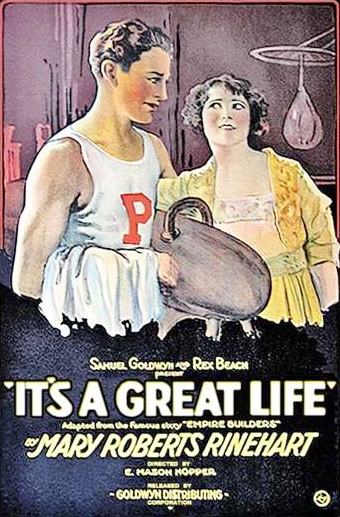
The year 1920 represented a seismic shift in the global consciousness, a moment where the Victorian vestiges of the previous century were finally being discarded in favor of a frantic, jazz-fueled modernity. In this cultural crucible, It's a Great Life emerged not merely as a piece of light entertainment, but as a fascinating artifact of the era's obsession with upward mobility and the burgeoning identity of the American teenager. Directed with a deft hand and written by the formidable duo of Edward T. Lowe Jr. and the legendary Mary Roberts Rinehart, the film navigates the liminal space between childhood innocence and the cynical machinations of the adult world.
Mary Roberts Rinehart, often heralded as the American Agatha Christie, brings a level of structural precision to this screenplay that was frequently absent in the more improvisational comedies of the time. While her reputation was built on shadows and suspense, here she applies her keen observational skills to the micro-society of a boys' boarding school. The setting acts as a laboratory for social experimentation. Unlike the dark, brooding atmosphere of Eye of the Night, this film breathes with an airy, almost bucolic vitality, even as it dissects the greed that bubbles beneath the surface of its youthful protagonists.
The central conceit—a pearl found in a restaurant oyster—is a classic MacGuffin, yet it serves a deeper thematic purpose. It is the catalyst for a transformation from student to entrepreneur, a metamorphosis that mirrors the broader American transition from an agrarian society to a titan of global commerce. Stoddard and his friend, the enigmatically nicknamed "The Wop," are not merely seeking pocket change; they are seeking agency. In this regard, the film shares a thematic kinship with the labor struggles depicted in Strejken, though filtered through a lens of privileged adolescence rather than industrial strife.
The casting of Thomas Persse and Francis X. Bushman Jr. provides a compelling anchor for the film's energetic pacing. Bushman Jr., carrying the weight of a famous lineage, displays a charismatic screen presence that hints at the matinee idol status he would later solidify. His chemistry with Persse is the engine that drives the narrative forward. Their interactions are characterized by a rapid-fire physical comedy that feels organic rather than choreographed, a stark contrast to the more rigid performances found in The Crimson Dove.
Molly Malone, as the obligatory yet charming female lead, provides a necessary counterbalance to the testosterone-fueled high jinks of the academy. While the role of women in these early boarding school films was often relegated to the periphery, Malone manages to infuse her character with a sense of wit and independence that predates the more radical flapper archetypes of the mid-20s. She is less a prize to be won and more a participant in the chaotic social dance. This nuance is something we also see glimpses of in Rose o' the River, where the female lead must navigate a world of masculine expectations.
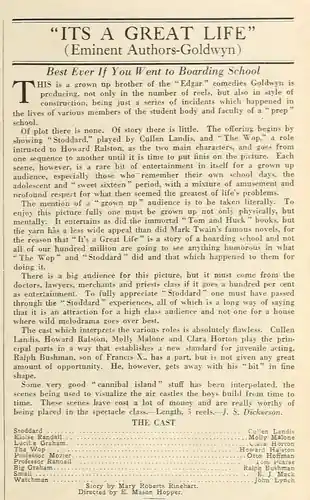
Technically, It's a Great Life is a testament to the sophistication of late-silent cinematography. The use of natural light in the outdoor scenes at the school creates a nostalgic, almost dreamlike quality that heightens the sense of a world apart. The camera work is surprisingly fluid, avoiding the static theatricality that plagued many films of the late 1910s. The framing of the restaurant scene, where the pearl is discovered, uses depth of field to create a sense of bustling reality, drawing the viewer into the boys' excitement.
When compared to the stark, almost documentary-like aesthetic of Il frantoio, this film feels like a polished jewel. The art direction by the Goldwyn studios (where the film was produced) ensures that every frame is packed with period-accurate detail, from the cluttered dormitories to the stiff, formal attire of the faculty. This attention to detail serves to ground the more fantastical elements of the plot, making the boys' scheme feel like a plausible, if ambitious, endeavor.
At its core, the film is an interrogation of value. What is a pearl worth? To the boys, it represents freedom. To the adults, it represents a breach of decorum or a potential tax liability. This divergence in perspective is where the film finds its most poignant humor. The "Great Life" promised by the title is a double-edged sword; it is both the carefree joy of youth and the heavy burden of material success. This duality is a recurring theme in the era's cinema, often explored with more tragic overtones in films like Moral Suicide.
The inclusion of the character "The Wop" is, by modern standards, a jarring ethnic caricature that cannot be ignored. However, in the context of 1920, it reflects the melting-pot anxieties of a nation grappling with immigration. The character’s resourcefulness and loyalty actually subvert some of the more malicious stereotypes of the time, positioning him as an equal partner in the enterprise rather than a mere sidekick. This complexity is absent in more straightforwardly xenophobic works like Alien Souls, suggesting that Rinehart and Lowe were attempting a more inclusive, albeit flawed, vision of American friendship.
To understand the unique positioning of It's a Great Life, one must look at its contemporaries. While In Search of the Castaways offered grand-scale adventure and The Bulldogs of the Trail provided rugged frontier justice, this film finds its drama in the mundane. It suggests that the greatest adventures are not found on high seas or dusty trails, but in the tactical maneuvers of a school lunchroom or the negotiation of a business deal. It shares the lighthearted romanticism of The Wooing of Princess Pat, yet it is anchored by a more cynical, mercantile heart.
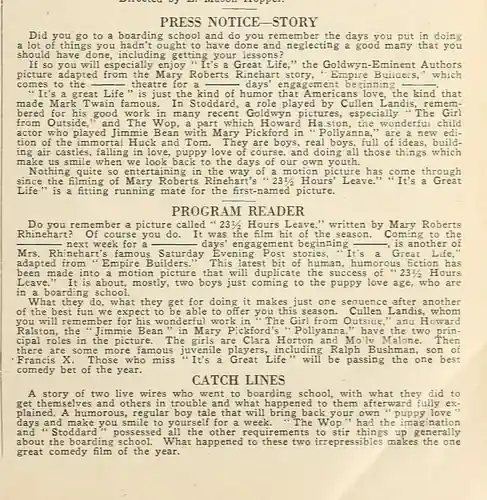
Even when compared to the whimsical Gretna Green, there is a groundedness here that is refreshing. The stakes feel real to the characters, and by extension, to the audience. We are not watching gods or heroes; we are watching boys who want to be men, and men who have forgotten how to be boys. This psychological depth is a hallmark of Rinehart’s writing and elevates the film above the standard "college comedy" fare of the early 20s.
The boarding school genre would eventually become a staple of American and British cinema, leading to everything from Dead Poets Society to the Harry Potter series. It's a Great Life stands as one of the earliest blueprints for this trope. It establishes the archetype of the rebellious student, the eccentric teacher (played with wonderful dry wit by Otto Hoffman), and the oppressive weight of institutional tradition. Unlike the heavy-handed social critique of Delo Beilisa, which deals with institutional injustice on a macro scale, this film focuses on the micro-injustices of the classroom and the dormitory.
The film also avoids the melodramatic pitfalls of After the Ball, opting instead for a brisk, episodic structure that keeps the audience engaged without overstaying its welcome. The pacing is modern, almost frantic at times, mirroring the energy of its protagonists. It is a film that demands to be watched with an eye for detail, as many of the best jokes and character beats are found in the background of the frame or in the subtle expressions of the supporting cast, such as Cullen Landis or Clara Horton.
In the final analysis, It's a Great Life is a film that transcends its simple premise. It is a vibrant, witty, and surprisingly insightful look at the dawn of the American century. Through the lens of a schoolboy’s get-rich-quick scheme, it captures the optimism, the greed, and the indomitable spirit of an era. It lacks the dark cynicism of Kinkaid, Gambler, choosing instead to believe in the fundamental goodness of its characters, even when they are led astray by the glitter of a pearl.
For the modern viewer, the film offers a rare glimpse into a vanished world. It is a reminder that the anxieties of youth—the desire for independence, the fear of failure, the bonds of friendship—are universal and timeless. While it may not possess the epic scale of some of its contemporaries like For Liberty, its intimate focus and sharp writing make it a far more enduring piece of art. It is, quite simply, a great life captured on celluloid, a pearl found in the vast oyster of silent cinema history that deserves to be polished and admired once more.
A masterful blend of adolescent whimsy and sharp social observation, this 1920 gem remains a high-water mark for the boarding school genre.
IMDb 6.1
1936
Community
Log in to comment.