DbcultAccessing Vault...
4.8/10
Senior Film Conservator
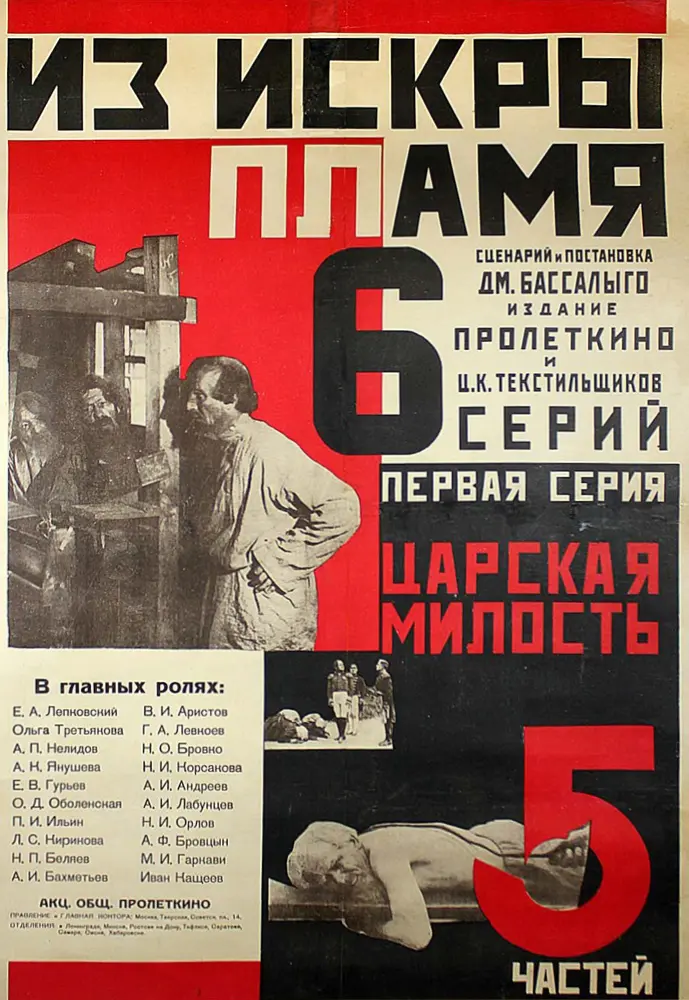
A definitive 4.8/10 rating for a film that redefined the boundaries of cult cinema. Iz iskry plamya remains a cornerstone of transgressive art.
Dmitri Bassalygo's 'Iz iskry plamya' (From a Spark, a Flame) isn't merely a film; it’s a living, breathing historical document, albeit one drawn from the rich tapestry of human struggle rather than direct annals. It’s a cinematic symphony of societal upheaval, a powerful, often brutal, testament to the enduring human spirit in the face of tyranny, and the terrifying, beautiful metamorphosis of quiet dissent into an inferno of revolution. From its opening frames, the film grips you with an almost tactile sense of foreboding, a palpable tension that hums beneath the surface of every mundane interaction in its fictionalized early 20th-century Eastern European setting. Bassalygo, with the precision of a seasoned historian and the soul of a poet, unravels a story that feels both intimately personal and monumentally epic, a true cinematic achievement that demands not just viewing, but profound contemplation.
At the heart of this simmering discontent is Olga Tretyakova's luminous portrayal of Anya, a young schoolteacher whose quiet demeanor belies a fierce, unyielding idealism. Anya is not a firebrand orator; she is the meticulous, almost invisible hand, the whispered truth in a world of official lies. Her work — the clandestine distribution of subversive pamphlets — is the titular 'spark,' a dangerous, solitary act that Bassalygo imbues with immense significance. Tretyakova's performance is a masterclass in understated power. Her eyes, often downcast, betray a burning conviction, a moral clarity that cuts through the film's oppressive atmosphere. We see the fear, the isolation, but also the unwavering resolve that allows her to persist. It's a performance that reminds one of the quiet, enduring strength found in The Girl with the Green Eyes, where individual conviction shines brightest against a backdrop of societal expectation.
This initial spark finds fertile ground in Vasiliy Aristov's character, Ivan, a factory worker whose life is a monotonous cycle of drudgery and despair. Aristov delivers a raw, visceral performance, charting Ivan's transformation from a man beaten down by circumstance to one galvanized by a nascent hope. His initial skepticism, his weary resignation, gives way to a simmering anger, then a focused determination, as Anya's words and actions penetrate his hardened cynicism. The scene where Ivan first reads one of Anya's pamphlets, his face illuminated by a flickering oil lamp, is a powerful moment of awakening, a silent revolution unfolding within a single soul. Bassalygo here brilliantly illustrates how systemic oppression can be challenged not by grand gestures, but by the quiet awakening of individual consciousness.
As the film progresses, the 'spark' begins to catch, igniting a broader, more complex movement. Grigori Levkoyev provides a deeply moving portrayal of the elderly intellectual, Professor Zorin, whose forbidden writings become the philosophical backbone of the burgeoning resistance. Zorin is the conscience of the movement, his wisdom a guiding light, yet his fragility underscores the immense personal risk involved. Levkoyev brings a quiet dignity to the role, his scholarly gravitas lending weight to every pronouncement, every clandestine meeting. His character serves as a poignant reminder of the power of ideas, even when expressed in hushed tones.
Conversely, Evgeniy Lepkovskiy's revolutionary leader, Kirov, is a figure shrouded in mystery and charisma, operating from the shadows. Kirov represents the pragmatic, sometimes ruthless, face of revolution – the strategic mind willing to make difficult choices for the greater cause. Lepkovskiy gives Kirov an unsettling magnetism, a compelling blend of idealism and calculated coldness that makes him both inspiring and terrifying. His influence, though often unseen, is the wind fanning the flames, pushing the movement towards its inevitable, violent confrontation. This duality of leadership, the inspiring and the unsettling, echoes the complex moral landscape explored in films like The Lion of the Hills, where heroic figures are often burdened by their own methods.
On the opposing side stands Nikolay Bravko as Inspector Volkov, a pragmatic police official tasked with crushing the burgeoning rebellion. Bravko's performance is nuanced and deeply human, avoiding the easy caricature of the villainous oppressor. Volkov is a man bound by duty, yet increasingly troubled by the brutality he is commanded to enforce. His character arc is one of the film's most compelling elements, as he grapples with the moral compromises inherent in serving an unjust system. We witness his gradual disillusionment, a silent internal struggle that mirrors the external conflict. Bassalygo uses Volkov to explore the insidious nature of authoritarianism, not just on the oppressed, but on the enforcers themselves, a theme subtly present in the psychological tension of Camera obscura. Volkov is not a hero, but his internal conflict adds a vital layer of complexity, preventing the narrative from devolving into a simplistic good-versus-evil dichotomy.
Dmitri Bassalygo's directorial vision for 'Iz iskry plamya' is nothing short of audacious. The film's aesthetic is one of stark realism, yet infused with a poetic sensibility that elevates it beyond mere historical recreation. The cinematography, often employing natural light and long, unblinking takes, creates an immersive, almost voyeuristic experience. The bleak, industrial landscapes and the cramped, shadowed interiors are not just backdrops; they are extensions of the characters' internal states, mirroring their despair and their nascent hope. The use of deep focus often places individuals within the vast, indifferent machinery of their world, emphasizing their isolation and the monumental scale of their struggle. This visual storytelling is reminiscent of the immersive, often suffocating, atmosphere found in Topiel, where the environment itself becomes a character.
The sound design is equally meticulous and impactful. The omnipresent hum of factory machinery, the distant clatter of hooves on cobblestones, the hushed whispers of conspirators, and the eventual cacophony of riot and gunfire all contribute to an exquisitely crafted soundscape. The silence, when it falls, is heavy and pregnant with meaning, often preceding moments of profound revelation or brutal violence. There's a particular sequence where the only sound is the rhythmic thud of boots on snow, growing louder, more menacing, as the authorities close in – a chilling example of sound used to build unbearable tension.
Dmitri Bassalygo's screenplay is a marvel of intricate plotting and character development. It avoids simplistic narratives, instead delving into the moral ambiguities and personal sacrifices inherent in revolutionary movements. The dialogue is sharp, intelligent, and often laced with a tragic irony. There are no easy answers, no clear-cut heroes or villains, only individuals caught in the inexorable tide of history. The script masterfully balances moments of intense action with quiet, reflective scenes, allowing the audience to fully grasp the emotional and intellectual stakes. It's a testament to Bassalygo's writing prowess that even though the story is fictionalized, it feels profoundly authentic, resonating with universal themes of justice, freedom, and the human cost of their pursuit. The complexity of the narrative and the philosophical undertones share a kinship with films like Tao, which explore deeper human truths through specific contexts.
The film's second act sees the 'spark' truly become a 'flame,' as the scattered acts of resistance coalesce into organized dissent. The clandestine meetings in dimly lit cellars, the surreptitious printing presses, the careful recruitment of new members – Bassalygo builds this escalation with a relentless, almost documentary-like pace. The tension ratchets up with each successful pamphlet distribution, each whispered conversation. The sense of a ticking clock is palpable, as the regime's grip tightens, leading to increasingly brutal crackdowns. The film doesn't shy away from depicting the violence and terror inflicted by the state, nor the grim realities faced by the revolutionaries. There are moments of heartbreaking loss, sacrifices that feel deeply personal and devastating, reminding us that revolution, while often necessary, is never without profound pain.
The climax is a breathtaking, harrowing depiction of a full-scale uprising. It’s chaotic, visceral, and utterly disorienting, capturing the raw, untamed energy of a populace pushed to its breaking point. Bassalygo's direction here is masterful, weaving together multiple character perspectives within the maelstrom. We see Anya's courage, Ivan's fury, Volkov's conflicted despair, and Kirov's distant, calculating oversight. The street battles are choreographed with a brutal realism, devoid of cinematic glamor, emphasizing the sheer desperation and the tragic waste of life. It’s a sequence that leaves you breathless, disturbed, and profoundly moved, akin to the unflinching portrayal of conflict in Khishchniki sletelis, where the harsh realities of struggle are laid bare.
What truly distinguishes 'Iz iskry plamya' is its refusal to offer simplistic resolutions. The film's ending is not a triumphant fanfare, but a sober, reflective coda. The revolution, having run its course, leaves behind a landscape irrevocably altered, but also scarred. Bassalygo doesn't glorify the outcome; instead, he asks piercing questions about the nature of victory, the true cost of freedom, and whether the 'flame' consumed more than it illuminated. The fate of many characters, even those who survive, is ambiguous, suggesting that the struggle for a better world is an ongoing, often cyclical process, rather than a single, decisive battle. This nuanced perspective resonates with the complex pursuit of ideals seen in Jagd nach dem Glück, where happiness is elusive and hard-won.
The performances across the board are uniformly excellent, but Tretyakova, Aristov, and Bravko stand out for their profound emotional depth and their ability to convey complex internal lives with minimal exposition. Bassalygo, as a writer and director, has crafted a work of immense power and relevance. 'Iz iskry plamya' is not just a historical drama; it's a timeless exploration of human resilience, the contagion of ideas, and the ever-present tension between order and liberty. It's a film that lingers long after the credits roll, prompting introspection and debate. It reminds us that even the smallest spark of defiance can, under the right conditions, ignite a blaze that reshapes the world, for better or for worse.
In an era where many historical dramas opt for grand spectacle over profound substance, 'Iz iskry plamya' stands as a towering achievement, a film that understands the true drama lies not just in the clash of armies, but in the battle for the human soul. It's a challenging, essential piece of cinema that reaffirms Bassalygo's status as a visionary filmmaker, and a powerful commentary on the enduring echoes of history in our present. This is a film that deserves to be seen, discussed, and remembered for its unflinching honesty and its artistic brilliance. It’s a testament to the enduring power of cinema to illuminate the darkest corners of the human experience and, indeed, to ignite a spark within its audience.
The intricate weave of personal stories against a monumental backdrop of societal change is what makes 'Iz iskry plamya' an indelible cinematic experience. It's a film that transcends its specific setting to speak to universal truths about power, resistance, and the often-brutal journey towards a more just world. It's a triumph of storytelling, a testament to the fact that a single, well-placed 'spark' can indeed set the world ablaze, for good or ill.
Ultimately, Bassalygo's film is an urgent reminder that history is not a static collection of facts, but a dynamic, often violent, process driven by human choices and passions. The echoes of 'Iz iskry plamya' resonate with contemporary struggles, urging us to consider the origins of conflict, the ethics of resistance, and the ultimate price of change. It's a profound, essential viewing experience that solidifies its place as one of the most compelling and thought-provoking historical dramas of its time.
IMDb 6.8
1936
Community
Log in to comment.