DbcultAccessing Vault...
5.6/10
Senior Film Conservator
A definitive 5.6/10 rating for a film that redefined the boundaries of cult cinema. La comtesse de Somerive remains a cornerstone of transgressive art.
To watch La comtesse de Somerive in the modern era is to engage in a form of cinematic archaeology that yields surprisingly visceral rewards. Released in 1917, a year when the world was hemorrhaging under the Great War, this French production directed by Georges Denola and Jean Kemm offers a stark, claustrophobic look at the internal wars waged within the drawing rooms of the elite. It is a film that breathes through its shadows, utilizing the visual grammar of the late 1910s to articulate a story of shame, redemption, and the inescapable gravity of one's history.
The screenplay, adapted from the work of Théodore Barrière, carries the DNA of the 19th-century stage, yet it transcends its theatrical origins through a sophisticated use of mise-en-scène. Unlike many of its contemporaries that relied on static, wide-angle tableaus, this film begins to experiment with the intimacy of the frame. We see the Somerive estate not just as a backdrop, but as a character—a gilded cage where every ornate mirror and heavy velvet curtain serves to remind the protagonist of her confinement.
"The film functions as a precursor to the psychological realism that would later define European cinema, predating the haunting interiority of films like Sumerki zhenskoy dushi by several years in its treatment of the female psyche."
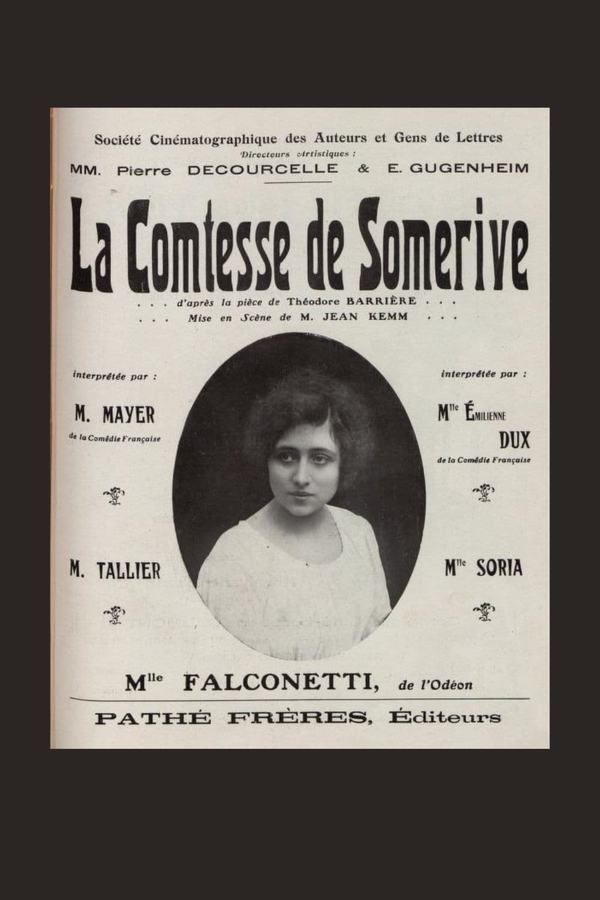
The casting is nothing short of inspired. While Émilienne Dux carries the emotional heavy lifting with a performance of weathered dignity, modern cinephiles will undoubtedly be drawn to the presence of a young Maria Falconetti. Years before she would be immortalized by Dreyer as Joan of Arc, Falconetti displays here a nascent version of that legendary intensity. Her eyes, even in this early role, possess a luminous quality that seems to pierce through the grain of the film stock. She provides a youthful counterpoint to the more rigid, traditional acting styles of the veteran cast, hinting at the revolution in screen performance that was just over the horizon.
Thematically, the film shares a spiritual lineage with Et Syndens Barn, focusing on the 'child of sin' motif that was so prevalent in early 20th-century narrative. However, La comtesse de Somerive avoids the easy path of moralizing. Instead, it invites the viewer to empathize with the impossible choices forced upon women by a patriarchy that demanded purity while simultaneously thriving on exploitation. The conflict between the Countess and the forces of blackmail is not just a plot device; it is a critique of a society that values the appearance of virtue over the existence of actual compassion.
Visually, the restoration reveals a surprising depth of field. The use of natural light in the exterior garden scenes contrasts sharply with the stifling, low-light interiors of the Somerive mansion. This visual dichotomy mirrors the Countess's own internal struggle: the desire for the freedom of her past versus the suffocating reality of her present title. In many ways, the film’s aesthetic approach reminds me of the atmospheric tension found in The Mystery of the Yellow Room, where the architecture itself seems to hold the secrets of the inhabitants.
One cannot discuss this film without acknowledging its pacing. In an era where many American films like The Flames of Johannis were moving toward faster editing and more overt action, the French school—and this film in particular—retained a certain meditative quality. The camera lingers on the faces. It allows the silence to settle. This creates a sense of mounting dread that is far more effective than any orchestral swell could achieve. When the climax arrives, it feels earned, a logical explosion of the pressures that have been building since the first frame.
The supporting cast, including Jean Kemm and Albert Mayer, provides a solid framework for the central drama. Kemm, who also co-directed, understands the necessity of understated masculinity in this context. His performance allows the women to remain the focus, a rarity for the time. This shift in perspective makes the film feel remarkably modern, echoing the character-driven depth of The Mysterious Miss Terry but with a distinctly European cynicism.
As a blogger who has waded through hundreds of silent-era reels, I find La comtesse de Somerive to be a vital link in the evolution of the social drama. It lacks the bombast of the Italian epics like Cleopatra, but it gains something far more precious: an authentic emotional resonance. It is a film about the cost of a name, the price of a secret, and the ultimate futility of trying to outrun one's own shadow.
The final act of the film is a masterclass in tension. As the various threads of the Countess's life begin to unravel, the cinematography becomes more frantic, the framing tighter. We feel her world closing in. The resolution is not a neat bow tied around a happy ending; it is a somber acknowledgment of the permanence of social exile. It leaves the viewer with a lingering sense of melancholy, much like the ending of At Bay, where the victory feels hollow because of what was lost along the way.
In the pantheon of 1917 cinema, this film stands as a testament to the sophistication of the French industry during a time of global upheaval. It managed to produce a work of art that was both a product of its time and a timeless exploration of human frailty. For those interested in the roots of cinematic performance, seeing Falconetti here is essential. For those interested in the history of the melodrama, the narrative structure is a blueprint. And for the casual viewer, the story remains a gripping, if tragic, journey into the heart of a woman who dared to have a past in a world that only cared for her present.
Final Thought: A haunting, beautifully composed artifact that proves the 'silent' era was anything but quiet when it came to the complexities of the human condition. It is a must-watch for anyone looking to understand the bridge between 19th-century literature and 20th-century visual storytelling.
IMDb 5.3
1919
Community
Log in to comment.