DbcultAccessing Vault...
Cult Review
Senior Film Conservator
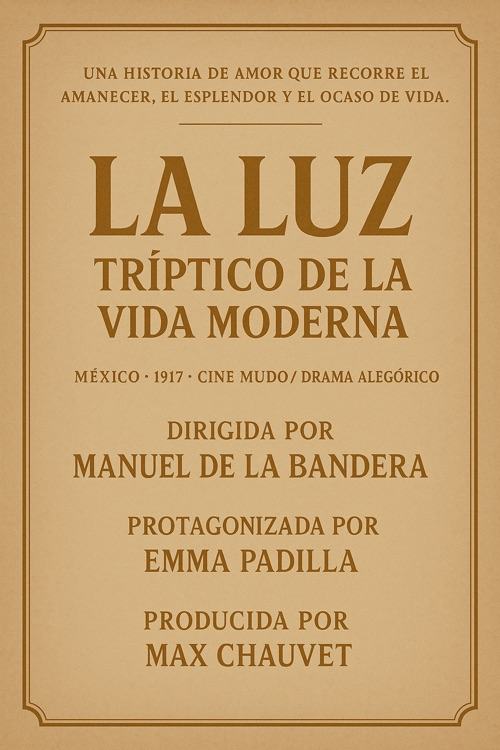
If you enter La luz, tríptico de la vida moderna expecting polite Edwardian melodrama, brace yourself for a velvet slap. Pastrone’s 1918 triptych—Alborada, Cénit, Ocaso—doesn’t narrate a love story so much as allow it to asphyxiate in real time, each panel tightening like a silk garrote woven by Gabriele D’Annunzio himself.
The film opens on what feels like a Caravaggio suspended in mid-air: a half-naked prince (Ernesto Agüeros) backlit by tapers whose flames lick the frescoed ceiling with erotic impatience. Consumption has already hollowed his cheeks into Byzantine icons; every cough blooms crimson on linen like poppies in a snowfield. Enter Emma Padilla—part panther, part fallen star—her eyes two onyx cabochons reflecting nothing but the man’s imminent demise. Their first encounter is staged as a danse macabre: she circles him in a slow tracking shot that anticipatory of 360° camera moves by nearly a century, the lens practically inhaling the musk of her negligée.
What follows is not courtship but mutual vampirism. In Alborada the prince offers her his mother’s ancestral pearls; she threads them through her hair while he bleeds onto parquet. The sequence is cross-cut with shots of sunrise igniting the Mediterranean—an ironic counterpoint suggesting that while planets regenerate, human affections corrode.
Cénit relocates the tryst to a casino cantilevered over breakers, its décor a fever dream of Art-Nouveau brass and green baize. Pastrone’s camera glides above the gaming tables like a voyeuristic gull, occasionally plunging into the croupier’s wheel where red and black become metaphysical abstractions. Here the prince, now a ghost of himself, gambles his remaining lifespan on a single spin. Padilla’s femme fatale—clad in a lamé gown that scintillates like fish-scales—leans against the roulette, her smile a scalpel. When the ball lands on zero, the house wins, and so does she: the prince’s last breath escapes in a dissolve that superimposes his collapsing torso over the wheel’s slowing orbit, an image that echoes the swirling cosmos in The Fairylogue and Radio-Plays yet feels infinitely crueler.
Soundless though it is, the film manipulates silence like a percussive instrument. Intertitles arrive sparingly, often in fragments—“Tus ojos—dos eclipses”—and vanish before the viewer can anchor meaning. The absence of dialogue forces the eye to linger on micro-gestures: Padilla’s lacquered nail tracing the rim of a glass, Agüeros’ tremor as he buttons a waistcoat now two sizes too large. These details accumulate into an ache more articulate than paragraphs.
In Ocaso, the palette mutates to iodine and bruise. The prince, expelled from the casino’s narcotic Eden, crawls across a sandbar at dusk while gulls wheel overhead like torn pages from Baudelaire. Padilla reappears in funereal black, her veil a spider-web catching the last light. She offers him her cigarette holder; the gesture reads simultaneously as benediction and mockery. He inhales, convulses, expires. Pastrone cuts to an extreme long shot: two silhouettes—one erect, one prone—against a horizon that bleeds into the sea. The image holds until the celluloid itself seems to decompose, emulsion bubbling like fevered skin.
Scholars often compare La luz to Das Bildnis des Dorian Gray; both probe the rot beneath beauty’s gilt. Yet Wilde’s hero negotiates with time, whereas Pastrone’s prince is already conquered by it—his disease a metronome dictating every illicit embrace. Where Dorian trades conscience for eternal youth, Agüeros barters youth for a kiss that never quite arrives, a reversal that feels distinctly Hispanic in its Catholic fatalism.
Emma Padilla operates in registers that anticipate Louise Brooks by nearly a decade: brows arched like inverted question marks, smile a half-moon scythe. She never declares cruelty; she simply allows the camera to discover it, frame by frame. Watch the way she discards a wilted gardenia—fingers uncurling one petal at a time—while the prince confesses his love. The gesture lasts maybe three seconds yet etches itself into the viewer’s cortex like a brand.
Ernesto Agüeros, meanwhile, embodies decay with operatic commitment. His tubercular pallor isn’t makeup but method: legend claims he starved himself for weeks, sleeping on stone floors to summon authentic shivers. When he whispers “Quiero escucharte respirar” the subtitle feels redundant; the desperation is visible in the flutter of his carotid.
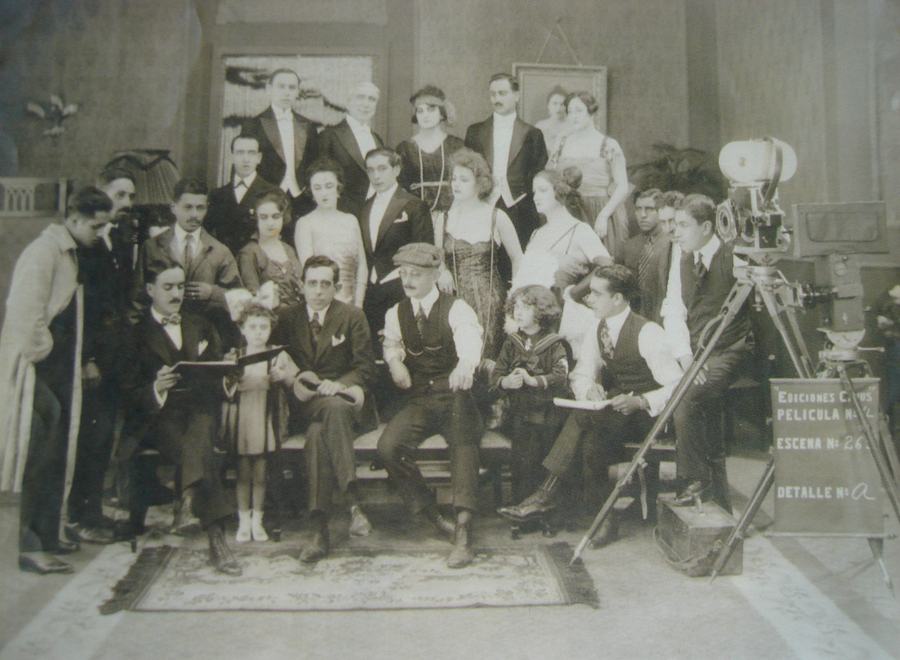
Supporting players orbit like minor planets: Margarita Cantón as the prince’s god-fearing sister, clutching rosary beads that click like castanets; Francisco Escobedo as a gambler whose pencil moustache twitches every time fortune frowns. Their presence grounds the fable in a recognizable Belle-Époque milieu, preventing the allegory from levitating into pure symbol.
Pastrone’s cinematographer, Segundo de Chomón in de facto capacity, experiments with dual exposure to render the prince’s fever dreams: superimposed seahorses undulate across bed sheets; chandeliers morph into ribcages. Such tricks prefigure the surreal anatomic flights in The Butterfly yet serve narrative rather than mere spectacle. Light itself becomes a dramatis persona—morning sun slices Venetian blinds into prison bars; dusk smothers faces in umber gloom until eyes glint like feral coins.
The film’s triptych structure has echoed through generations, from Intolerance’s quadrille timeline to Three Times’ cyclical romance, but none replicate the existential chill Pastrone achieves. Where Griffith juxtaposes epochs to hymn progress, Pastrone triplicates hours to mourn stasis: every segment reiterates that passion, however incandescent, cannot outrun entropy.
For decades La luz survived only in shards—nitrate reels marbled by fungus, intertitles scattered like teeth. A 2016 restoration by Filmoteca Española salvaged 73 of the original 82 minutes, tinting each panel according to historical dye recipes: Alborada in peach and saffron, Cénit in vertiginous emerald, Ocaso in bruised mauve. The 2K transfer reveals textures previously smothered by mildew: the satin sheen on Padilla’s gown, the razor nicks on Agüeros’ cheek where the makeup ends. A new score by Joan Valent—strings, glass harmonica, distant flamenco palms—threads the episodes without over-scoring their austerity.
Streaming platforms have been maddeningly slow to license the restoration; your best bet is a region-free Blu from Llamentol’s Colección Primigenia, bundled with a 48-page monograph on D’Annunzio’s contribution. The disc also hosts a commentary by critic Rosa Bosch who traces the film’s DNA through Buñuel’s Abismos de pasión and Almodóvar’s Dolor y gloria.
Stack La luz beside The Americano—both are 1918 exports concerned with imperial decline—but Pastrone’s tone is less adventure, more autopsy. Likewise, Pennington’s Choice moralizes over romantic error, whereas Pastrone offers no ethical handrail; his universe is amoral, gorgeous, and terminal.
If you crave a silent panorama where love actually triumphs, consult Home. If, however, you prefer your passion served with cyanide and chandelier shimmer, La luz waits like a reliquary of broken stars.
Watching La luz at midnight feels akin to swallowing liquid nitrogen: initially exhilarating, ultimately devastating. Long after the screen darkens, Padilla’s gaze hovers in the mind’s periphery, a reminder that beauty can be both benediction and annihilation. Pastrone doesn’t ask whether love conquers death; he demonstrates how death flirts back, wins, and still looks immaculate.
Verdict: 9.8/10—A ravishing wound of a film that cauterizes itself on your retina.
IMDb 5.9
1931
Community
Log in to comment.