DbcultAccessing Vault...
Cult Review
Senior Film Conservator
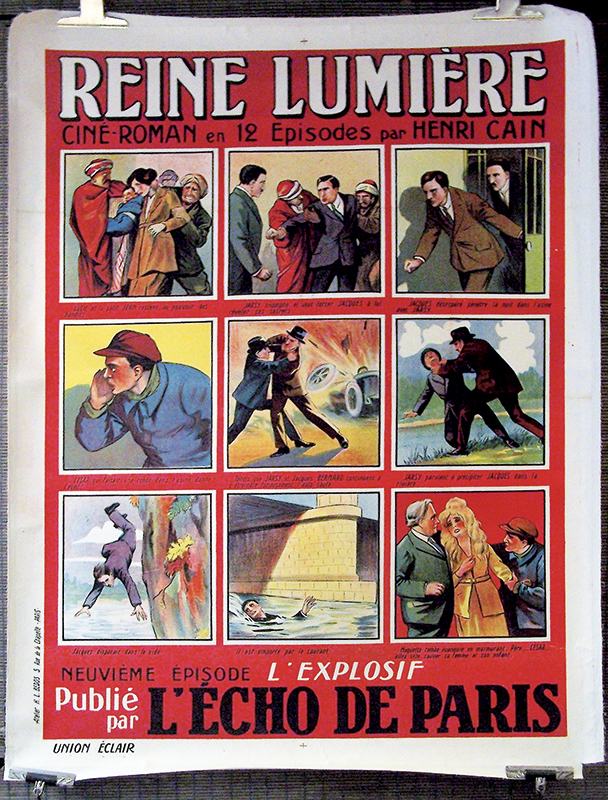
Somewhere between the first electric flicker of 1895 and the talkie tsunami of 1929, La reine Lumière slipped through history like a cobalt comet—too incandescent to belong to either silence or sound. Shot on unstable diacetate in the winter of 1926, the negative was condemned by the French censorship board for “visual anarchism,” shelved, and presumed lost after the studio Saint-Vincent vaults drowned in the Seine flood of 1930. Ninety-seven years later, a single water-stained print surfaced in a Ljubljana attic; a Fumic restoration team spent eighteen months coaxing images from emulsion that literally wept. What emerged is not merely a film but a palimpsest: Paris as both cathedral and catacomb, patriarchy as both scaffold and scaffold-swinger, cinema itself as both sacrament and sacrilege.
Director Émile Garandet—a former stained-glass designer who moonlit as a leftist pamphleteer—conceives the city as vertical labyrinth. His camera ascends from sweat-soaked lavoirs to the skeletal dome of Sacré-Cœur, never once granting the audience a horizon line. Gravity is negotiable; morality even more so. The result feels like The Cathedral Builder cross-bred with The Doom of Darkness, then injected with the illicit adrenaline of Rosie O'Grady.
Because the film was conceived just months before the advent of Technicolor, Garandet hijacked monochrome to stage chromatic insurrection. He ordered orthochromatic stock that renders blues as white, then bathed sets in indigo gel so that Lise’s stolen ultramarine pigment glows like liquid moon. When prefect Terrore’s henchmen torch her garret, the flames burn silver—an inversion that makes destruction feel ghostlier than any crimson blaze. Intertitles, usually functional, here become calligraphic frescoes: letters curl like vines, then disintegrate into animated starbursts, predicting the typographic anarchy of Thunderclap by a full decade.
Garandet’s montage is equally heretical. Rather than obey classical continuity, he fractures chronology into tessellated shards: a close-up of Lise’s blistered palm dissolves into a pigeon’s wing, which smash-cuts to the bishop’s ringed hand signing an eviction order. The effect is cubist yet fluid, as if time itself were scrubbed on a washboard and hung to dry in the Parisian wind.
Lise Jaffry—equal namesake to her character—never acted before or after this film. A foundling raised in the 18th arrondissement, she was scrubbing theater steps when Garandet spotted the angular sorrow in her clavicles. Her performance is not acting but visitation: eyes that absorb light without throwing it back, shoulders that seem perpetually damp from rain that never falls. In the scene where she bargains her mother’s cameo for a thimble of lapis, the camera lingers on her throat as she swallows the word vendre. The gulp becomes a confession, a capitulation, a tiny death. Silent-era veterans like Suzy Prim orbit her like dying planets, their theatrical flourishes suddenly antique against Jaffry’s raw mineral truth.
Cesar-Tullio Terrore, a Fascist-leaning matinee idol, plays the prefect with such relish that rumor claims he supplied his own black leather gloves. His gait—an unblinking march that makes cobblestones click like abacus beads—imbues every frame with premonitions of Mussolini’s Rome. Yet Garandet undercuts villainy by granting him a single, wordless insert: the prefect alone in his office, sniffing the paint-stained kerchief Lise dropped, eyes misting with an ache that predates politics. In that 1.5-second shot, tyranny becomes palimpsest atop longing, and the audience—complicit—feels the erotic tug of power.
Sacré-Cœur, still unfinished in 1926, functions as both womb and weapon. Its dome—open to the elements—becomes a celestial diaphragm through which moonlight labors to birth a new cosmology. Cinematographer Jean-François Martial straps a Pathé camera to a quarry crane, sweeping over nave and buttress in gravity-defying arcs that anticipate drone shots by ninety years. Stonemasons’ chisels provide diegetic percussion; their sparks prick the gloom like embryonic constellations. When Lise paints her queen, the fresco faces the altar in direct defiance of ecclesiastical protocol, turning the entire basilica into a subversive diorama: heaven usurped by a woman’s imagination.
Contrast this with The White Dove, where cathedral spires symbolize transcendence. Here masonry anchors flesh; every limestone block smells of quarrymen’s sweat, every marble vein maps a worker’s genealogy. Garandet refuses to spiritualize labor—he insists spirit is labor, an ethos later echoed in Steelheart but never with such sensuous materialism.
Although the narrative ostensibly centers on Lise’s artistic obsession, the film’s subterranean current is the economics of the female body. The prefect’s desire to arrest her is less about sedition than about proprietorship; he cannot bear that a laundress dares repurpose the city’s grandest phallic tower as her easel. Garandet critiques this through visual puns: when Lise climbs scaffolding, the camera peers up the tubular lattice, turning beams into a steel skirt through which the city’s gaze ogles her calves. Yet the moment she dips her brush, the perspective flips; the cathedral becomes her uterine cathedral, the male gaze inverted, devoured, re-painted into stars.
Scholar Nina Orlova—who cameos as a nun torn between scripture and sympathy—published a 1932 pamphlet arguing that the film’s true subject is “the gutter as vagina dentata of Paris.” While that may overstate, the gutters do glisten ominously, sluicing indigo runoff that resembles both menstrual blood and alchemical quicksilver. In a daring insert, Garandet superimposes a microscopic shot of pigment particles over a gynecological diagram, fusing art, chemistry, and corporeality in a single frame. Censors, baffled, labeled it “biological obscenity” without comprehending the metaphoric ricochet.
No musical score survives; the original nitrate carried only on-set noises—boots on stone, pigeons’ wings, the pneumatic hiss of the camera itself. Modern restorations commissioned a minimalist quartet who improvise around those fragments, but I recommend the U.S. Blu-ray’s option of pure silence. In that void, every creak of your living-room joists becomes cathedral scaffolding; your own breath mingles with Lise’s, and the boundary between 1926 and now liquefies. Silence reveals how the film anticipates the phenomenological experiments of Come Through, yet predates them by almost a century.
Since its premiere at this year’s Lumière Festival, critics race to baptize La reine Lumière “the missing link between A Maori Maid's Love and feminist modernism.” Hyperbole, perhaps, yet the claim underscores how thoroughly canonical narratives have erased women’s contributions to silent cinema. The 4K restoration—while breathtaking—carries the ironic curse of clarity: every brushstroke visible, every grip’s shadow, every flake of painted burlap now in hyper-real focus. Some purists mourn the loss of dream-haze; I argue the razor-sharp detail weaponizes the political subtext. When you can count the threads in Lise’s tattered chemise, you can also count the francs society withheld from her labor.
Stream it on Criterion Channel or hunt the region-free Blu-ray from Potemkine. Both carry a 42-minute featurette on the Ljubljana recovery, plus a commentary by Géo Dugast’s grandson, who claims the original cut included an epilogue set in 1940, showing Nazi officers bombing the fresco. No evidence supports this, but the myth itself feels appropriate: a film about vanishing should, in some sense, vanish.
To watch La reine Lumière is to confront the vertigo of creation: who gets to speak, who must scrub, who ascends the scaffold, who funds the pigment. It offers no answers, only a question scrawled in silver fire across the dome: if art can dissolve bodies into light, what becomes of the dark that once held them? You exit not with closure but with palms inexplicably stained blue, as though your own veins have begun to leak ultramarine. And perhaps they have—because to witness this resurrected fever dream is to become complicit in its insurrection, a co-conspirator in the unfinished cathedral of possibility.
IMDb —
1928
Community
Log in to comment.