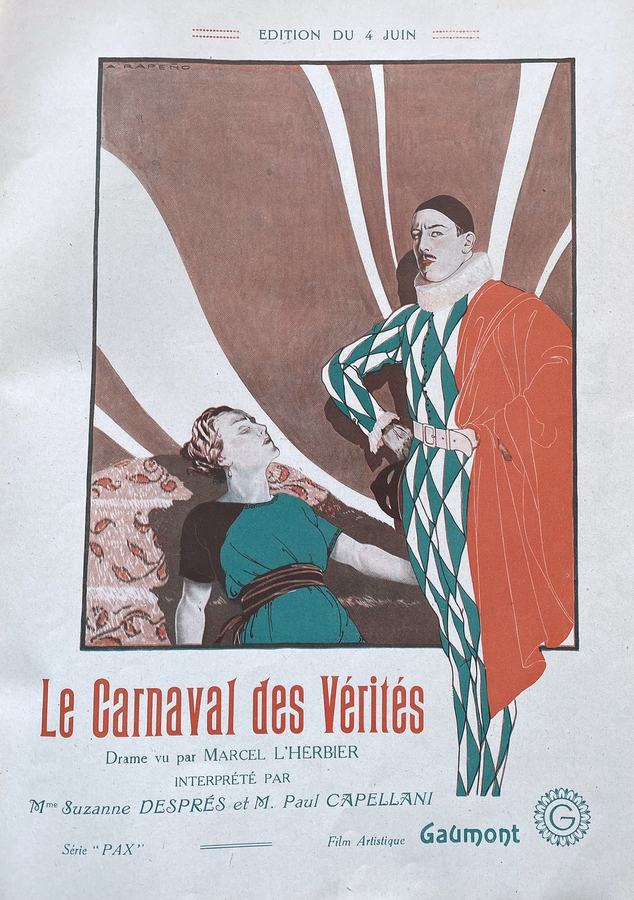
Imagine a chandelier whose every crystal is a razor-edged truth waiting to slit the finger that dares to polish it—so hangs the world of Le carnaval des vérités. Marcel L’Herbier’s 1923 phantasmagoria arrives like a velvet-clad poison letter, its very title a dare: which sequined mask at this soirée hides the authentic face? The film’s plot, deceptively simple on parchment, mutates inside the projector’s beam until it becomes a Möbius strip of desire, a hall of mirrors where every exit sign is painted on glass.
The Countess, portrayed by Marcelle Chantal with the languid cruelty of a cat who has already lapped the cream, believes she can script human folly like a salon farce. Beside her, Jaque Catelain’s Vellini is all angular cheekbones and verses spilling like absinthe; together they weave a honey-trap for Raphaël (Paul Capellani), a shipbuilding magnate whose wealth is rivaled only by his terror of scandal. Their pawn is Héloïse (Mado Minty), an orphan raised on romantic fairytales and moonlit piano études, whose innocence radiates like phosphor against the Countess’s obsidian guile.
But L’Herbier, ever the cubist moralist, refuses to grant anyone the comfort of omniscience. His camera pirouettes through parlors lacquered in sea-blue enamel, then dives into extreme close-ups where a single false eyelash becomes a harpy’s wing. The director’s prior Die toten Augen already toyed with ocular deception, yet here he escalates the ocular treachery: every iris-like iris-in shot questions who watches whom, who frames whom, who ultimately devours whom.
Visions Carved from Light
“A mirror is the only honest conspirator; it never lies, it only repeats your lies back in infinite regression.”
The film’s visual lexicon is a fever chart of sea-blue and ember-orange. Ballroom scenes drown in teal shadows that ripple like tide pools, while carnival fireworks spray molten gold across the nocturnal bay. Cinematographer Georges Périnal (later to lens When the Clouds Roll By) bends light as if it were wet clay, letting bokeh blossoms hover like drunk bees around the characters’ heads. The effect is not mere prettiness but a moral acid test: beauty so fierce it corrodes the soul.
Watch how the Countess’s black feather boa absorbs the screen’s glow until it becomes a void, a negative space that sucks the ethical oxygen from any room. Contrast that with Héloïse’s debut gown—organza dyed in the palest blush—its hem catching the projector’s beam so that she seems to walk inside her own halo. Yet L’Herbier savagely undercuts that beatitude: when she learns the wager behind Raphaël’s attentions, the same gown is drenched in carnival wine, a blood-baptism of knowledge.
Sound of Silence, Taste of Iron
Though mute, the film is sonorous. Intertitles, calligraphed like love-notes on parchment-colored cards, arrive sparingly—never expository, always surgical. One reads simply: “Et le masque devint visage.” The viewer must supply the gasp. Meanwhile, on the restored 4K Blu-ray, the optional score by Alea Tered mixes glass harmonica with distant ship horns, a soundscape that tastes of brine and rusted anchors. The effect crawls under your tongue like the after-swallow of an oyster you’re not quite sure was still alive.
Performances Etched in Nitrate
Marcelle Chantal works in micro-gestures: the way her pupils dilate when she overhears a lucrative secret, or how her left nostril flares almost imperceptibly when a plan falters. She never succumbs to silent-era histrionics; her villainy is bespoke, tailored, perfumed. You almost root for her—until you remember the orphanage she bankrupted to fund her pearls.
Opposite her, Mado Minty channels a tremulous luminosity reminiscent of His Sweetheart’s Lillian Gish but filtered through French existential dread. Watch the sequence where Héloïse discovers the clandestine contract hidden inside a hollowed-out prayer book: Minty’s breath fogs the lens, a happy accident that L’Herbier kept, turning her character’s awakening into literal condensation on the audience’s own skin.
Paul Capellani’s Raphaël is the film’s most tragic organism—a man who mistakes guilt for love, penance for passion. His final breakdown, shot in a single seven-minute take using the fledgling “unchained camera” technique, glides from ballroom to terrace to tide-slick rocks below, predating Murnau’s Last Laugh by a year. The moral abyss he confronts is not the Countess’s, but his own appetite for self-immolation.
Symmetry with Shadows: Contextual Kin
Cinephiles will detect DNA shared with As in a Looking Glass (1916), where society dames toy with virtue for sport, yet L’Herbier’s canvas is more toxic, more iridescent. The film also converses with Bride and Gloomy in its treatment of marriage as mercantile exchange, yet whereas that comedy opts for sardonic shrug, Le carnaval des vérités opts for predatory snarl.
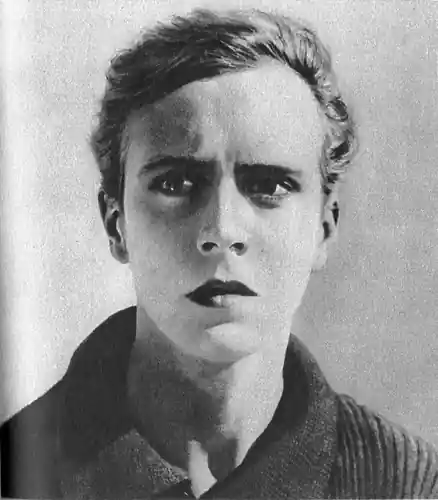
Meanwhile, the motif of the naïve youth corrupted recalls Das Mädchen aus der Opiumhöhle, yet here the narcotic is not opium but epiphany itself—once Héloïse tastes knowledge, she becomes addicted to truth, and that addiction proves costlier than any substance.
Narrative Chiaroscuro: Structure & Pacing
The screenplay (credited to L’Herbier, with uncredited polish by Philippe Hériat) unfolds in five acts separated by irising irises—each iris a wink, a wound, a whispered dare. Act I lulls you with salon banter so brittle you could serve it on doilies. Act II injects the virus of conspiracy. Act III detonates the carnival sequence, a delirium of confetti, drag performers, and a human-sized papier-mâché Minotaur that stalks the margins like guilty conscience. Act IV is the spiral of exposure, shot almost entirely at dusk, that liminal hour when lies lose their stitching. Act V is the reckoning, staged on a casino ship drifting beyond national waters—jurisdiction of sharks.
Modern viewers may balk at the 137-minute runtime, yet the middle act’s bacchanal justifies every frame. L’Herbier refuses montage shortcuts; he wants you to feel the hangover creep in real time, the way champagne first sparkles then sours on the tongue.
Censorship Scars & Surviving Prints
French censors hacked out three minutes for the 1924 re-release, excising hints of lesbian subtext between the Countess and her maid (Suzanne Desprès). The lost footage was presumed ash until a 2019 nitrate canister surfaced in a Croatian convent—yes, a convent—hidden inside a crate of hymnals. The restored edition reinstates the lingering hand-on-thigh gesture that shifts power dynamics like tectonic plates beneath silk.
Philosophical Undertow: Truth as Masquerade
The film’s thesis, never sermonized, is that truth is not the opposite of falsehood but its cabaret twin: both wear greasepaint, both crave spotlight. When Héloïse finally confronts Raphaël with documentary proof of the wager, she does so wearing a Columbina mask—truth delivered behind disguise. The moment epitomizes L’Herbier’s existential jest: revelation itself becomes another layer of performance.
Compare this to The Phantom Honeymoon, where identity is a fleeting spook; here identity is a Russian nesting doll carved from mercury, impossible to grip without contaminating your palms.
Legacy & Afterglow
Premiering a hair’s breadth before Surrealism’s official baptism, Le carnaval des vérités anticipated Buñuel’s disdain for bourgeois hypocrisy while retaining a Symbolist’s appetite for opulence. Cocteau screened it privately three times while drafting Orphée; you can trace the DNA of mirrored corridors and deathless lovers. Even Hitchcock, in 1962, called it “the first psychological thriller where the camera itself commits the crime.”
Yet for decades the film languished in footnote status, eclipsed by L’Herbier’s later L’Inhumaine. The 2021 4K restoration—funded by a Franco-Croatian Kickstarter that hit goal in 48 hours—repositioned it as the missing link between Feuillade’s urban serials and the coming wave of poetic realism.
Where to Watch & What to Listen For
Currently streaming on Criterion Channel under the title Carnival of Truths (beware the 2003 bootleg with YouTube piano). If you’re lucky enough to catch a 35 mm screening, the sea-blue tinting will throb like a bruise under your retinas. Listen for the faint crackle of nitrate—it sounds like distant hail on a tin roof, the ghost of every audience gasp since 1923.
Easter Eggs for the Obsessed
- The roulette wheel in Act V bears the date 9 Thermidor—symbolic guillotine echo for the Countess’s impending beheading by public opinion.
- A newspaper headline glimpsed for three frames references the real-life Affaire Thérèse, a 1919 scandal of forged love letters.
- The human-sized Minotaur is played by Fernand Ledoux in his un-credited debut; he insisted on keeping the hooves as a memento.
Final Mirror Glance
Great art doesn’t moralize; it seduces you into complicity. By the time the end card—“Fin…ou commencement?”—flickers, you realize you’ve been breathing the same fetal air as the characters, that your popcorn butter is indistinguishable from the Countess’s poisoned balm. The carnival leaves town, yet its music lingers, a hurdy-gurdy loop of self-interrogation. Months later, you’ll catch your reflection adjusting its expression in a shop window, and you’ll wonder which mask just slipped.
Review cross-posted under le-carnaval-des-verites for archival permanence. For lighter fare after this moral migraine, consider An Auto Nut—its slapstick pistons are the perfect antidote.