DbcultAccessing Vault...
5.2/10
Senior Film Conservator
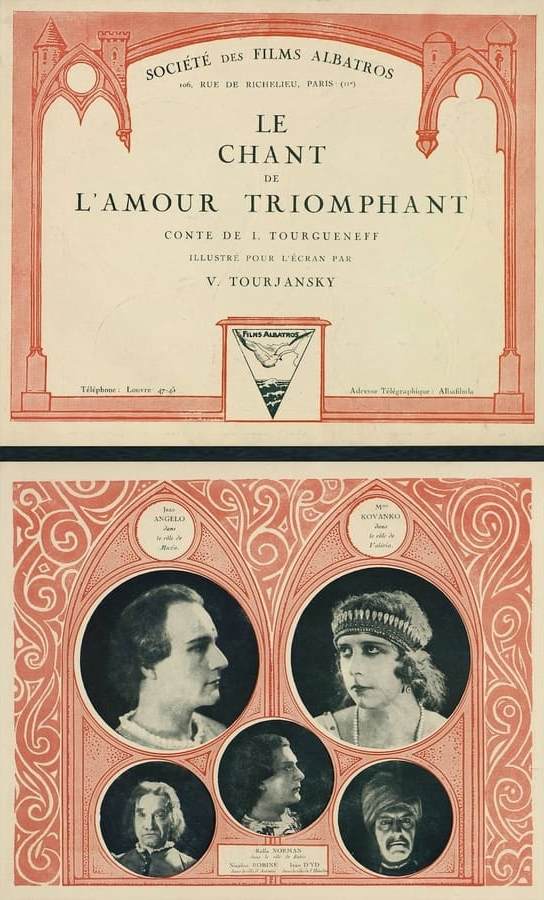
A definitive 5.2/10 rating for a film that redefined the boundaries of cult cinema. Le chant de l'amour triomphant remains a cornerstone of transgressive art.
In the pantheon of the French silent era, specifically within the illustrious orbit of the Albatros film studio, few works resonate with the haunting, atmospheric potency of Le chant de l'amour triomphant. Directed by the visionary Viktor Tourjansky and adapted from Ivan Turgenev’s novella, this 1923 production is a masterclass in the cinematic translation of literary mood. It is not merely a period piece; it is a visceral exploration of the psychosexual anxieties that underpin the transition from the High Renaissance to the Baroque, where the clarity of the image is perpetually threatened by the dissonance of the sound—or, in the case of silent cinema, the visual representation of that sound.
The film opens in a Ferrara that feels less like a historical location and more like a curated dreamscape. The production design, heavily influenced by the Russian émigré community in Paris, utilizes architecture as a character. We see Fabio (played with a stoic, almost tragic grace by Jean Angelo) and Muzio (the intense Rolla Norman) as two halves of a singular creative soul. Fabio’s painting represents the Apollonian ideal—ordered, bright, and public. Muzio’s music, conversely, hints at the Dionysian—internal, fluid, and ultimately volatile. This duality is the engine of the film's early movements, establishing a peace that we, as the audience, know is inherently fragile.
When compared to the domestic dramas of the era, such as The Girl of My Heart, Tourjansky’s work eschews simple sentimentality for a more profound, almost architectural sense of longing. The way the camera lingers on the marble corridors and the sprawling gardens suggests a world that is too large for its inhabitants, a space where human emotions are dwarfed by the weight of history and stone. This is a common trope in early European cinema, yet here it is executed with a precision that rivals the best work of Griffith, notably in his more psychologically dense efforts like The Avenging Conscience.
The narrative pivot occurs with Muzio’s return from the East. In the 1920s, the "Orient" served as a convenient cinematic shorthand for the irrational and the supernatural. However, Tourjansky treats this not as a mere plot device, but as a genuine metaphysical threat. Muzio returns not just with new clothes and servants, but with a new ontology. He brings the Song of Triumphant Love, a melody that supposedly has the power to transcend death and time. Unlike the straightforward villainy found in Number 13, Muzio’s corruption of the household is subtle, played out through hypnotic gazes and the rhythmic pulsing of incense smoke.
Nathalie Kovanko, as Valeria, provides a performance that is a miracle of silent-era nuance. She must convey a transition from contented wife to a woman possessed, a vessel for a melody she cannot escape. Her face becomes a palimpsest whereon the conflicting desires of her two suitors are written. This internal struggle is far more sophisticated than the binary moralities often seen in contemporary films like The Straight Way or Thoughtless Women. Valeria is not "thoughtless"; she is overwhelmed by an atavistic force that her refined Renaissance upbringing has not prepared her to combat.
Technically, Le chant de l'amour triomphant is a marvel of light and shadow. The cinematography uses multiple exposures and soft-focus lenses to simulate the hallucinatory effects of Muzio’s magic. There is a sequence involving a dream—or perhaps a telepathic visitation—that stands as one of the most beautiful passages in silent cinema. It captures a sense of dread that is purely visual, predating the more overt horror of German Expressionism but sharing its interest in the externalization of the psyche. This film shares a certain DNA with The Dark Star in its fascination with fate and celestial influence, yet it remains grounded in the tangible textures of the Italian setting.
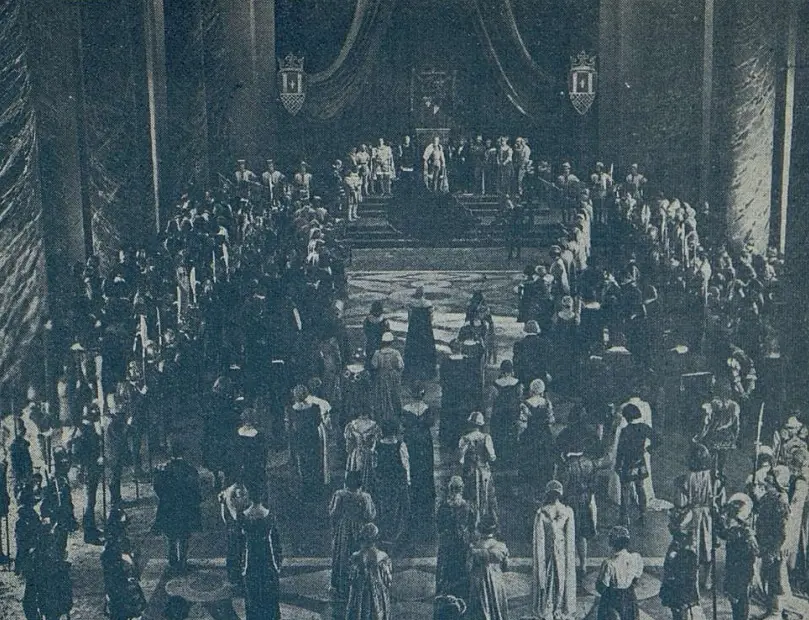
The pacing is deliberate, almost liturgical. Tourjansky understands that for the "triumphant love" to feel earned or sufficiently tragic, the audience must feel the slow accumulation of time. The years of Muzio’s absence are felt in the deepening lines of Fabio’s face and the increasing stillness of the estate. This is a stark contrast to the rapid-fire editing found in American adventure films of the same year, such as The Challenge. Here, the challenge is not physical, but spiritual.
When we look at the cinematic landscape of the early 1920s, Le chant de l'amour triomphant occupies a unique niche. It lacks the populist sentiment of Rose o' Paradise or the rustic simplicity of The Cub. Instead, it aligns more closely with the sophisticated European experiments in psychological realism and stylized melodrama. It shares a thematic kinship with The Polish Dancer regarding the destructive power of fame and artistic obsession, but Tourjansky adds a layer of the fantastic that elevates the material into the realm of myth.
Furthermore, the film’s handling of the "love triangle" is far more mature than the comedic antics of Three of a Kind or the lighthearted escapades of Felix Lends a Hand. In Ferrara, love is a zero-sum game, a destructive force that leaves only ruins in its wake. This bleakness is somewhat mitigated by the sheer beauty of the images, creating a tension between the attractive surface and the corrosive core—a technique also explored in the German production Die Diktatur des Lebens - 1. Teil: Die böse Lust.
The climax of the film, involving a confrontation that is as much about the soul as it is about the body, remains haunting. The resolution—or lack thereof—refuses to offer the easy catharsis found in A Seaside Siren or the moralistic closure of An Alpine Tragedy. Instead, Tourjansky leaves us with the image of a woman forever changed, a husband broken, and a melody that continues to echo in the silence of the theater.
Ultimately, Le chant de l'amour triomphant is a testament to the power of the Albatros school of filmmaking. It combines Russian soulfulness with French technical elegance to create a work that feels both ancient and modern. It is a film that demands to be seen not as a historical curiosity, but as a living piece of art—a vibrant, pulsing exploration of the dark side of devotion. For anyone interested in the intersection of art, music, and the occult, or for those who simply wish to see the heights to which silent cinema could soar, this film is an essential, if melancholic, journey into the heart of the Renaissance.
A phantasmagoria of light and longing, this Turgenev adaptation is a high-water mark for 1920s European cinema. It transforms a simple love triangle into a cosmic struggle between the known and the unknown, the painted image and the invisible song.
IMDb 5
1919
Community
Log in to comment.