DbcultAccessing Vault...
Cult Review
Senior Film Conservator
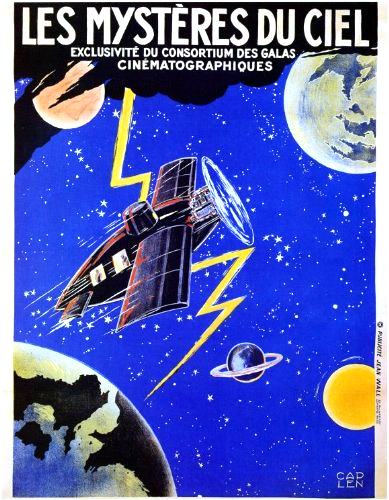
In the pantheon of early French cinema, few works attempt the sheer ontological scale of Les mystères du ciel. Released in an era when the medium was still wrestling with its own identity—oscillating between the documentation of reality and the fabrication of dreams—this film stands as a bold, if occasionally esoteric, monument to the visual potential of silence. Pierre Marodon’s direction suggests a filmmaker deeply attuned to the zeitgeist of the 1920s, a period where the horrors of the Great War had left a vacuum that only the infinite could fill. By turning the camera toward the sky, Marodon wasn't just exploring astronomy; he was charting the geography of hope and despair.
To understand the gravity of this film, one must first reckon with Georges Wague. Known as the 'Prince of Mimes,' Wague brings a revolutionary physicality to his role. Unlike the melodramatic gesticulations found in contemporary works like En Skuespillers Kærlighed, Wague’s movements in Les mystères du ciel are precise, calculated, and deeply resonant. Every tilt of the head, every reach toward the horizon, feels like a silent scream against the limitations of the flesh. He treats the screen as a three-dimensional space, navigating the set with a grace that bridges the gap between the balletic and the cinematic. His performance reminds us that in the silent era, the body was the primary vessel of narrative truth, a concept often explored with less subtlety in films such as The Idol of the Stage.
Counterbalancing Wague’s grounded intensity is Claude Mérelle. In an age where female roles were frequently relegated to the damsel or the vamp, Mérelle occupies a space of intellectual and emotional agency. Her presence is not merely decorative; she is the lens through which the audience perceives the film’s more abstract concepts. There is a specific scene, bathed in a soft, ethereal glow, where her character observes a lunar eclipse. The play of light across her features reflects the celestial event with a synchronicity that is breathtaking. This level of nuanced performance is a far cry from the more traditional archetypes seen in Her Lord and Master, elevating the film into a realm of sophisticated gender dynamics.
The visual language of Les mystères du ciel is one of high contrast and deep shadows. The cinematography utilizes a proto-noir aesthetic that predates the movement by decades. Marodon employs the frame to isolate his characters, often placing them against vast, empty backdrops that emphasize their solitude. This isolation is not punitive but contemplative. When we compare the spatial awareness of this film to the rugged, expansive landscapes of The Uncovered Wagon, we see a stark difference in intent. While the latter uses space to signify conquest and frontier, Marodon uses it to signify the internal frontier—the undiscovered country of the mind. The 'sky' of the title is a multifaceted metaphor; it is the physical atmosphere, yes, but it is also the ceiling of human understanding.
In the broader context of 1920s cinema, Les mystères du ciel occupies a unique niche. It lacks the documentary-style sobriety of Les funérailles de Sir Wilfrid Laurier, yet it avoids the whimsical escapism of Her Lucky Day. Instead, it aligns more closely with the atmospheric dread and wonder of Out of the Clouds, though with a more philosophical bent. Where a film like The Boxing Kangaroo seeks to entertain through novelty, Marodon seeks to provoke through stillness. The pacing is deliberate, demanding a level of patience from the viewer that is rarely asked for in the frantic comedies or serials of the day. It is a film that breathes, each frame a lungful of cosmic dust.
Technically, the film is a marvel of its time. The use of double exposures to represent celestial phenomena was a cutting-edge technique that Marodon used with surprising restraint. He doesn't allow the special effects to overshadow the human drama. This is a lesson many modern directors could stand to learn. The integration of these visual tricks feels organic, as if the camera itself is a telescope peering into another dimension. This sophistication puts it on par with the dramatic weight of Der Richter von Zalamea, albeit in a completely different genre. The film’s ability to create a sense of scale within a studio setting is nothing short of miraculous, rivaling the theatricality of The Tempest while maintaining a distinctly cinematic texture.
There is a recurring motif in the film involving an hourglass, a trope that could easily slide into cliché. However, in the hands of Wague and Marodon, it becomes a visceral reminder of the ephemeral nature of life. As the sand falls, the characters look upward, suggesting that while time is finite on Earth, the heavens offer a version of eternity. This thematic depth is what separates Les mystères du ciel from the more grounded realism of Unclaimed Goods or the familial intimacy of The Old Folks at Home. It is a film that dares to ask 'why' rather than just 'what'. It explores the 'how' of our existence through the 'where' of our location in the universe.
Perhaps the most striking element of Les mystères du ciel is its confidence in what it leaves off-screen. In an era where many films felt the need to explain every plot point through excessive intertitles, Marodon trusts his audience. The 'mysteries' are never fully solved, and the 'sky' remains largely unreachable. This ambiguity is its greatest strength. It invites the viewer to fill in the blanks with their own anxieties and aspirations. It shares this quality with the more adventurous travelogues like The Land of the Pygmies or the harrowing Shipwrecked Among Cannibals, where the unknown is the primary antagonist. Yet, here, the unknown is not a threat to be conquered, but a beauty to be admired.
Ultimately, Les mystères du ciel is a testament to a time when cinema was unafraid to be poetic. It is a film that requires the viewer to engage not just with their eyes, but with their soul. The collaboration between Wague’s physical prowess, Mérelle’s ethereal grace, and Marodon’s visionary direction creates a work that feels as relevant today as it did a century ago. It reminds us that no matter how much we learn about the mechanics of the stars, the wonder of looking up at them remains one of the few universal human experiences. This is not just a movie; it is a meditation on celluloid, a silent prayer to the cosmos that continues to echo through the halls of film history. To watch it is to participate in a ritual of discovery, a journey that begins in the dark of the theater and ends in the light of the stars. It remains a cornerstone of French avant-garde, a flickering beacon of artistic ambition that refuses to be dimmed by the passage of time. For those seeking a cinema that transcends the mundane, Les mystères du ciel is an essential destination.

IMDb —
1924
Community
Log in to comment.