DbcultAccessing Vault...
5.7/10
Senior Film Conservator
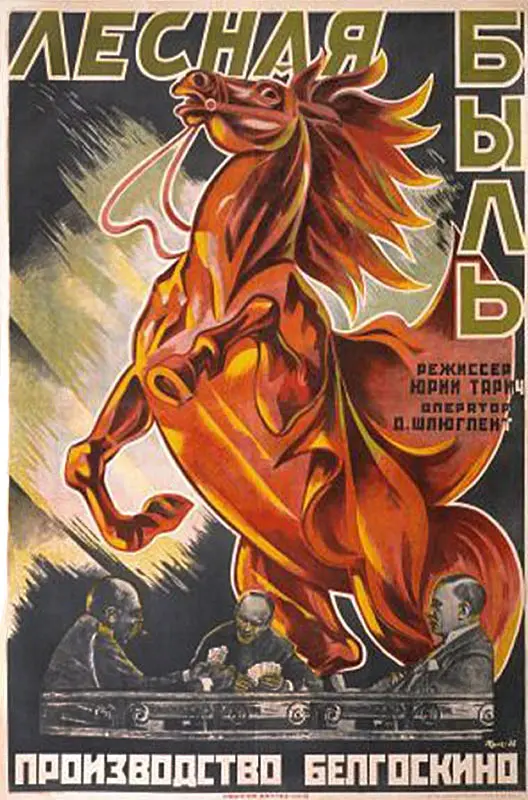
A definitive 5.7/10 rating for a film that redefined the boundaries of cult cinema. Lesnaya byl remains a cornerstone of transgressive art.
Is Lesnaya byl worth your time nearly a century after its release? Short answer: Yes, but only if you approach it as a gritty piece of political archaeology rather than a standard historical drama.
This film is specifically for students of early Soviet cinema and those interested in the raw, unpolished origins of national filmmaking. It is absolutely not for viewers who require high-definition pacing or a balanced, non-partisan view of 20th-century Eastern European history.
1) This film works because it utilizes the natural Belarusian landscape as a claustrophobic, high-stakes character that dictates the rhythm of the insurgency.
2) This film fails because its characterizations of the Polish 'occupiers' are so cartoonishly villainous that they occasionally strip the film of its genuine tension.
3) You should watch it if you want to see the literal foundation of Belarusian cinema and a rare look at the 1920s 'agit-film' style in its prime.
Released in 1926, Lesnaya byl (Forest Story) holds the distinction of being the first feature film produced by the fledgling Belarusian film industry, then known as Belgoskino. Director Yuri Tarich didn't have the luxury of massive studio lots or sophisticated lighting rigs. Instead, he took his camera into the bogs. This decision gives the film a tactile, damp quality that modern digital productions can never quite replicate.
The story is simple, bordering on skeletal. A young man, played with a surprising amount of restrained intensity by A. Otradin, is forced out of his domestic life by the invading Polish forces. He joins the partisans. They fight. They hide. They win. While the plot beats are predictable, the execution is anything but. Unlike the more polished Western dramas of the same year, such as Body and Soul, Lesnaya byl feels like it was filmed in the middle of a live conflict.
The film lacks the urban sophistication found in Paris, opting instead for a primitive, almost documentary-like focus on the mechanics of rural sabotage. There is a scene early on where the partisans are navigating a swamp using only fallen logs. The camera stays low, almost at water level. You can feel the cold. You can see the genuine strain on the actors' faces. It is in these moments that Tarich transcends propaganda and touches something human.
A. Otradin’s performance is a fascinating study in silent-era physicality. He doesn't rely on the exaggerated eye-widening common in 1920s Hollywood. Instead, he uses a slumped, wary posture that suggests a man who has spent too many nights sleeping on wet moss. It’s a grounded performance that anchors the film’s more hyperbolic political messaging.
The supporting cast, including Mstislav Kotelnikov and Vladimir Korsh-Sablin, fill out the partisan ranks with a variety of 'peasant' archetypes. There is a ruggedness here that feels earned. These aren't actors who just put on costumes; they look like they belong in the dirt. This level of authenticity is something that even big-budget Western films of the era, like A Gun Fightin' Gentleman, often struggled to achieve with their clean-cut heroes.
However, the film stumbles when it moves away from the protagonist. The Polish officers are depicted with such sneering, mustache-twirling malice that they cease to be threats and become caricatures. It’s a common flaw in early state-sponsored cinema, but it remains a distraction. When the villain is a joke, the hero's struggle feels less significant. It works. But it’s flawed.
The visual language of Lesnaya byl is defined by its use of light and shadow within the dense Belarusian woods. Tarich and his cinematographer use the vertical lines of the trees to create a sense of imprisonment for the invaders and a sense of cover for the locals. The forest isn't just a setting; it's a tactical participant in the war.
There is a specific sequence involving a night raid on a supply line that stands out. The use of practical fire for lighting creates deep, flickering shadows that hide the numbers of the partisan force. It’s a masterclass in low-budget tension. While it lacks the intricate editing of Eisenstein, it possesses a raw energy that is arguably more accessible. It’s less about the 'montage of attractions' and more about the 'montage of survival'.
Compared to the domestic dramas like The Neglected Wife or the structured suspense of The Man Who Wouldn't Tell, Lesnaya byl feels wild and untamed. It’s a film that smells of woodsmoke and gunpowder. The pacing is uneven—occasionally dragging during the long political meetings—but it snaps back to life whenever the action returns to the wilderness.
Should you watch Lesnaya byl today? You should watch this film if you want to understand the roots of Soviet partisan cinema and see a genuine 1920s artifact. It is a vital historical document that captures the landscape and spirit of a specific time and place. Do not watch it if you are looking for a nuanced historical analysis or a fast-paced action movie. It requires patience and an interest in the evolution of cinematic language.
One cannot discuss Lesnaya byl without addressing its blatant ideological slant. The film was produced to bolster a specific national identity within the Soviet framework. The Polish forces are not just the enemy; they are the 'occupiers' in the most literal sense. This binary worldview is what prevents the film from being a truly universal piece of art.
Yet, there is a surprising amount of cultural specificity that survives the propaganda. The depictions of Belarusian village life, the traditional clothing, and the folk songs (implied through the silent medium's title cards and rhythm) provide a window into a world that was rapidly changing. In this sense, the film acts as a time capsule. It records a culture in transition, caught between the feudal past and the industrial, revolutionary future.
I would argue that the film is most successful when it forgets its political mission and focuses on the physical reality of the characters. When the protagonist is shown simply trying to start a fire in the rain, the film speaks a universal language of endurance. It’s a shame that these moments are often interrupted by heavy-handed title cards explaining the 'glory of the proletariat'.
Pros:
Cons:
Lesnaya byl is a rough, jagged stone of a movie. It isn't pretty, and it isn't particularly fair, but it is undeniably powerful. Yuri Tarich succeeded in creating a template for the 'partisan film' that would become a staple of Soviet cinema for the next fifty years. It shares the DNA of early struggle narratives like Brothers Divided, but with a specifically Slavic grit that is all its own.
The film’s greatest strength is its refusal to look away from the mud. While it was intended to inspire, it often ends up being a sobering look at how war deconstructs a person’s life. It’s a flawed work, burdened by the requirements of its time, but its heartbeat is real. If you can look past the mustache-twirling villains, you’ll find a haunting story of a man lost in the woods, trying to find a way back to a home that no longer exists.
It is a foundational text. It is a survival story. It is a bit of a slog in the middle. But for those who care about where cinema came from, it is essential viewing. You won't find the polish of modern war films, but you will find a raw, unvarnished truth about the landscape of Belarus and the people who fought for it. It’s a relic, but one with sharp edges.
IMDb 7.5
1927
Community
Log in to comment.