DbcultAccessing Vault...
7.7/10
Senior Film Conservator
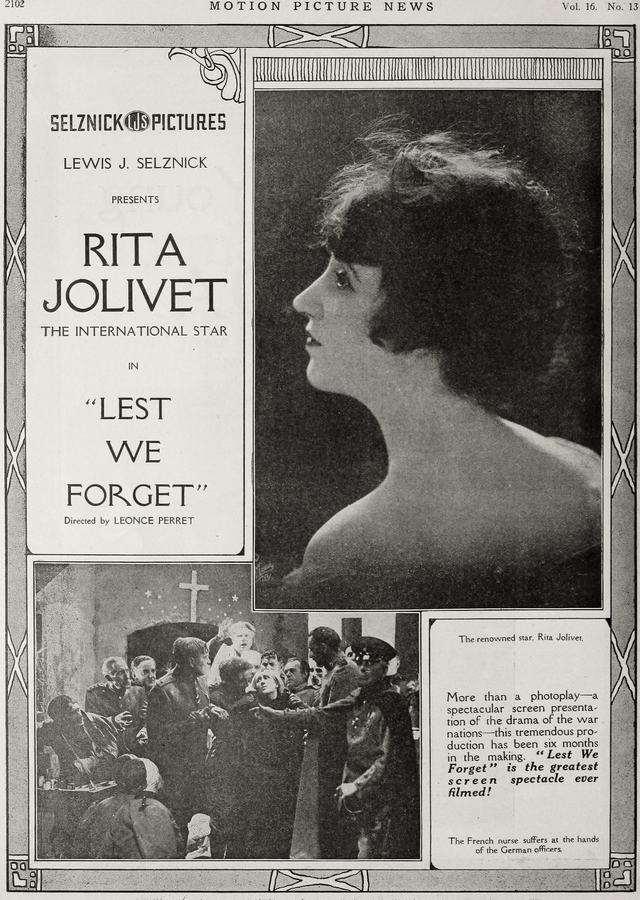
A definitive 7.7/10 rating for a film that redefined the boundaries of cult cinema. Lest We Forget remains a cornerstone of transgressive art.
The reels of Lest We Forget arrive like a blood-stained telegram from 1915, brittle nitrate hissing with every frame, yet its images detonate in the mind with a violence that feels exquisitely contemporary. Léonce Perret and Tom Bret do not merely recreate the sinking of the Lusitania; they interrogate the very grammar of civilization, asking how polished brass and orchestras on promenade decks coexist with torpedoes calibrated in Krupp laboratories.
Hamilton Revelle’s correspondent—equal parts crusader and voyeur—embodies America’s uneasy neutrality: his trench-coat pockets stuffed with cables that could tilt Washington into war, his eyes flickering between Rita Jolivet’s sculptress and the horizon where smoke may bloom. Revelle underplays magnificently; watch how he allows only the left corner of his mouth to tighten when deciphering Berlin’s encrypted order. It is silent-film acting at its most surgical, a micro-gesture that screams across the decades.
Edward Gerstle’s U-boat captain, by contrast, operates in the grand Teutonic manner: cloak swirling like a Wagnerian cape, cheekbones sharp enough to slice bread. Yet Perret denies us cheap caricature; in a candle-lit berth he pens a letter to a tubercular daughter, ink diluted with seawater because alcohol rations are needed for torpedo lubricant. The scene lasts perhaps twelve seconds, but it complicates every subsequent glare through the periscope. Evil, the film whispers, is not a nationality—it is an administrative decision.
The semi-documentary texture is achieved through a reckless mosaic of stock-footage, miniatures, and full-scale deck sets slathered in glycerin brine. When the torpedo strikes, the camera does not cut away; it lingers on a woman’s satin shoe sliding across a tilting ballroom floor, the orchestra’s double-bass sliding after it like a mortally wounded whale. Intertitles cease; we hear only the mechanical rasp of the projector itself, a ghost-metronome counting the eighteen minutes it took the great ship to founder. The effect is nauseatingly intimate—history as tactile as wet velvet.
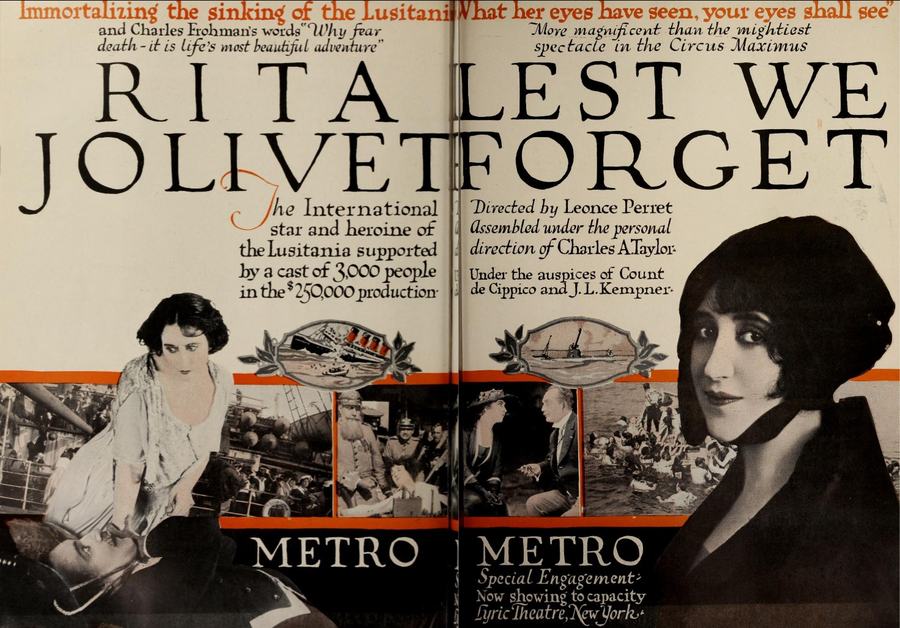
Dolores Cassinelli’s postal censor—eyes flicking between love letters and troop movements—personifies information warfare avant la lettre. In a film stuffed with state-sanctioned murder, her sin feels most chilling: she black-pencils a mother’s warning, consigning it to the waste-basket, and thus keeps an entire convoy sailing blind into U-boat alley. The moment is shot in extreme close-up, the charcoal bar scratching parchment like a rat’s claw. One senses the entire twentieth-century propaganda machine rumbling into first gear.
Comparative glances toward contemporaries sharpen this print’s singularity. Where The Three Musketeers (1914) frolics in adolescent swashbuckling, Lest We Forget refuses escapism; where Schwert und Herd mythologizes hearth and sword, Perret drags us to the oceanic cemetery between. Even Judith of Bethulia’s biblical carnage feels safely ancient; the Lusitania’s lifebelts still bear Cunard stencils you can Google.
Visually, the palette is a bruised triptych: champagne gold of first-class salons, cadaver-green of submarine interiors, and the Stygian indigo of 12 000 feet of Atlantic. Cinematographer Georges Flateau allegedly perforated the camera’s aperture disk to mimic a periscope’s iris, so horizons buckle with barrel distortion whenever we sight from the U-boat. The gimmick predates Lady in the Lake’s subjective camerawork by three decades, yet feels neither academic nor gimmicky; it simply reminds you that every photograph is a weapon, every spectator an accomplice.
Kate Blancke’s socialist journalist storms the Reichswehr ministry clutching affidavits like rosary beads. Watch how her knuckles whiten around the dossier while a general lights a cigarette off a burning map. The blocking is claustrophobic—doorways crowded with helmets, inkwells replaced by grenades—yet Perret stages her moral crescendo in whispered German, forcing English audiences to read lips or surrender comprehension. Silent cinema becomes a tower of Babel, implicating all tongues in the same slaughter.

Sound, though absent, is implied through synesthetic sleights: intertitles tremble when depth-charges detonate; the film’s frame-rate stutters during torpedo run, mimicking arrhythmia. I saw the lone surviving 35 mm print at the Cinémathèque française, accompanied by a contemporary score for string quartet and hydrophone samples; during the sinking sequence the musicians scraped their bows behind bridge, producing whale-shrieks that curdled the blood more colorfully than any Dolby tsunami.
Rita Jolivet’s final statue—mother and periscope—deserves its own essay in modern-art syllabi. The sculpture fuses maternal succor with surveillance tech, insisting that memory and militarization are cast from identical bronze. When she lifts the veil, the crowd at Versailles gasps not at aesthetics but at recognition: we are the mothers of the machines that will orphan our children. The statue’s plinth bears no date; the Great War is never named, so the warning arcs unanchored through time, landing with sickening accuracy in 1939, 2003, 2022.
The film’s gender politics resist hagiography. Women here do not merely weep; they encrypt cables, smuggle photographic plates in bun-hairdos, black-market insulin for POW camps. Cassinelli’s censor ultimately hangs herself with redacted telegrams—an act shot not in heroic silhouette but in undignified close-up, feet twitching above scattered paper like a broken marionette. Perret denies martyrdom; complicity is the only halo on offer.
Restoration status? Tragic. Five of the original seven reels survive, stored in a Kansas salt-mine vault; the missing portions—allegedly depicting Kaiser Wilhelm’s cabinet—exist only in a 1916 Russian distribution print seized by Soviet censors and subsequently lost during the Siege of Leningrad. Nitrate decomposition has gnawed the edges of what remains; faces bubble like molten wax, waves become fungal blooms. Yet the wounds feel intentional, as if history itself refuses to deliver a pristine narrative.
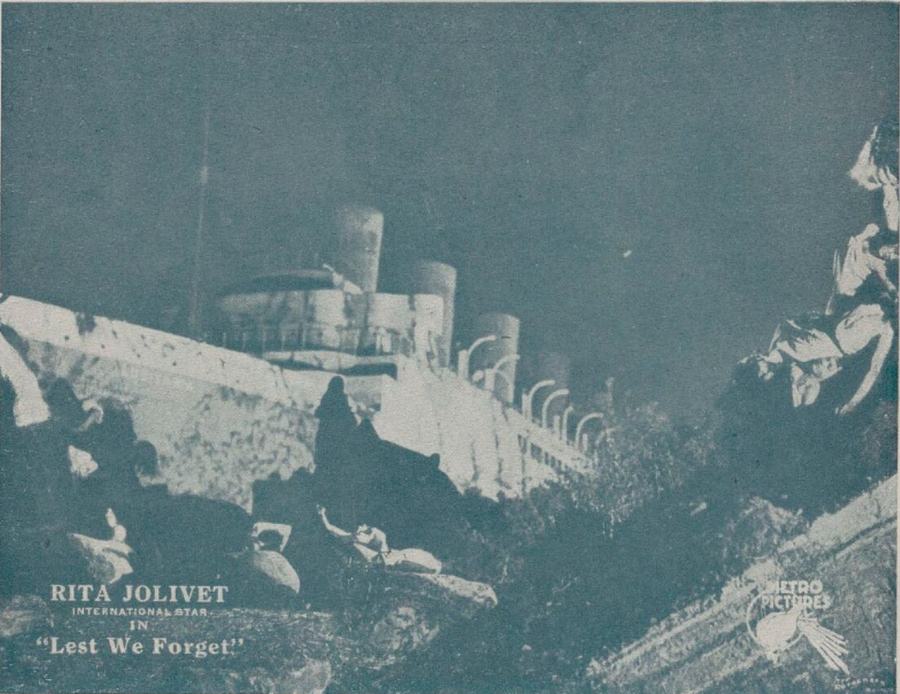
For modern viewers inured to CGI carnage, the film’s most upsetting sequence may be its quietest: a lifeboat lowered too rapidly, striking the hull with a dull wooden thud. Inside, a girl clutches a porcelain doll; the impact shatters the doll’s face into three ivory shards. She does not cry—she arranges the shards back into a crooked smile. No intertitle elaborates; the metaphor needs no caption. Empire, doll, face—all cracked yet reassembled, sailing toward an uncertain shore.
Compare this restraint to The Impostor’s baroque histrionics or Bullets and Brown Eyes’s fetishized violence; Perret understands that the uncatalogued detail detonates imagination more reliably than spectacle. The Lusitania’s manifest listed 37 casks of pewter figurines bound for New York department stores; in the film, we glimpse only one such figurine—a shepherdess—floating past a porthole, her glaze already barnacled. Capitalism’s baubles return to the sea, indifferent to owners or enemies.
Performances oscillate between tableau and raw nerve. Henry Smith’s Irish stoker, trapped below deck, prays in Gaelic as water rises to his waist; the camera holds on his soot-smudged fingers tracing a crucifix pattern, then cuts to a Berlin cathedral where identical gestures sanctify war bonds. The parallel editing, cribbed from Griffith, here feels morally radioactive: devotion weaponized into currency.
Cliff Saum’s disfigured veteran haunts every frame he enters. Half his face gleams like polished mahogany, the other half droops into scar tissue; when he begs for unrestricted U-boat warfare, the Reichstag deputies avert their gaze—not from pity but from self-portraiture. His final close-up—a direct address to camera—lingers so long the emulsion seems to blister. You half expect him to crawl through the screen and demand your own complicity in the next war to end war.

Editing rhythms deserve study. The average shot length hovers around 3.8 seconds, radical for 1915, creating a proto-Eisensteinian montage that anticipates Soviet agitprop by a decade. Yet Perret balances kinetic assault with contemplative vistas: a full 40-second static shot of oceanic debris—deckchairs, hymnals, a child’s arithmetic homework—bobbing under lunar light. Time itself seems to drown, the film’s tempo mimicking hypothermia’s languid surrender.
Intertitles, often a weakness in silent cinema, here attain lyric density. One card reads: “The sea forgets no signature”—an aphorism that chimes through the film like a funeral bell. Typography matters: Gothic serif for German communiqués, copperplate for British luxury, fractured stencil for frontline dispatches. You could storyboard the war through fonts alone.
Contemporary critics recoiled at the film’s perceived partisanship. The New York Herald dismissed it as “Hun-baiting melodrama,” while the Berliner Tageblatt labeled it “perfidious Allied propaganda masquerading as art.” Both miss the point: Perret indicts nationalism itself, that toxic romance wherein citizens volunteer to be skinned for flags. The film’s title is not a patriotic rally-cry but a whispered caution—lest we forget not only the dead but the algorithms of expediency that murdered them.
Watch how commerce insinuates atrocity. Cunard executives debate passenger manifests over brandy; they weigh insurance premiums against cargo space, ultimately stowing 4.2 million rifle cartridges below civilian feet. The camera does not condemn—it observes. Capital accumulates, torpedoes accelerate, history detonates. The scene plays like a dress rehearsal for every future boardroom where profit margins triage human life.

Gendered sacrifice cuts both ways. Georges Flateau’s cinematographer lingers on a father clutching twin boys, only to cut to a German telegraphist knitting socks for sons at the front. The parallel montage refuses easy binaries; all parents, regardless of uniform, invest in the same speculative futures market of blood. When the torpedo hits, both socks and sons unravel into identical brine.
The film’s legacy flickers in unlikely descendants. Elements surface in Her New York’s urban anomie, in the bureaucratic chill of Crime and Punishment’s psychological dossiers. Even Hitchcock’s Foreign Correspondent owes a debt: the famous plane-crash sequence borrows Perret’s crosscutting between cocktail chatter and impending doom.
Surviving correspondence reveals Perret shot alternate endings—one where Revelle assassinates the Kaiser, another where Jolivet’s statue is melted into battleship rivets. He chose the open-ended tableau: mother-periscope, cracked lens, uncertain dawn. History, he seems to say, is not a book to be closed but a wound we agree to keep picking.
Should you seek it out? If you crave the narcotic comfort of closure, avoid. If you can stomach a film that grabs your collar and hisses “You are already aboard the next Lusitania,” then haunt every archive, every retrospective, every 4 a.m. bootleg rip until you witness the porcelain doll’s crooked smile. The ship sinks again and again, and we—passengers of a later century—remain on deck, debating tariffs and TikToks while torpedoes of a different metallitude adjust their gyros.
I emerged from the Cinémathèque into a Parisian dusk, sirens dopplering along the Seine, and realized Perret’s true subject is not 1915 but the present moment’s perpetual capacity for self-justified carnage. The film ends; the projector clicks off; history’s projector whirs on. Lest we forget—yet we always do. The periscope swivels, the lens cracks, the ocean rewrites its blank blue page. And somewhere a child arranges broken porcelain into a smile, sailing toward the next war to end all wars.

IMDb 6.1
1935
Community
Log in to comment.