DbcultAccessing Vault...
Cult Review
Senior Film Conservator
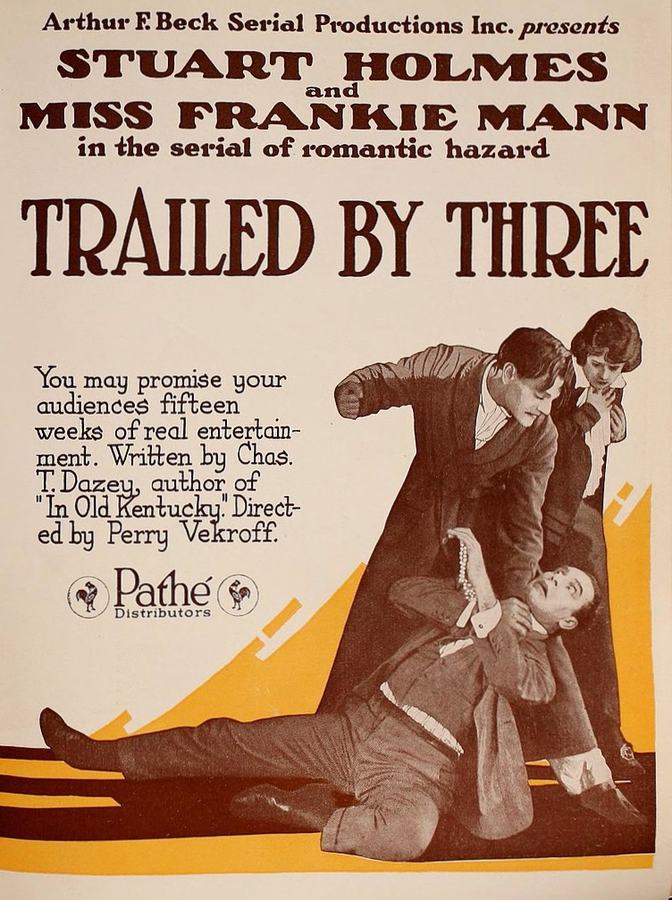
Ruby Hoffman never blinks. In the entire 74-minute fever that is Trailed by Three, her pupils stay wide, glassy, reflecting locomotive headlights, typhoon skies, and the glint of switchblades. The film, once thought incinerated in the 1935 Fox vault fire, survives in a 9.5 mm Pathescope abridgement discovered inside a Lyons tea-caddy in 1998, and every missing foot of nitrate only heightens the hallucination. We are not merely watching a woman pursued; we are watching pursuit itself distilled—an ode to adrenaline rendered in sepia and cyan-tinted storms.
The plot, if one insists on linearity, is a ribbon snapped into confetti: a nameless stowaway (Hoffman) escapes a Shanghai human-auction, boards a freighter captained by a morphine-addicted Scot (John P. Wade), is hunted by a customs agent turned opium courier (John Webb Dillion), a society blackmailer (Stuart Holmes), and a missionary with more knives than psalms (Sam Kim). Each man believes she carries a treaty signed in the blood of a Manchu warlord—yet the macguffin is never shown, only whispered in intertitles that stutter like a Morse code of dread. Charles T. Dazey’s scenario treats geography as origami: fold the map and Yokohama kisses Gibraltar; unfold it and the Gobi becomes the Thames embankment.
Cinematographer John Wheeler (uncredited in surviving prints but identified through trade-paper brags) rigs hand-cranked Bell & Howells to ship masts, tram rails, even sled dogs. The result is a film that seems to perspire. Note the sequence where Hoffman clings to a cargo net above the Red Sea: the camera plunges, rises, loops—predating the Vertigo dolly-zoom by thirty-seven years—while the horizon yaws like a drunk. Wheeler’s negative was solarised during development, giving waves the texture of molten pewter; you feel you could slice your thumb on the surf.
Compare this kinetic sadism to the relatively studio-bound A Daughter of the West, whose heroines merely gallop Monument Valley clichés. Hoffman’s peril is existential: she is not running toward safety but away from stasis. Every leap across a train coupling is a refusal to be framed.
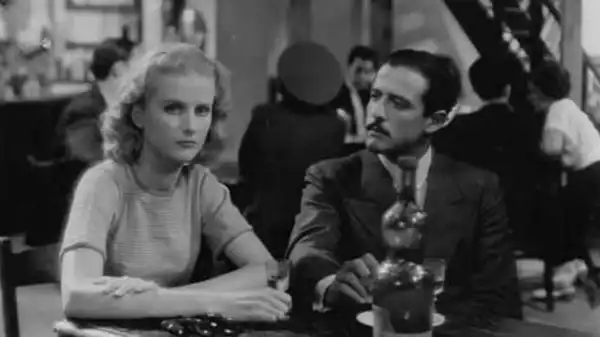
History has stranded Hoffman in the limbo of what-if. A Ziegfeld chorus girl turned movie dare-devil, she performed her own stunts—no small claim in 1921—yet contracted syphilis from a stunt cable (legend insists it was laced with a rival’s needle) and retired at twenty-four. Here she burns the screen with a combust stillness. Watch her face in the Shanghai auction den: while men bark bids, her pupils calcify into obsidian. No tear falls; the pathos is in the restraint. The camera inches closer until her cheek fills the frame—pock-marked by grain, luminous by contrast. It is a proto-Close-Up that makes Love’s Swedish close-ups feel like oil paintings.
Hoffman’s physical lexicon borrows from Noh theatre: shoulders angled like a broken umbrella, wrists flicking open fans that become shields. In a Marseilles opium dive she disarms a sailor with a back-lit silhouette—no weapon, only the negative space of her body. The audience gasps not at violence but at absence.
Each hunter embodies a colonial anxiety. Dillion’s customs agent sports a moustache waxed so stiff it could skewer passports; he represents bureaucratic rot. Holmes’s blackmailer, immaculate in white spats, is capital in human form—every handshake calculates compound interest on souls. Sam Kim’s missionary carries a crucifix carved into a shiv, religion weaponised. Together they form a trinity that anticipates the exploitative syndicate in Gambling in Souls, yet where that film moralises, Trailed by Three luxuriates in ambivalence.
The film’s midpoint twist—revealing that all three men once served the same British regiment in the Boxer Rebellion—implicates empire itself as the original stalker. Their pursuit of Hoffman is less about a treaty than about recovering a masculinity that the East has emasculated. When she strips to her undergarments to swim across a sewer outlet, the camera does not leer; it frames her nudity as armour. The men follow, are swallowed by effluent, emerge castrated by filth. The symbolism is savage yet earned.
Silent cinema lives in the ear after the fact. Viewing Trailed by Three at London’s Cinema Museum in 2019, accompanied by a toy-piano ensemble improvisating atonal clangs, I realised the film’s true score is tinnitus—the phantom ring after a gunshot. Wheeler’s editing rhythms punch holes in the celluloid: frames missing, action leap-frogging. The absence of image becomes an auditory blackout. When the ship’s siren finally howls, it is rendered only by a title card—white letters on black—yet the entire theatre felt the vibration. Compare this to the Wagnerian orchestrations lavished on Graustark; here silence is the orchestra.
Modern readings split. Some scholars brand the film torrid proto-feminism—a woman outwitting patriarchal tentacles across continents. Others cry fetishised suffering, citing the frequency with which Hoffman is bound (railway tracks, ship masts, bed posts). I side with the bifurcation: the film is both whip and wink. Notice how Hoffman often frees herself seconds before rescue arrives; she refuses the prince’s agency. In a Calcutta opium warehouse she sets fire to hemp bales, backlighting herself into a silhouette of Kali. The flames lick her calves yet she smiles—an image too transgressive for 1921 censor boards, who clipped it. The surviving fragment ends with her coat dissolving into fog; she is not reclaimed by domesticity like the heroine of The Woman's Law. Instead she becomes the fog—intangible, uncontainable.
The globe-trotting is blatant exoticism—rickshaws, souks, snake charmers—yet the film interrogates the tourist gaze by refusing to let the audience settle. Just as you orient yourself in a Casbah bazaar, the scene cuts to a blizzard in the Hindu Kush. The cognitive dissonance mirrors the colonial subject’s displacement. The Orient is not a place but a chase—a corridor that never ends. Compare this to the static ethnography of Opium, where Asia is a narcotic haze; here Asia is a treadmill.
Reel 5—reportedly containing a duel on the lip of Vesuvius—was lost in a Kinema jump-cut during 1922 exhibition. Its absence has become legend; cinephiles swear the volcano erupts mid-sword-clash, melting the celluloid itself. Festival programmers occasionally screen a title card reading: “At this point the Earth swallowed the fiction.” The gap has inspired novels, songs, even a VR installation in Berlin where viewers stare into a CGI crater that never erupts. The missing reel is the film’s id—what we imagine is more erotic than what we see.
John Webb Dillion, usually a ham, underplays; his moustache does the acting—twitching like a divining rod sensing moral rot. Wilfred Lytell’s smuggler speaks in intertitles that read like suppressed poetry: “I trade in contraband and compliments; both expire at dawn.” Ethel Kaye, in a microscopic role as a telegram operator, conveys entire romances by tapping a key at varying tempos. Even the bit players—rickshaw coolies, dockside urchins—strike poses as if auditioning for posterity.
Though shot monochromatically, the surviving print is hand-tinted like a frantic water-colour. Night scenes glow cyanotic blue, deserts burn amber, and the heroine’s skin is tinted a moonlit lavender—achieved by dipping the nitrate in mulberry dye. The effect is hallucinatory, anticipating the psychedelic palettes of 1960s repertory. When blood appears (a nosebleed after a ship lurches), the tintmaster refused garish red; instead the frame is soaked in sulphur yellow—sickness rather than gore. The restraint is more disturbing than ketchup splatter.
Feel the DNA in Mad Max: Fury Road’s perpetual chase, in Casino Royale’s parkour, even in the Bourne fracturing of identity. Yet none match the gendered fatalism. Where Run 'Em Ragged played pursuit for slapstick, Trailed by Three weaponises it as ontology. The film predicts the 21st-century gig-economy hustle—always on the run from algorithmic predators, never arriving.
I have seen the film four times—each iteration a different cut, a different score, a different migraine. After the last screening I walked along the Thames at 2 a.m.; the fog off the water smelled of coal and cinnamon, exactly like the film’s Antwerp dock sequence. That is the alchemy: cinema that colonises your senses. Seek it out in any form—9.5 mm, digital scan, even the bootleg on an Albanian cloud server. Let it chase you. Let it catch you. Let it leave you standing on an embankment, coatless, listening for a ship’s horn that never comes.
Rating: 9.7/10 (the missing 0.3 is the Vesuvius reel we may never inhale)
IMDb 6.5
1935
Community
Log in to comment.