DbcultAccessing Vault...
Cult Review
Senior Film Conservator
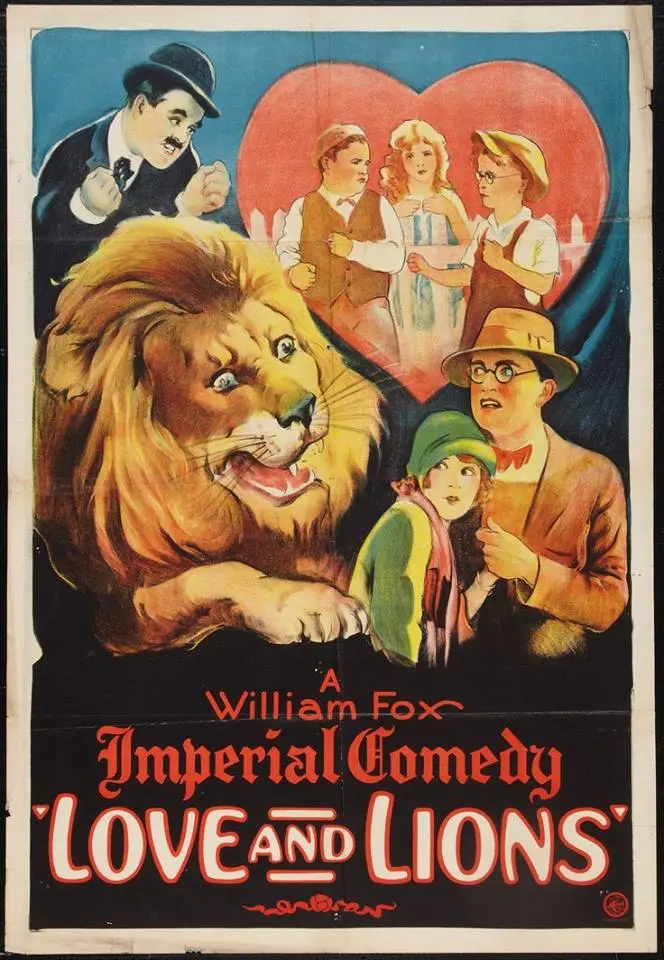
To witness Love and Lions is to step into a temporal capsule of mid-1920s frantic energy, a period where the syntax of cinema was still being written in the sweat of its performers and the audacity of its stunt coordination. While contemporary audiences might initially dismiss the premise of fraternity hazing as a relic of a bygone collegiate era, the film utilizes this micro-culture to explore themes of performance, fear, and the fragile boundary between the civilized and the feral. Harold Goodwin delivers a performance of twitchy, earnest vulnerability, embodying the 'everyman' archetype that anchored so many silent comedies, yet here, he is surrounded by a cast that functions more like a chaotic ensemble of moving parts than mere supporting players.
The narrative engine is fueled by a delicious irony: the fraternity members, led by the imposing Bud Jamison, attempt to manufacture a synthetic wilderness within the confines of a hunting lodge. Their costumed charade—men dressing as birds and beasts to intimidate a novice—is a poignant commentary on the performative nature of masculinity. However, the film takes a sharp, kinetic turn when Earl Mohan’s character, Earl, stumbles into a reality that eclipses their theater. The accidental release of a genuine lion from a nearby farm serves as the ultimate 'deus ex machina'—or perhaps 'felis ex machina'—shattering the controlled environment of the prank and forcing the characters into a genuine struggle for survival.
Technically, the film navigates the spatial limitations of the hunting lodge with a surprising degree of fluidity. The cinematography captures the frantic geometry of the chase, a staple of the era, but with an added layer of tension provided by the presence of a real animal. Unlike the more atmospheric or brooding works of the period, such as the later psychological depths found in The Isle of the Dead, Love and Lions leans into the bright, sharp edges of slapstick. The lighting is functional yet effective, emphasizing the cluttered, claustrophobic nature of the lodge which serves to heighten the comedy of errors.
The juxtaposition of the costumed men and the actual lion creates a surrealist visual palette. There is a specific shot where a 'bird-man' rounds a corner only to be met by the king of the jungle—a moment that encapsulates the film's core philosophy: the universe has a way of mocking our attempts to simulate danger. This thematic thread of artificiality versus reality is something we also see explored, albeit in a more dramatic and socialite context, in films like The Branded Woman, where social masks are just as restrictive as the animal costumes worn by Bud’s fraternity.
One of the most striking aspects of Love and Lions is its final act. In an era where the damsel in distress was a ubiquitous trope, the climax of this film offers a refreshing subversion. As the lodge is consumed by flames—a sequence that, even by today's standards, carries a palpable sense of heat and danger—it is not Harold who emerges as the valiant savior. Instead, Judy King’s character, Judy, demonstrates a level of agency and fortitude that was often reserved for the male lead. Finding herself safe, she realizes Harold is still trapped within the inferno, overcome by smoke and his own ineptitude. Her return into the burning structure to drag him to safety is a powerful moment of role reversal.
This dynamic elevates the film beyond a simple animal-on-the-loose comedy. It positions Judy not merely as a prize to be won or a romantic interest to be protected, but as the most competent individual in a cast of bumbling men. This proto-feminist undercurrent is a fascinating counterpoint to the more traditional romantic structures found in The Shuttle or the melodramatic constraints of Married in Name Only. It suggests that while the men are busy playing at being lions, the women are the ones actually dealing with the fire.
When comparing Love and Lions to its contemporaries, specifically Loose Lions, one can see a burgeoning fascination with the 'beast in the parlor' motif. The 1920s were a time of rapid urbanization, and the cinematic intrusion of wild animals into domestic or structured social spaces (like a college fraternity) served as a visceral reminder of the untamed world just outside the city gates. While a film like In a Naturalist's Garden might take a more observational or scientific approach to the animal kingdom, Love and Lions uses the animal as a chaotic catalyst to strip away the veneers of its human characters.
The pacing of the film is relentless. Unlike the slower, more methodical build-up found in mystery-dramas like Green Eyes or the sprawling historical scope of Christopher Columbus, this movie understands that its strength lies in the accumulation of stakes. We move from a simple prank to a wild animal escape, then to a multi-character chase, and finally to a life-threatening fire. Each escalation is handled with a deftness that prevents the audience from questioning the increasingly improbable coincidences.
Harold Goodwin’s Harold is a masterclass in silent reaction. His eyes, wide with a mixture of collegiate hope and existential dread, carry the narrative weight when the physical comedy takes a backseat. Bud Jamison, as the fraternity head, provides the perfect foil—his bluster and overconfidence are the very things the lion eventually dismantles. The chemistry between the 'initiates' and the 'masters' creates a satirical look at hierarchy that feels surprisingly modern. Even in a film that seems designed for simple entertainment, there is a biting critique of the 'herd mentality' that drives these young men to participate in such ridiculous rituals.
Consider the plight of Earl Mohan. His character’s quest for a simple chicken—a mundane task that leads to a catastrophic release of a lion—is a classic comedic trope of the 'small man' caught in the gears of a larger, more dangerous machine. This sense of being trapped by circumstances is a common thread in silent cinema, echoing the more literal entrapment seen in Trapped by the London Sharks, though here the 'sharks' are replaced by a very real African lion and a very real house fire.
The production of Love and Lions likely faced immense logistical challenges. Working with live animals in the 1920s was a feat of both bravery and perhaps a disregard for modern safety standards. The integration of the lion into the scenes with the actors—often with very little between them—adds a layer of 'real' tension that modern CGI simply cannot replicate. There is a primal quality to the fear on the actors' faces that isn't entirely acting. This authenticity is what keeps the film grounded even as the plot spirals into the fantastical.
Furthermore, the fire sequence is a testament to the era's practical effects. The use of real smoke and controlled flames creates a visual texture that is both beautiful and terrifying. It reminds one of the visceral nature of early cinema, where the spectacle was not just seen but felt. This intensity is a far cry from the more staged or theatrical settings of Seven Bald Pates or the domestic drama of A False Alarm. Here, the danger feels immediate and uncontainable.
In the broader context of 1920s cinema, Love and Lions occupies a unique space. It is not as high-brow as the European imports of the time, nor is it as purely slapstick as the shorts coming out of the Hal Roach studios. It sits in a middle ground—a feature-length exploration of a single, chaotic night that manages to weave in themes of courage, gender, and the absurdity of social institutions. It lacks the cynicism of Broadway Gold or the tragic weight of Syndig Kærlighed, opting instead for a jubilant, if dangerous, celebration of survival.
The film’s conclusion, with Judy and Harold escaping the ruins, leaves the audience with a sense of catharsis. The fraternity has been burned down, the lion has presumably been dealt with, and the social hierarchies have been upended. It is a clean slate, born of fire and fur. For the modern viewer, the film serves as a reminder of the sheer inventiveness of the silent era—a time when a 'simple' college comedy could involve a lion farm, a fraternity masquerade, and a heroic rescue, all within the span of a few reels.
Ultimately, Love and Lions is a testament to the enduring power of physical comedy when it is paired with genuine stakes. It may not have the philosophical depth of The Runt or the satirical bite of Sadhu Aur Shaitan, but it possesses a kinetic heart that beats with the untamed energy of its namesake. It is a roar from the past that still echoes with the laughter of an audience long gone, proving that some things—like the fear of a lion or the heat of a fire—are truly universal.
Reviewer's Note: For those interested in the evolution of animal-centric comedy, this film is an essential bridge between the early shorts and the more complex feature-length comedies of the late 20s. Its use of the 'initiation' plot also provides a rare glimpse into the collegiate myths of the era.
IMDb —
1923
Community
Log in to comment.