DbcultAccessing Vault...
Cult Review
Senior Film Conservator
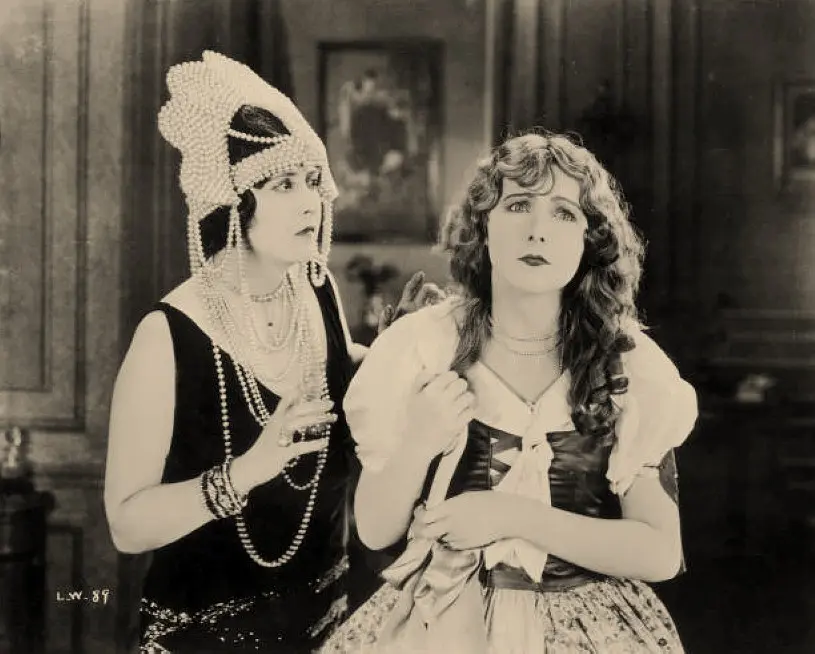
To traverse the celluloid landscapes of 1925 is to witness the zenith of the silent melodrama, a period where the syntax of visual storytelling reached an almost operatic intensity. Ivan Abramson’s Lying Wives stands as a quintessential artifact of this era, a film that weaponizes the domestic sphere to explore the darker recesses of human jealousy and the precariousness of reputation. Unlike the more fantastical elements found in The Unholy Three, Abramson’s work is rooted in a bourgeois anxiety that feels remarkably contemporary despite its nearly century-old vintage. It is a film that demands we look past the flickering grain and recognize the timeless anatomy of the 'vamp' and the victim.
The narrative architecture of Lying Wives is built upon a foundation of structural irony. We are introduced to Margery Burkley, played with a luminous vulnerability by Madge Kennedy. Margery is the archetypal 'working girl,' a trope frequently explored in European cinema of the time, such as in Erlebnisse einer Sekretärin. However, her ascent into the upper echelons of society via her marriage to Wallace Graham (Niles Welch) is not a fairy tale but a catalyst for catastrophe. The film’s antagonist, Patricia Chase (portrayed with icy precision by Clara Kimball Young), is a masterclass in the 'meretricious'—a character whose external elegance masks a profound moral rot. Young, a titan of the silent screen, brings a gravitas to Patricia that elevates her from a simple plotter to a Shakespearean figure of envy.
Patricia’s obsession with Wallace is not merely romantic; it is an act of territorial aggression. In a culture that prioritized the sanctity of the hearth, her attempt to dismantle the Graham marriage is portrayed as the ultimate transgression. She utilizes the presence of Ted Stanhope (Fred Ross) as the fulcrum for her leverage. Stanhope, a millionaire who claims a paternalistic interest in Margery, becomes the unwitting target of a smear campaign that mirrors the social ostracization seen in Black Oxen. The ease with which Patricia sows doubt in Wallace’s mind speaks volumes about the fragility of the male ego in the 1920s—a recurring theme in Abramson's filmography.
Visually, Lying Wives employs a chiaroscuro of emotion. The lighting, though primitive by modern standards, effectively delineates the spaces of safety and the spaces of conspiracy. When Patricia arranges for Wallace’s arrest for embezzlement, the film shifts into a legalistic thriller, reminiscent of the tension found in The Girl and the Judge. The use of intertitles here is sparse, allowing the physical performances to carry the weight of the betrayal. The scene where Wallace, incarcerated and embittered, learns of Margery’s visits to Stanhope is a highlight of silent era histrionics. The audience is privy to the truth—that Margery is seeking bail money—while Wallace is blinded by the green-eyed monster, a classic dramatic irony that keeps the viewer tethered to the screen.
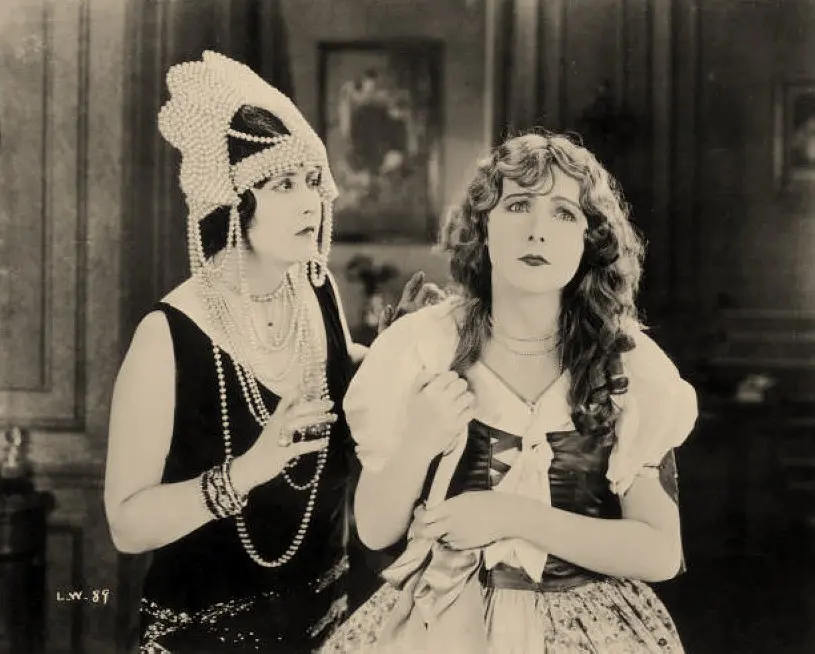
The pacing of the film is deliberate, almost agonizingly so, as it builds toward the inevitable confrontation. This slow-burn approach is a hallmark of the Abramson brothers' style, often seen in their more controversial works like The Black Stork. They understand that the true horror of melodrama lies not in the event itself, but in the anticipation of the fallout. The birth of the child and the subsequent questioning of its paternity is a narrative beat that would later become a staple of soap operas, but here, it is treated with a somber, almost religious intensity. The child becomes a silent witness to the adult world’s mendacity, a motif also explored in Always in the Way.
The 'anagnorisis'—the moment of critical discovery—occurs when Wallace learns that Stanhope is not a paramour, but Margery’s long-lost father. This revelation serves a dual purpose: it exonerates Margery and exposes the hollowness of Patricia’s machinations. In the context of 1920s cinema, the restoration of the father figure is a potent symbol of the restoration of social order. While films like The Wildcat (1920) might play with subverting authority, Lying Wives ultimately reinforces it. The reunion of the Grahams is portrayed with a sybaritic warmth, a stark contrast to the cold fate awaiting Patricia.
Patricia’s downfall is perhaps the most modern aspect of the film. Her husband’s refusal to accept her back, ordering her from the house with a finality that brooked no negotiation, is a subversion of the typical 'forgiven wife' trope. It echoes the harsh moralism found in Gefangene Seele, where the consequences of one's actions are inescapable. Clara Kimball Young’s performance in these final moments is haunting; the realization that her web of lies has only succeeded in ensnaring herself is etched into her features with devastating clarity.
When compared to contemporary works like The Italian, which focuses on the immigrant experience and visceral struggle, Lying Wives is a more insulated, psychological study. It lacks the sweeping historical scope of Dorothy Vernon of Haddon Hall, but it gains a claustrophobic power by focusing on the domestic interior. The film’s exploration of embezzlement and false accusation also invites comparison to Time Lock No. 776, though Abramson’s interest lies less in the mechanics of the crime and more in the emotional wreckage it leaves behind.
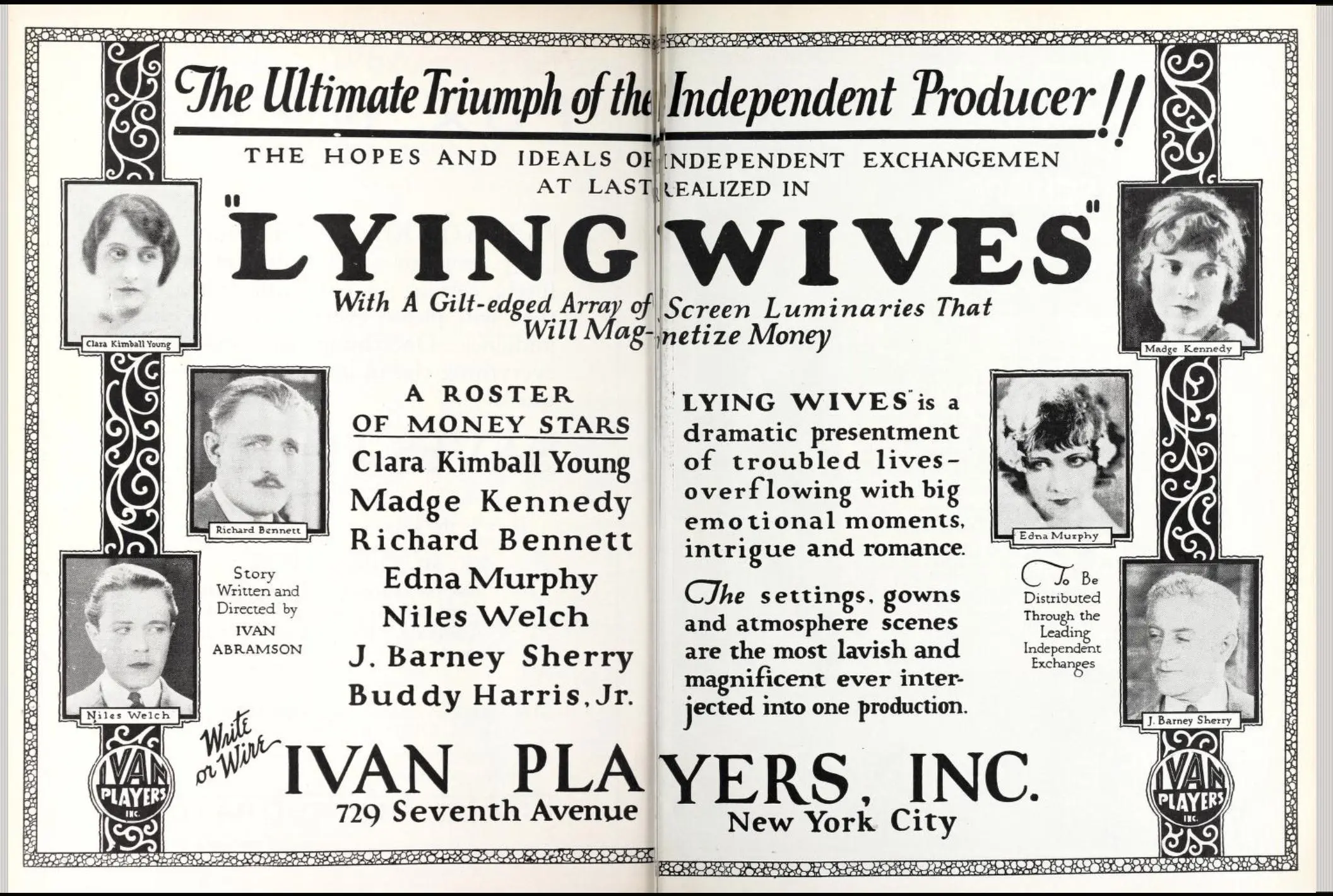
The ensemble cast, including J. Barney Sherry and Edna Murphy, provides a solid framework for the central conflict. Each performance is calibrated to emphasize the stakes of the social game being played. The film also touches upon the theme of the 'courageous coward,' a concept popularized by films like The Courageous Coward, as Wallace must find the strength to admit his lack of faith in his wife and seek her forgiveness. It is a journey from suspicion to enlightenment that mirrors the audience’s own journey through the convoluted plot.
One cannot discuss Lying Wives without acknowledging the technical artistry of the mid-20s. The set design reflects a world of opulence that feels both enviable and stultifying. The costumes, particularly those worn by Clara Kimball Young, are extensions of the characters' personas—sharp, imposing, and meticulously crafted. This attention to detail is what separates a standard melodrama from a work of art. While it may not have the surrealist leanings of Mouchy or the kinetic energy of Caught in the Act, it possesses a steady, rhythmic pulse that is undeniably effective.
In the broader context of silent cinema, Lying Wives serves as a reminder of the power of the 'secret.' The silent era thrived on information asymmetry—characters knowing things others did not, and the audience watching the resulting chaos. This film is a pure distillation of that dynamic. The 'lying' of the title refers not just to Patricia’s overt falsehoods, but to the societal masks everyone is forced to wear. Even the choice of a title like Pick Out Your Husband suggests a similar preoccupation with the performative nature of marriage in the early 20th century.
To watch Lying Wives today is to engage with a form of storytelling that relies on the purity of emotion. There are no CGI spectacles or rapid-fire edits to distract from the core human drama. It is a film about the weight of words—even when those words are only seen on title cards. The brilliance of Ivan Abramson lies in his ability to make a domestic dispute feel like an existential crisis. He understands that for Margery and Wallace, the loss of trust is more devastating than the loss of fortune.
As the final frames fade to black, the viewer is left with a sense of the precarious nature of truth. The film suggests that while the truth may eventually emerge, the scars left by deception are permanent. It is a sobering message for a melodrama, and one that elevates Lying Wives above its peers. It is a sophisticated, albeit histrionic, exploration of the human condition that remains relevant as long as there are secrets to be kept and lives to be unraveled. For any aficionado of the silent era, this is an essential viewing experience, offering a window into a world where every gesture had meaning and every lie had a price.
© 1925/2024 - A Cinematic Retrospective on the Abramson Legacy.
IMDb 2.6
1935
Community
Log in to comment.