DbcultAccessing Vault...
6.6/10
Senior Film Conservator
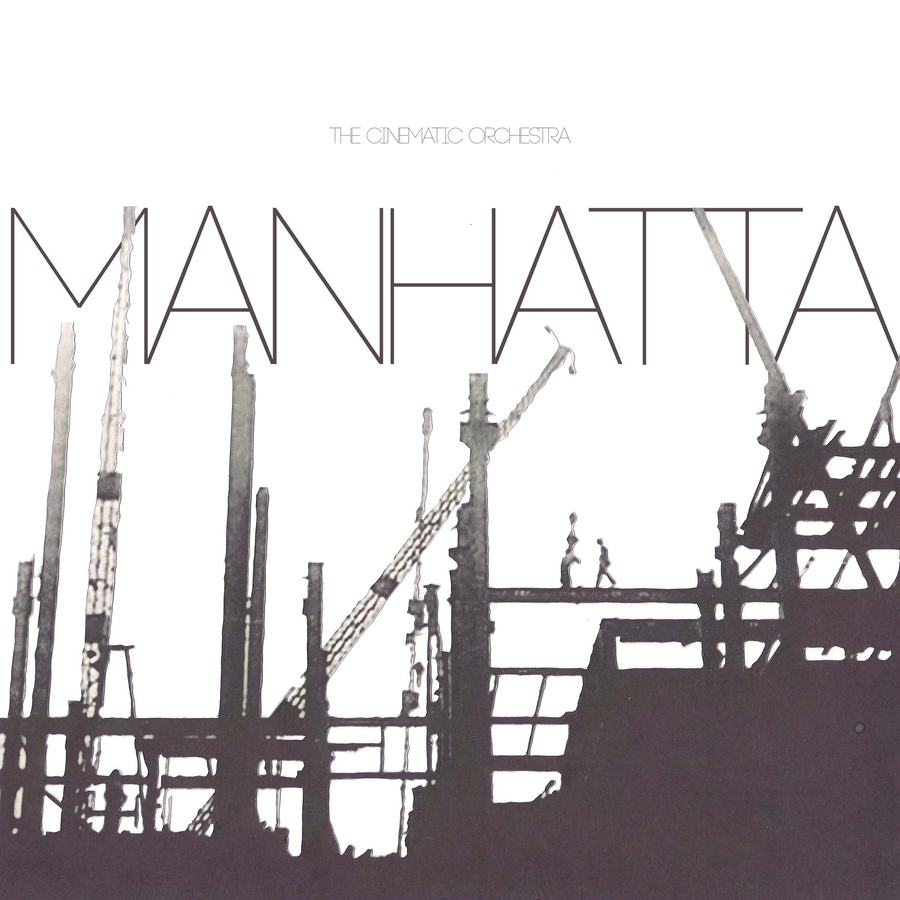
A definitive 6.6/10 rating for a film that redefined the boundaries of cult cinema. Manhatta remains a cornerstone of transgressive art.
Imagine a newborn century flexing its steel sinews for the first time. In Manhatta, every frame quivers with that adolescent metropolis, drunk on its own verticality, daring the camera to keep up. Paul Strand and Charles Sheeler—painters with shutter nerves—descend into the carnivorous streets, then ascend to parapets where wind tastes of tar and ozone. They film not just a place but a velocity: the speed of elevators, of capital, of immigrant dreams stacked twelve stories high.
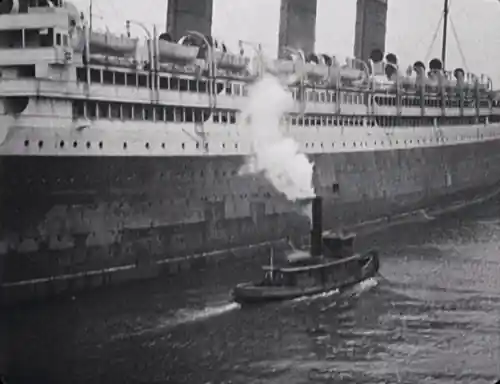
The opening shot is baptism by ferry. White foam slaps hulls, commuters surge like corpuscles through a colossal artery, and Whitman’s verse splashes across the screen: "City of hurried and sparkling waters! City of spires and masts!" Immediately you sense the movie’s contrapuntal strategy: image and text duel for supremacy, neither willing to illustrate the other. Instead, they ricochet, creating a phantom third city inside your skull.
"A million people—orderly, swift, and seemingly superhuman."
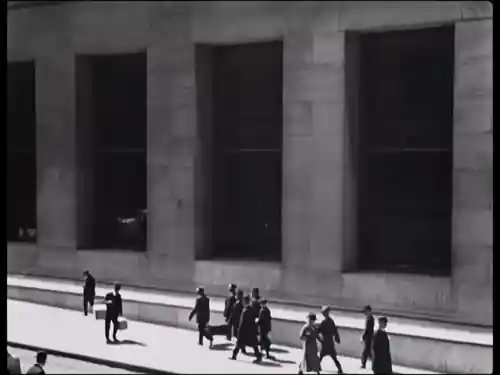
That intertitle lands like a gauntlet. You scan the crowd for cracks—fatigue, revolt, loneliness—but the edit won’t grant them. Bodies pour off boats, funnel into shadowed streets, vanish up staircases. The camera, itself a stowaway, refuses close-ups; anonymity is the metropolis’s religion. Only the geometry of hats and coats survives, forming tessellations worthy of Mondrian.
Watch how skyscrapers are birthed: girders swing overhead like gallows in reverse, rivets flare orange, masonry climbs in accordion folds. The lens tilts until verticals slice the sky into Gothic ribs. There is no narration of labor disputes or steel trust profits; the film’s politics hide in the ecstasy of verticality itself—a hymn to human reach, but also to the abyss yawning beneath each scaffolder’s boot.
Strand’s photographic pedigree shows in tonal gradations: sea-blue shadows pool around foundation stones while sulfurous smoke turns noon into chiaroscuro dusk. Compare this to Fellow Citizens, where the city feels stage-lit and moralistic. Manhatta refuses sermon; it renders infrastructure as eros: the coupling of iron to iron, of river to tide, of citizen to clock.
Ten minutes contain a solar wheel. Morning mists lift like theatre curtains, noon blazes on glass canyons, twilight smolders into night sequined with carbon-arc ads for B.V.D. underwear. Sheeler plays time like a accordion: footage shot across months collapses into one circadian breath, predicting the temporal compression later canonized by Men of the Desert. Yet here the device feels organic, because cities already live multiple chronologies atop one another—subway time, stock-market time, harbor tide.
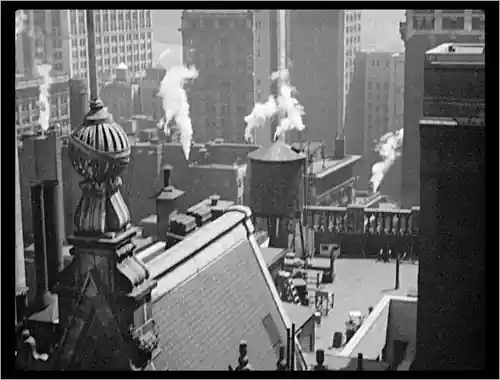
Notice the cut from a noon whistle to silhouettes lunching on a beam thirty floors up. The workers chew, chat, dangle boots above vertiginous air as if picnicking on Mars. The frame freezes that nonchalance; history will later tint it with the 1913 Woolworth building deaths. But inside the film’s moment, death is mythic, unreachable. Only the spectator, armed with retrospect, feels the stomach drop.
The poet’s lines arrive fragmented, like telegrams from a ecstatic elsewhere. "The little plentiful manikles skipping around in collars and tail’d coats"—superimposed over a cauldron of hats—makes the commuters seem both miniature and infinite, diorama ants constructing capital cathedrals. The tension between individual and swarm haunts the entire project, a proto-Baudrillard glimpse of simulation eating the real.
Yet the verse also humanizes. When a ferry cleaves the water, Whitman’s "hurried and sparkling waters" turns the Hudson into a living archive of arrivals. Every immigrant footstep since 1850 vibrates beneath the celluloid. Thus Manhatta performs a double conjuring: it abstracts citizens into pattern, then reinstates their ghostly subjectivity via poetry—a dialectic missing from more pedestrian city symphonies like The Steel King’s Last Wish.
Though labeled silent, the film is noisy as tinnitus. You supply the claxons, the elevated screech, the pneumatic drills. Contemporary screenings with live ensembles often lean dissonant—prepared piano strings threaded with paper, subway rumble samples—acknowledging that Manhattan 1921 already sounded like Stockhausen. The silence is merely a frequency beyond hearing, a vacuum into which modernity’s roar floods.
Compare this sonic absence to the moral silences in Crime and Punishment, where guilt throbs unheard. Here the unheard is possibility itself, the moment before jazz, before the crash, before radio crooners. The city’s mouth opens; no word yet emerges.
Black and Asian faces flicker—shoe-shine boys, stewedores—yet the film declines to name them. Their anonymity dovetails with Whitman’s democratic vistas, but also exposes the era’s racial grammar: invisibility as both inclusion and erasure. Meanwhile Irish and Italian navvies swing hammers, their ethnicity dissolved into muscular whiteness. Manhatta thus encodes the racialized division of labor that later explodes in the 1930s dock strikes, though the camera, blinkered by its own rapture, cannot prognose.
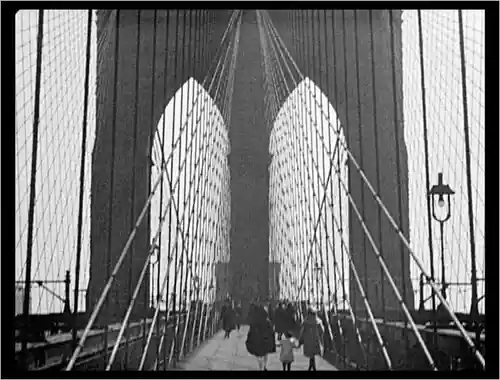
Still, the negative space—what the film refuses to foreground—becomes an archaeological layer. You search the margins for Black Bottom dancehalls, for Chinatown opium raids, and find only granite façades. That absence speaks louder than inclusion, teaching us that every city symphony is also an act of selective memory.
Critics often wed Manhatta to Napoleon und die kleine Wäscherin via Eisensteinian montage, but the comparison limps. Eisenstein fractures time to reveal class violence; Strand & Sheeler fracture space to sculpt transcendence. Their cuts are less sledgehammer than scalpel, less dialectic than kaleidoscopic. Where Soviet cinema weaponizes discontinuity, this film aestheticizes continuity—of capital, of empire, of vertical aspiration.
Later urban poems—The Jay Bird’s noir labyrinth, A Nymph of the Foothills’s pastoral counter-reverie—owe their gliding transitions to Sheeler’s tripod ascents. Even sci-fi cityscapes crib the film’s vertiginous tilt, proving that modernity’s iconography was minted here, in ten minutes of smoke and rivet.
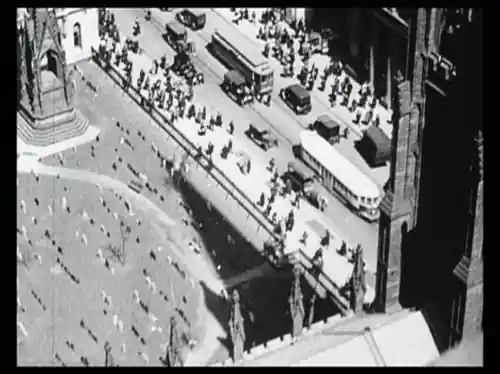
MoMA’s 2021 4K scan peels decades of vinegar syndrome from the original negative. What emerges? Grain like mica flakes, shadows drinking light, steam veils striated with rainbow diffraction. Every cornice now brands itself into your retina; window reflections reveal the cameramen’s straw boater, a ghost inside a ghost. The yellow ferry smoke once bled into sepia; now it erupts in sulfuric yellow against sea-blue water, a color collision unavailable to Strand’s ortho stock yet prophetically accurate to the city’s chemical soul.
Purists carp about digital sharpening, but the ethic aligns with the original modernist credo: shock of the new, even at 103. The restoration mints fresh details—graffiti on pier pylons, a woman’s defiant cigarette—making the past feel illegally present.
The film ends where it begins—on water—but the ferry now recedes, shrinking Wall Street into a cardboard cut-out. The spectator is expelled, left hovering between exaltation and exile. That buoyant aftertaste is the residue of secular transcendence: a skyscraper replacing the steeple, electricity substituting for stained glass, Whitman for psalms.
In an age when Manhattan’s skyline ossifies into billionaire mausoleums, Manhatta recaptures the moment when verticality still equaled possibility. It offers no critique, yet its very rapture indicts our present timidity: we build higher but dream smaller. Strand and Sheeler knew altitude without imagination is mere paralysis. Their ten-minute prophecy invites us to reenchant the city we’ve allowed to calcify into capital’s playground. Until we answer, the film loops—ferry, rivet, skyline, ferry—an eternal return daring us to look up and hallucinate again.
IMDb 6.6
1936
Community
Log in to comment.