DbcultAccessing Vault...
5.9/10
Senior Film Conservator
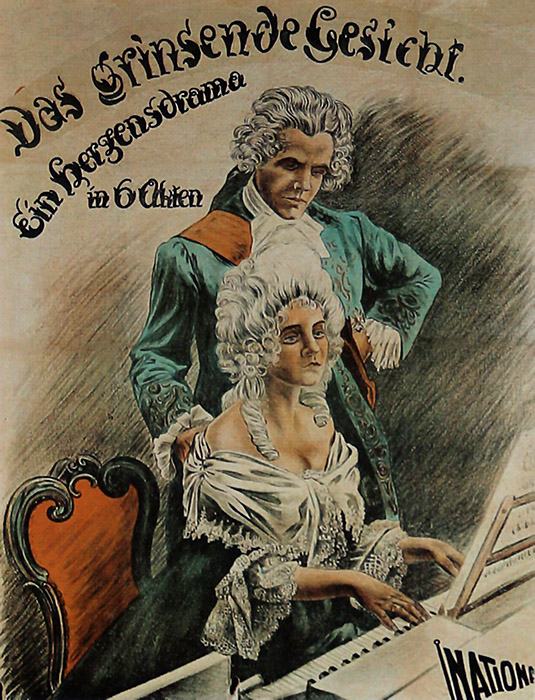
A definitive 5.9/10 rating for a film that redefined the boundaries of cult cinema. The Man Who Laughs remains a cornerstone of transgressive art.
Leni’s camera glides through chiaroscuro corridors as though Dante commissioned a cinematographer: every guttering torch throws a lattice of shadows that nibbles at faces like hungry moths. The film’s first movement—an infant’s abduction beneath a scaffold—announces itself with a title card dripping icicles, yet the true prologue is the close-up on a child’s mouth being turned into a gargoyle; the iris-in feels more surgical than voyeuristic. From that instant, the viewer becomes complicit in a centuries-old spectacle: the commerce of deformity.
Gwynplaine’s rictus is not mere make-up; it is history incarnate, the Reformation’s collateral damage etched in flesh. Conrad Veidt, beneath a mask that forbids anything as merciful as a frown, acts with the only muscles left to him—eyes that oscillate between hunted terror and saintly resignation. When he first removes his scarf before a tavern crowd, the on-screen spectators recoil in a collective shudder, but Leni cuts to a medium shot that traps us in the same voyeuristic position. We pay our penny too; we always have.
Dea, played by Mary Philbin with the translucent vulnerability of a Meissen figurine, cannot see the horror that frames her beloved; instead she maps the geography of his kindness through fingertips and breath. Their scenes inside the rickety caravan glow with the amber of a world reduced to two heartbeats. Leni double-exposes frost on the window, turning it into a halo around their shoulders, suggesting that innocence itself is a fragile greenhouse in winter. The erotic undertow is unmistakable: when she traces the ridge of his smile, the gesture is more intimate than any kiss, because it accepts the wound as integral to the man.
Enter Josiane—Olga Baclanova in a performance that predates her conniving trapeze artist in The Unknown by six years—part Circe, part ancien-régime algorithm. Her boudoir is a panther’s den of lacquered screens and peacock feathers; she lounges like Ingres’ odalisque reimagined by Sade. The seduction sequence—where she offers Gwynplaine a collar of diamonds to match his iron grin—plays out in a single, unbroken medium-long take, the camera slowly dolling backward as though the frame itself is retreating from moral contamination. The scene’s kink is not in what is shown but in what is legislated: a duchess demands the right to purchase anguish as foreplay.
Compare this to the comparatively chaste power plays in A Woman’s Honor or the knock-about gender farce of Oh, Lady, Lady; Leni insists that sexuality is never separate from class parasitism. Josiane’s final humiliation—stripped before the court, her robe pooling like molten wax—registers as both erotic spectacle and political exorcism.
While Caligari’s madness unfolded in jagged cardboard sets, Leni opts for a baroque realism: vaulted crypts, snow-salted parapets, and torture chambers that smell of damp stone. Yet the Expressionist DNA persists in the way architecture warps psychology. Note the staircase in the royal palace: each step is lit so that ascending equates to drowning in light, while the descent drags faces into Stygian black. The film’s most vertiginous angle occurs when Gwynplaine, newly ennobled, stands on a balcony overlooking a sea of courtiers; the camera tilts 30 degrees, turning the throng into a swirling maelstrom hungry for the novelty of monstrosity.
This visual vertigo finds a distant cousin in The Forbidden Path, yet that film’s moral universe remains reassuringly Manichaean. Leni refuses such comfort: every torchbearer in the court is also a potential torturer; every giggle at the freak show is a rehearsal for the scaffold.
The 1921 release predates synchronized dialogue by six years, yet the existing Kino restoration layers a Mooresque organ score that wheezes like a consumptive cathedral. Listen during the climactic storm: bass pedals trundle underneath diminished chords, suggesting tectonic plates grinding beneath Versailles. When Gwynplaine’s identity is proclaimed to the House of Lords, the score drops to a single oboe line—thin, reedy, almost taunting—mirroring the protagonist’s disbelief that a piece of parchment could overwrite a lifetime of scars.
Horror silents often luxuriate in the Grand Guignol—severed hands in The Hawk’s Trail, sadistic surgeons in Up in the Air. Leni, however, wields spectacle as ethical inquiry: are we, the paying public, any different from the court that pays Gwynplaine to grimace? The final shot—an iris that closes on the lovers drifting into a frozen dawn—doesn’t reassure; it traps us in the same aperture that once displayed horror for coins. Exit the theatre, and the grin lingers, not on the face but on the conscience.
Franz Weißmüller’s Barkilphedro—court jester turned state inquisitor—deserves a study in venality unto itself. With a spine that seems perpetually mid-bow, he slithers across the palace parquet, whispering edicts with the relish of a man who has weaponized servility. His eyes, two obsidian beads, glint with the joy of someone who knows that information, not beauty, is the sharpest blade in Versailles.
Anna Kallina’s Dame D’Effy provides a brittle counterpoint: a dowager whose laughter ricochets off marble like a musket shot. In the scene where she first spies Gwynplaine’s grin, her fan snaps shut—an audible crack even in silence—signaling the moment appetite crystallizes into conquest. The gesture, lasting perhaps three seconds, encapsulates an entire economy of aristocratic predation.
The 4K restoration by La Cinémathèque Française unearths textures previously smothered in dupe grain: the silken bruise-blue of Josiane’s peignoir, the arterial crimson of the executioner’s shirt, the chalky dust motes that swirl when a stone trapdoor slams. The tints—amber for interiors, viridian for exteriors, lavender for dream interludes—no longer feel like nostalgic garnish; they function as emotional subheadings. On Blu-ray, the bit-rate hovers around 36 Mbps, preserving the flicker of candle nimbus without reducing it to digital lava.
Place the film beside Greater Than Love and you’ll see how swiftly melodrama can curdle into tragedy when the stakes are corporeal rather than marital. Contrast it with the feather-weight continental romps of Der gestreifte Domino and you realize how Leni weaponizes opulence: every rococo flourish is another bar in the prison of privilege.
Christopher Nolan cited Leni’s crowd compositions when blocking the courtroom in The Dark Knight; the Joker’s smile, too, is a heritage brand borrowed from Gwynplaine. Meanwhile, the carnival of cruelty anticipates the reality-TV appetite for public humiliation: we are the tavern spectators who toss coins to see the freak, only now we vote with hashtags.
To call The Man Who Laughs a horror film is to mistake the symptom for the disease; it is a social autopsy performed with velvet gloves and a scalpel of light. Ninety-three minutes of silence roar louder than any talkie. When the end card arrives—"He who laughs has not yet heard the terrible news"—you realize the joke is on us, still paying for the privilege of watching.
Essential viewing for anyone who believes cinema can be both mirror and wound.
IMDb —
1919
Community
Log in to comment.