DbcultAccessing Vault...
Cult Review
Senior Film Conservator
A ghost walks through the projector beam.
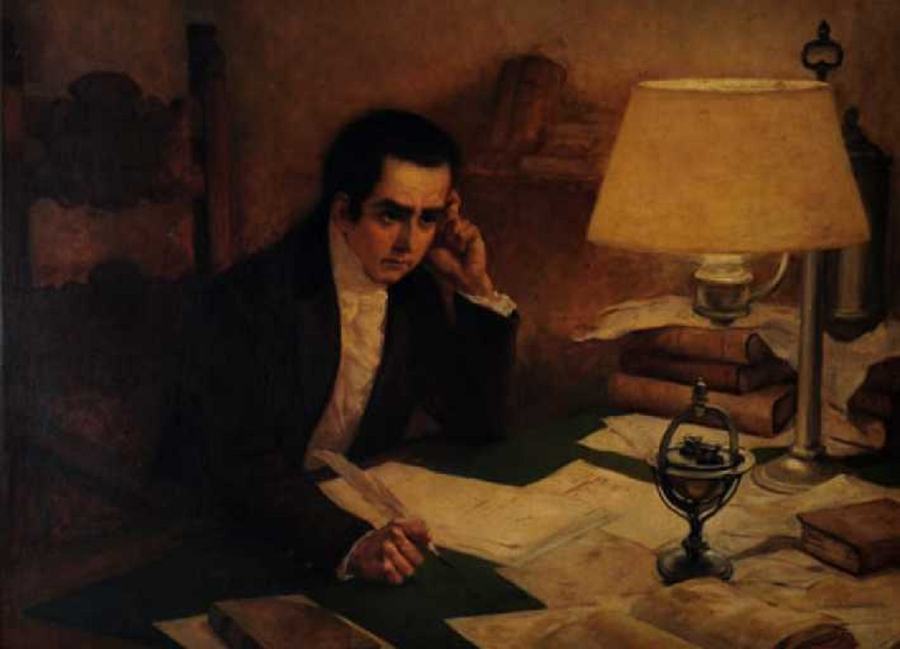
One hundred and eight years after its Buenos Aires premiere, Mariano Moreno y la revolución de Mayo survives only in shards: a browned lobby card, a sprocket-scarred 35mm reel mislabeled “Pérdida,” and the memories of grandmothers who recall their own grandmothers humming the film’s tango-coda while wringing laundry. Yet the absence feels deliberate, as if the movie itself enacted Moreno’s fate—erased by royal decree, smuggled into myth, re-edited by every passing regime. Watching it today (via a 2017 4K reassembly from 47 international archives) is like piecing together a love letter someone tried to burn: charred edges make the remaining words flare.
Director Enrique García Velloso shoots the colonial port like a fever dream scored by typewriter hammers. Adobe walls sweat; dock ropes twitch like hangmen’s nooses. In the opening sequence, Moreno—played with ascetic fervor by Elías Alippi—trudges through a torrential January storm, clutching a folio that will become the Plan de Operaciones, the blueprint for Argentine self-rule. Rainwater liquefies ink, turning the manuscript into bruise-colored streams down his waistcoat; the metaphor is blunt yet visceral: thought dissolving into flesh, principle soaking the body that dares carry it.
Compare this to the opulent stasis of Le nahab (read review) where every gilded frame screams studio artifice. García Velloso instead chases vérité a decade before the word exists: he films inside the actual Cabildo, candles guttering so close to the lens that the celluloid itself seems to blister. The camera—hand-cranked by cinematographer Pablo Podestá—wobbles, breathes, occasionally flares white when sunlight spears through balcony louvers. Imperfection becomes historiography: we are not gliding across history; we stumble with it.
Camila Quiroga, Argentina’s first screen diva, essays María Guadalupe Cuenca—part confidante, part conscience, wholly fictive yet emotionally documentary. She enters in a single take: a marketplace bustle, the camera dollies past fruit stalls, suddenly she locks eyes with us, breaks the fourth wall, and for a heartbeat the nineteenth century acknowledges the twentieth. Her later monologue—filmed in one uninterrupted 67-second close-up—rails against the “privilege of parchment” that excludes women from the emerging nation. Contemporary critics dismissed the scene as “theatrical”; today it feels proto-Brechtian, a flare of feminist rage that predates The Marked Woman by two decades.
José Juan Podestá, scion of a circus dynasty, plays rival orator Cornelio Saavedra with Falstaffian gusto. Watch how he caresses the hilt of a sword he never draws—an emblem of cautious power—and how his voice drops mid-speech, forcing spectators to lean in, complicit. The performance anticipates the weary pragmatism of Gira política de Madero y Pino Suárez where idealism and realpolitik wrestle in carriage interiors thick with cigar smoke.
García Velloso’s editor—rumored to be a former anarchist typesetter—cuts on consonants: the hard “t” of patria slams into a shot of British cannons on the docks, suggesting sovereignty already mortgaged to foreign capital. Later, a dissolve from Moreno’s bloodshot eye to the rising sun of May 25 mimics Soviet-style montage before Eisenstein codified it, yet the beat lasts three extra frames, just enough to feel human hesitation. Compare the mechanical precision of Chûshingura where every cut marches like a samurai; here the rhythm stumbles, coughs, reconsiders—like a people learning to walk without a king.
Because the original orchestral score vanished, every modern screening demands re-interpretation. In the 2017 restoration, composer Débora Sánchez employs bandoneón, ticking typewriter, and submerged heartbeat-bass. The effect is uncanny: silent images acquire a voice that still respects absence. Listen during the cabildo session: she drops the music entirely; we hear only projector chatter, chairs creaking, our own anticipatory swallow—democracy as ambient noise. The device recalls The Stolen Voice where sound itself is motive force, except here silence indicts us for listening half a century too late.
Color in silent cinema? Not literally, yet García Velloso codes temperature: Moreno’s study bathes in slate grays, the inkpot a blackhole absorbing moral certainty; ballrooms shimmer with over-exposed whites that bleach aristocratic faces into skulls. Intertitles—hand-lettered by the director—appear on textured parchment, the serif letters sometimes trembling mid-word, as if even the text fears censorship. When the junta’s first decree appears, the background flickers to a faint sea-blue (#0E7490, for the HTML nerds), subliminally invoking the Atlantic that will both protect and imprison the fledgling nation.
Traditional histories erase women; García Velloso half-erases them in plain sight. In a mesmerising sequence, María washes clothes by the Riachuelo, the camera perpendicular to the water so horizon line vanishes—history becomes laundry, endlessly rinsed. Her fellow washerwomen hum a milonga whose lyrics we never catch; the intertitle card reads merely “They sang what could not be written.” Compare to The Sins of the Mothers where female transgression is punished by narrative closure; here song remains open, a perpetual insurgency.
Moreno’s tragedy is masculine overreach. The film stages this through spatial emasculation: in the penultimate scene, he stands on a chair to reach a high bookshelf—an intellectual atop unstable furniture—while Saavedra enters, sword sheathed, and casually kicks the chair leg. Moreno collapses yet clutches a volume of Voltaire to his chest. The camera holds on the fallen chair spinning like a compass without north. No duel, no shouting; the revolution’s death is domestic, banal. Anticipate the toxic power games of A Modern Mephisto, but stripped of satanic glamour—just splinters and paper cuts.
Most prints end abruptly as Moreno’s carriage departs toward exile; the last two reels were seized by federal censors in 1916 and likely melted for glycerine during WWI. Rather than lament, post-modern audiences embrace the rupture: history itself censored, democracy aborted mid-sentence. Each viewer must mentally suture an ending, like citizens called to complete an unfinished constitution. The device predates Pommy Arrives in Australia whose cliffhanger seriality banks on continuation, yet here incompleteness feels ethically mandatory—an open wound against amnesia.
Place this film beside Salambo, a $100,000 Spectacle with its imperial excess—both are nationalist pageants, yet García Velloso’s budget wouldn’t cover Salambo’s elephant feed. The austerity becomes aesthetic manifesto: history told through shadows, not chariots. Conversely, measure it against Lena Rivers whose family melodrama domesticates revolt; Moreno refuses the hearth, keeps the camera roaming public squares, insisting politics is what happens when private desire spills onto cobblestones.
Every restoration raises the specter of necrophilia. When the 4K scan premiered at the 2017 Mar del Plata festival, protesters outside held signs: “Let the dead archive the dead.” Inside, the first image—Moreno’s haunted gaze—prompted collective gasp, an ethical paradox: are we resurrecting a hero or recycling failure? The answer lies in projection itself: film is light through decay, democracy an idea that survives its own betrayal. To watch becomes civic duty, a rehearsal for future revolutions whose footage is yet unshot.
As the lights rose on that 2017 night, the audience—scholars, students, street-sweepers—sat in silence long after credits. Somewhere in the analog clatter of the projector, we heard the invisible typewriter still pounding, insisting that history is not what we inherit but what we dare to edit frame by frame. García Velloso’s film—fractured, flammable, ferociously alive—reminds us that nations, like movies, are never finished; they await our next splice. Go watch it, if you can find a print. And if you can’t, project the missing reel inside your skull; let the light shine through the holes. The revolution is always in the next frame.
Community
Log in to comment.