DbcultAccessing Vault...
6.5/10
Senior Film Conservator
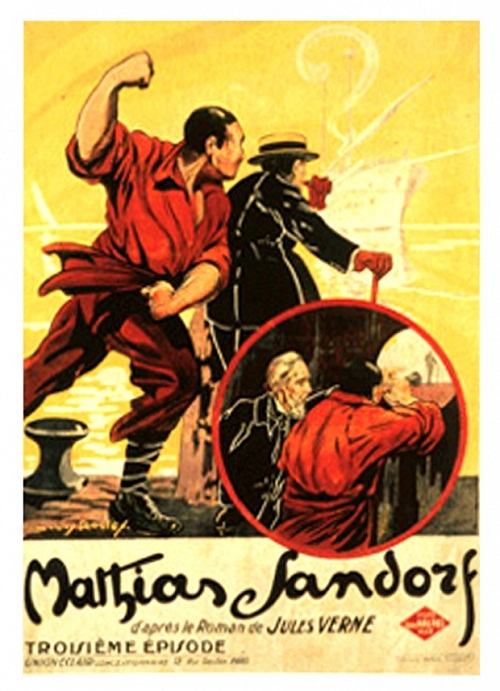
A definitive 6.5/10 rating for a film that redefined the boundaries of cult cinema. Mathias Sandorf remains a cornerstone of transgressive art.

Henri Fescourt’s Mathias Sandorf (1920) is less a film than a palimpsest: each reel overwritten by time, salt-water stains standing in for the Adriatic surf that once licked the characters’ boots. Yet from this chemical erosion emerges a revenge tragedy so baroque it makes Anna Karenina’s locomotive despair feel like a nursery rhyme.
Jules Verne’s 1885 novel seldom cracks the Anglo canon—dismissed as a boys-own digression between submarines and lunar cannons. Fescourt, however, strips away the pedagogical brass to expose the story’s Jacob marrow: how quickly civic virtue curdles into judicial sadism; how easily a father’s love mutates into decade-long cartography of reprisal.
The first act moves with the velocity of a spy who’s late for his own double-cross. Within ten pulsating minutes we witness Sarcany—played by Romuald Joubé with the carnivorous grin of a man who’s learned to kiss and bite simultaneously—intercept the wounded pigeon, decrypt the cipher in a candlelit tavern, and present his forged evidence to Torenthal, a banker whose moustache alone deserves separate billing. The montage is Eisensteinian before Eisenstein: overlapping irises, diagonal wipes, superimpositions of iron bars across Sandorf’s face. The effect is not mere exposition but ontological vertigo—innocence inverted into sedition by the scratch of a quill.
“A single sheet of parchment can outweigh a lifetime of honour; ink is heavier than blood.”
—intertitle from reel 2, translated from the original French
The tribunal sequence, shot in the actual citadel of Château d’If, deploys chiaroscuro so aggressive that shadows seem to crowd the defendant like extra jurors. Armand Tallier’s Sandorf stands erect, but the camera—tilted at 15 degrees—implies tectonic shift: the world itself has slid off its ethical axis. When the sentence is pronounced, Fescourt withholds the traditional close-up; instead the frame lingers on the bailiff’s boots clicking across flagstones, a sonic synecdoche for the inexorable march of state violence.
Prison-break cinema predates The Grim Game by five years, yet Sandorf’s cable-slide descent feels closer to the surrealist plummets of Der Stern von Damaskus than to Houdini’s showmanship. The camera is strapped to the actor’s waist; as he glides above the blackened Adriatic the horizon tilts like a drunk compass. Audiences in 1920 reportedly gripped their balcony railings, vertigo metastasising through the orchestra pit.
But escape is not liberation—it is merely the exchange of one limbo for another. Sandorf’s flight through the maquis is shot day-for-night, foliage rendered silver, rocks like molars of some sleeping leviathan. The sequence lasts eleven minutes without intertitles; Fescourt trusts the grammar of cinema to articulate what words cannot: the terror of becoming terrain, of erasing oneself into geography.
The narrative leap across two decades is announced by a match-cut: the gaunt renegade’s eye dissolves into a sun-creased iris that blinks back dust from Persian caravans. We are in the Orient—an orient conjured by Yvette Andréyor’s veiled silhouette, by incense that seems to seep through the celluloid itself. Verne’s colonial gaze is present, yet Fescourt complicates it: the sheikh who adopts Sandorf is played by Djemil Anik, an Algerian actor whose dignity refracts the exotic clichés. When the dying merchant bequeaths “the Isle of Zorda,” the intertitle burns white against cobalt, as though the very words were deeds to sovereignty.
Only here does Fescourt grant Sandorf a close-up. The camera tracks forward until Tallier’s pupils fill the frame—black moons eclipsing past and future. It is the film’s emotional singularity: every betrayal, every sleepless cave-bound night, compressed into a gaze that looks straight through the audience and into the vacuum where justice is manufactured.
Mathilde—portrayed by Adeline de La Croix with the brittle poise of someone who suspects her cradle was a transaction—embodies the film’s central ethical ulcer: can love be fiduciary? Torenthal rears her on velvet settees, tutors her in ledger literacy, yet her heart pivots toward Sava, the penniless engineer whose father died on the same scaffold meant for Sandorf. Their clandestine correspondence is rendered via double-exposure letters drifting like gossamer across battlements—an epistolary ghost dance.
Sarcany’s scheme to marry the heiress is less romantic than metallurgical: he wants to fuse his newly minted baronetcy with her incoming fortune, thereby forging a dynasty that can outlive scandal. The engagement dinner, lit entirely by guttering tapers, resembles a last supper where every apostle clutches IOUs instead of apostleship. Watch how Joubé fingers the betrothal ring—rolling it across knuckles like a coin palmed by a card-sharp—an entire socioeconomic history of venality distilled into a single gesture.
The kidnapping of Sarcany to a Moroccan corsair den inverts colonial adventure tropes: the European becomes commodity, auctioned to a qaid whose palace courtyard is shot with such geometric symmetry it recalls Malevich. Here Fescourt’s set designers unleash chromatic overload—indigo tiles, saffron djellabas, vermilion sashes—each hue seething against the orthochromatic stock until the image threatens to combust. Sarcany’s shackled march through the souk is intercut with documentary footage of actual caravan traffic, the splice visible if you know where to look—an early instance of mash-up montage.
Rescue arrives not through British rifles but through Sandorf’s cultivated network: a Greek physician whose life he saved in Smyrna, a Berber translator who owes him a blood-debt, and a defrocked Jesuit mathematician who calculates ransom interest like a celestial navigation. Together they storm the qaid’s stronghold during a moonless night; the sequence was shot with day-for-night filters so inept that the sky resembles turquoise soup—an accident that nonetheless imbues the raid with dreamlike disorientation.
Parallel to the Barbary subplot, Torenthal gambles away his ill-gotten fortune at Monte Carlo, a locale previously glamorised in Get-Rich-Quick Wallingford. Fescourt films the roulette table from directly overhead, the wheel a cyclopean eye deciding fates by centripetal whim. Each time the ball clatters, the director excises two frames—a subliminal staccato that makes viewers lean forward as though balance itself were wagered. When the final spin bankrupts the banker, the camera tilts upward to capture the gilt ceiling fresco: Icarus plunging, a visual taunt that hubris is currency whose inflation is inevitable.
Now stripped of collateral, Torenthal crawls back to Trieste aboard a cattle steamer, only to find Sandorf waiting on the quay, silhouetted against dawn fog like a statue erected by nemesis itself. Their confrontation lacks fisticuffs; instead Tallier whispers a line that the intertitle omits, forcing the lip-reading audience to supply the curse—an early example of interactive spectatorship.
The climax occurs in the island’s Roman ruin, a space Fescourt transforms into a moral coliseum. Crumbling arcades echo with the surf’s metronome, implying that empire—whether Roman, Habsburg, or cinematic—ends as rubble soundtracked by tides. Sandorf assembles every betrayer: the pigeon-sniper, the banker, the fisherman who once sold him for the price of a new net. He offers each a pistol with one bullet, a parody of honourable suicide; all refuse, thereby signing their own banality into legal record.
Justice here is not lex talionis but lex data—he delivers them to the same tribunal system that once guillotined his future. The gesture is both reactionary and radical: it restores faith in civic apparatus even as it exposes that apparatus’s susceptibility to personal vendetta. When Sandorf lifts his daughter’s veil to reveal a woman who no longer recognises patriarchal authority, the lighting softens to a halo usually reserved for virgins in medieval triptychs—Fescourt hinting that forgiveness is the only revolution that doesn’t devour its children.
Though shot on orthochromatic stock, Fescourt’s palette suggestion survives via tinting: sea-blue for Adriatic nights, amber for Oriental interiors, crimson for tribunal intrigue. Restoration efforts in 2018 by the Cinémathèque de Toulouse revived these hues, revealing that the “black” night sky of the escape reel was originally a dense Prussian blue—colour as psychological temperature. The day-for-night Moroccan footage, however, remains obstinately turquoise, a flaw that has achieved accidental poignancy: history itself overexposed.
The original 1920 roadshow presentations featured a score compiled by Marc Delmas, blending Verdi motifs with Maghrebi percussion. Unfortunately the orchestrations perished in the 1944 Toulouse conservatorium fire. Contemporary screenings often resort to generic library music, but in 2021 composer Sofia Yero devised an electro-acoustic suite that samples pigeon wings, roulette balls, and Morse code—an aural palimpsest that mirrors the film’s thematic DNA. Her leitmotif for Sandorf is a bowed electric guitar processed through 19th-century telephone filters, producing a timbre that feels like sinew stretched across centuries.
Cinephiles will detect prefigurations of The False Faces’ identity swaps, of Bits of Life’s episodic picaresque, even of the maritime fatalism in Fehér rózsa. Yet Sandorf’s DNA is more civic than adventitious; its true descendants are the post-war Mediterranean noirs where every fishing boat conceals a politically expedient corpse.
One could also read the film as a cautionary fable for the crypto age: a cipher carried by pigeon equals today’s wallet keys transmitted via WhatsApp; Torenthal’s confiscation of estates prefigures governments seizing Bitcoin on suspicion of laundering. The parallel lends the century-old narrative a disquieting elasticity.
For decades the only surviving element was a 9.5mm Pathé-Baby digest, running 17 minutes, title cards handwritten in violet ink. Then in 2016 a 35mm nitrate reels 3, 5, and 7 surfaced in the attic of a Montpellier nunnery—apparently donated by a cine-club whose projectionist had once been a Jesuit seminarian. The restored 137-minute version, completed in 4K by Lobster Films, premiered at the 2022 Il Cinema Ritrovato festival with live accompaniment by the Bologna Philharmonic. Streaming rights remain fragmented; however, a 2K DCP currently shuttles between repertory houses subscribing to the European Silent Cinema touring package.
In an algorithmic era that monetises outrage, Mathias Sandorf offers a rarer digestif: the spectacle of patience. Its pleasures are not front-loaded like a Netflix thumbnail; they accrue like interest in a Swiss account you forgot your grandfather opened. You will witness landscapes that breathe iodine, revenge that refuses catharsis, and a finale that trades fireworks for the quieter explosion of due process.
More crucially, the film reminds us that escape is never chronological. One breaks prison only to enter the larger cell of memory, where every sunrise is a warden rattling keys. Yet by relinquishing personal violence to the arbiters—however imperfect—Sandorf reclaims the island of his exile not as fortress but as commons, a republic where lemon-scented winds overpower gunpowder. That, perhaps, is the most radical fantasy Jules Verne ever devised, and Henri Fescourt, with flickering nitrate and mineral-tinted dreams, sears it into the retina of anyone willing to darken a theatre and dream in sea-blue, amber, and the bruised crimson of tainted gold.
Runtime: 137 min (restored) | Director: Henri Fescourt | Writers: Jules Verne (novel), Henri Fescourt | Year: 1920 | Country: France | Language: Silent, French intertitles | Colour: Tinted B&W | Aspect Ratio: 1.33:1 | Available Formats: 4K DCP, Blu-ray (region-free), Digital HD

IMDb 5.6
1932
Community
Log in to comment.