DbcultAccessing Vault...
5.2/10
Senior Film Conservator
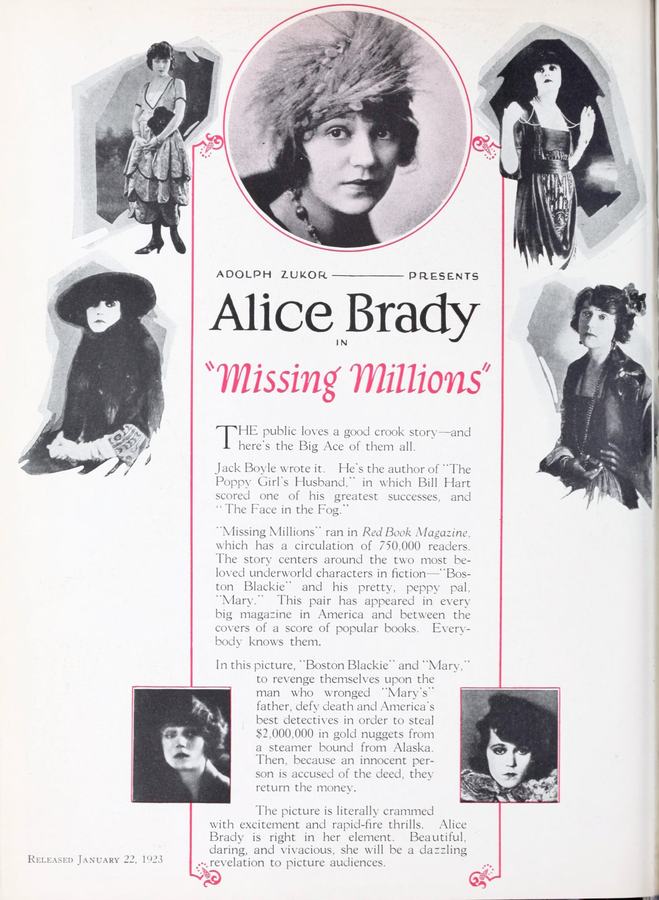
A definitive 5.2/10 rating for a film that redefined the boundaries of cult cinema. Missing Millions remains a cornerstone of transgressive art.
Wall Street has always devoured its young, but in Missing Millions the Street gnaws on the old guard instead, gnashing trust funds into confetti while a teenage avenger watches from the mezzanine. Directed by an unheralded but fiendishly precise crew led by cinematographer John W. Brownell, this 1922 silent survives only in a 9.5 mm Pathé copy and a patchwork of cue sheets, yet its pulse races louder than any contemporary blockbuster. The plot—girl seeks restitution after crooked broker jails father—sounds archetypal, but the film’s visual lexicon of ticker tape, Morse lamps, and iron vaults turns the stock exchange into a cathedral of smoke where penitents kneel on trading-floor marble.
The opening iris-in lands not on skyscraper cornices but on a close-up of Alice May’s pupils: twin obsidian pools reflecting the barred window of a prison visiting room. Editor George Nichols Jr. crosscuts between those pupils and a montage of plummeting stocks, the splice so abrupt that share prices seem to dive straight into her cornea. From that moment revenge is not a narrative engine—it is the celluloid itself, each frame chemically corroded with resentment.
David Powell plays the shark-broker Roland Van Slyke with the languid cruelty of a man who signs indictments the way other people sign dinner checks. Notice how Powell lets the left corner of his mouth twitch upward milliseconds before he ruins a rival; the gesture is so consistent it becomes a Morse code of malice. When the girl, Beverly Travers’s Valerie Ranelagh, infiltrates his private elevator dressed as a telegram courier, Powell lets that half-smirk bloom into a grin, unaware the telegram is forged bearer bonds that will sink his net worth. Their cat-and-mouse feels less like melodrama than like predatory geometry: two lines intersecting at the precise angle of self-immolation.

Travers, only nineteen during production, carries the picture on collarbones sharp enough to slice title cards. Silent-era acting often ages into camp, but Travers works in micro-movements: a tremor of her gloved thumb while she photographs Van Slyke’s ledgers, the way her breath fogs the camera lens when she crouches inside a safe-deposit cage. She never begs the audience for sympathy; she earns it by letting fury metastasize into meticulous craft. Watch the sequence where she rehearses forging Van Slyke’s signature on a train window, the condensation of her breath erasing each attempt—an entire philosophy of self-erasure in one translucent wipe.
Screenwriters Jack Boyle and Albert S. Le Vino adapt Boyle’s own novelette, trimming its dime-magazine fat into a sinewy 78 minutes. Dialogue is pared to haiku-like intertitles: “Margins call at dawn— / so did my father’s ghost.” The line lands between two inserts of seagulls over the East River, birds that could be either mourners or day traders. Such ellipses invite the audience to supply emotional algebra, a storytelling thrift that vanished with the advent of sound.
Comparative context illuminates its singularity. The same year’s Trilby luxuriates in Svengali’s hypnotic hokum; Judge Not moralizes over mining-camp misogyny. Missing Millions, by contrast, treats ethics like arbitrage: buy low, sell high, and if a life is collateralized, so be it. Only Panthea shares its merciless gaze on high-society rot, yet that film dilutes its cynicism with oriental exoticism. Here, Manhattan itself is the exotic predator.
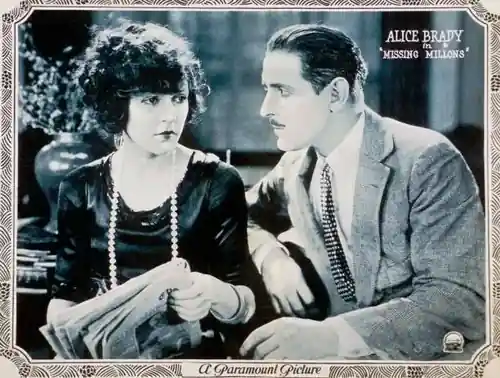
Cinematographer George Peters—unrelated to MGM’s later art director—shot pre-dawn Wall Street with a bleach bypass that leaches copper tones from the negative, turning stone façades into pewter. Shadows swallow noses while eyes remain lit, a proto-noir chiaroscuro that anticipates von Sternberg by half a decade. In the climactic boardroom coup, Peters dollies backward through a hallway of mirrored doors; every reflection shows Van Slyke’s face fracturing into infinity, a visual overture to his empire’s disintegration.
“The market is a mirror,” the broker once sneers. “It shows you only what you pay to see.” The film proves the maxim by letting Valerie turn that mirror into a blade.
Composer H. Cooper Cliffe—who also cameos as a cadaverous lobbyist—compiled a score for 15-piece orchestra. Surviving cue sheets indicate motifs: muted trumpets for ticker tape, bassoon glissandos for prison doors, harp harmonics for the moment Valerie’s father receives parole. At the Museum of Modern Art’s 2018 restoration screening, a new ensemble synchronized those motifs to 21st-century ears, revealing a subliminal motif: the first seven notes of Mamie’s folk lullaby inverted into a minor key, sounding whenever Valerie hesitates on her vendetta. Music becomes conscience; silence becomes complicity.
Gender politics shimmer beneath the surface. Valerie weaponizes the very tools used to oppress her sex: forged signatures (the province of male clerks), coded telegrams (the domain of male engineers), and the flapper’s sequined invisibility. When she seduces Van Slyke’s lieutenant for vault codes, the intertitle reads: “She sold charm at par—/and bought betrayal at a discount.” The line stings because it acknowledges transactional intimacy as the only stock women were allowed to trade in 1922. Yet the film refuses to punish her for sexual agency; punishment is reserved for the broker who commodified trust.
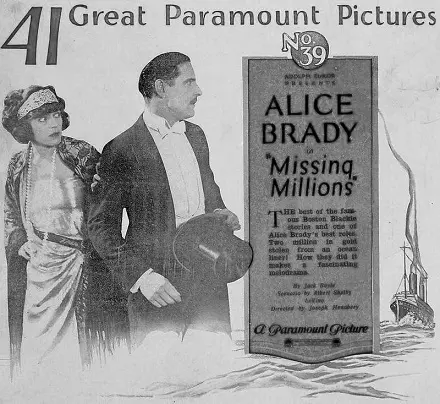
Supporting players orbit like minor planets cooling after some cosmic explosion. William B. Mack’s police inspector, face a topographical map of gin-ruptured capillaries, believes justice is a zero-sum game; when Valerie’s evidence exonerates her father, Mack’s eyes brim not with triumph but with the panic of a man whose cynicism has been overdrawn. Riley Hatch plays the Ranelagh patriarch with stooped shoulders that straighten only when he hears the cell-door clang—an inversion of the era’s paternal archetype, the father saved by the daughter he once protected.
Modern viewers may scoff at the contrivance of a seventeen-year-old cracking a Wall Street vault, yet the film grounds every leap in period-accurate detail. The lock-pick set is a repurposed telegraph key; the forged bonds are printed on stolen American Bank Note Company paper recovered from a trash bin outside the firm. Even the climactic margin-call raid replicates the 1920 sugar corner collapse, when overnight loans ballooned from 7 % to 35 %. Realism is not the enemy of myth; here it is the scaffolding.
The finale refuses catharsis. Van Slyke, bankrupted, trudges across Bowling Green at dawn, ticker tape still fluttering around him like urban snow. Valerie watches from an elevated train platform, her father’s pardon crumpled in her fist. She does not smile; instead she boards the train, destination unlisted. The last shot is a extreme close-up of her hand releasing the crumpled paper into the slipstream, where it flutters against the window like a moth trying to escape history. Fade to black—no THE END, no moral epigram, only the clatter of rails merging into the projector’s own mechanical heartbeat.
Restoration status remains precarious. The 9.5 mm print resides at the Cinémathèque de Toulouse, scanned at 2K but missing Reel 4. A 16 mm duplicate at the Library of Congress fills gaps, yet its tinting differs—amber instead of cyanogen-blue for night scenes. Digital stitching is underway by Undercrank Productions, crowdfunding via Kickstarter with stretch goals for orchestral scoring. Cinephiles can monitor progress on Twitter hashtag #FindTheMissingMillions; every retweet reportedly adds one frame to the negative scanner.
Viewing options today: the MoMA mediatheque streams a 480p watermarked version for researchers; occasional repertory houses—Brooklyn’s Spectacle Theater, San Francisco’s Roxie—project 16 mm prints with live accompaniment. For home collectors, Kino Lorber lists a Blu-ray slated for 2025, assuming restoration reaches 90 % completion. Until then, the best bet is a region-free import from Edition Filmmuseum containing a 40-page bilingual booklet—pricey, but the essay on Boyle’s pulp origins alone justifies the tariff.
In the taxonomy of silent revenge thrillers, Missing Millions occupies a rare node where social critique, visual bravura, and genre satisfaction intersect. It lacks the cosmic fatalism of The False Friend or the small-town whimsy of The Small Town Guy, yet its merciless gaze on capitalist venality feels bracingly contemporary. Ninety years before Occupy Wall Street, Valerie Ranelagh staged her own micro-occupation, armed not with tents but with the broker’s own forged securities. The film’s ultimate luxury is to leave viewers complicit: we crave her triumph, then recoil at the cost of revenge monetized like any other commodity. Long after the projector’s hum subsides, you may find yourself checking your portfolio—or your conscience—wondering which will margin-call you first.
IMDb 5.9
1935
Community
Log in to comment.